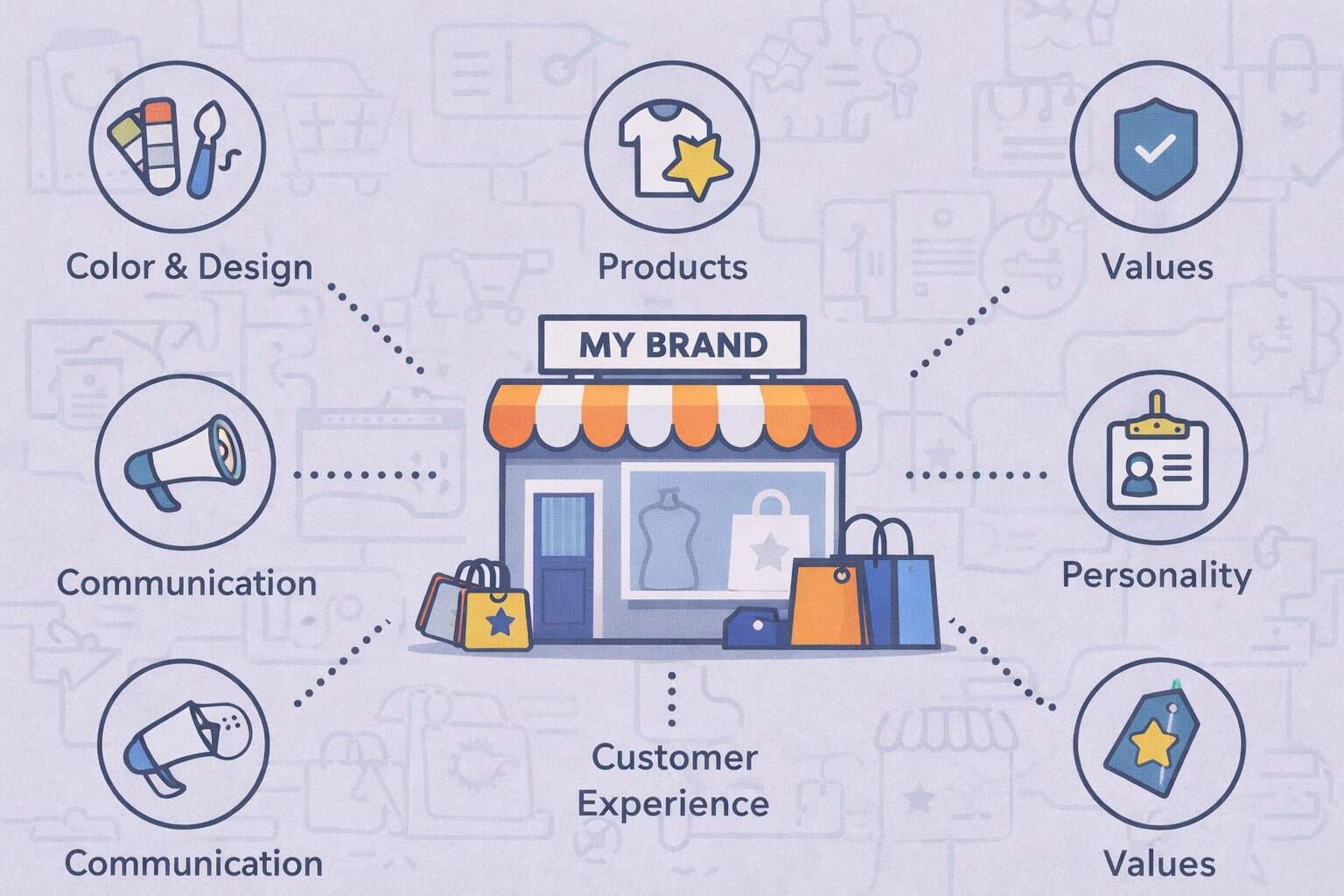
How to Build a Strong Retail Brand Identity
A strong retail brand identity is the difference between “a store that sells things” and “a brand people choose on purpose.” When your retail brand identity is clear, customers recognize you instantly, trust you faster, and remember you longer—whether they find you on a shelf, on a phone, through a shopping assistant, or by walking past your storefront.
The good news: building a retail brand identity isn’t about having the fanciest logo or the trendiest color palette. It’s about making a deliberate set of choices—who you serve, what you stand for, what you promise, and how you consistently deliver that promise through design, messaging, product, service, and experience.
Consistency matters more than complexity. Clarity matters more than cleverness. And in modern retail, identity is shaped as much by customer experience and community as it is by visuals.
This guide walks through a practical, step-by-step system to create a retail brand identity that feels authentic, is easy for customers to understand, and is built to scale.
You’ll also see what’s changing in retail branding—like AI-driven shopping discovery, higher expectations for personalization, and omnichannel consistency—and how to future-proof your identity so you don’t rebuild it every year. Retail is moving quickly, but a strong identity can keep you grounded while still letting you evolve.
Build the Strategy Foundation Before You Design Anything

Your retail brand identity starts with strategy, not aesthetics. If you design first, you usually end up with a brand that looks good but doesn’t “stick” because it lacks a strong point of view. Strategy gives your identity a job to do: attract the right customers, communicate value fast, and create a reason to choose you again.
At minimum, you need three strategic anchors: (1) a specific audience you can describe in real detail, (2) a clear position in the market, and (3) a brand promise you can deliver every day. This is what makes your retail brand identity consistent across new products, new locations, new staff, and new marketing channels.
A helpful way to think about it: strategy answers “Why us?” and identity answers “How do we show it?” When you have both, your store feels intentional and trustworthy. When you don’t, customers feel confusion—even if they can’t explain why. And confusion is expensive because it slows decisions, lowers conversion, and weakens loyalty.
Your foundation should also reflect modern shopping behavior. Customers research online even when they buy in person, and they expect a seamless journey across channels. That’s why strategy must account for both the “digital shelf” and the physical shelf, and why aligning your experiences matters for performance.
Define Your Ideal Customer With “Decision-Trigger” Personas
Personas aren’t about age and hobbies alone. For a strong retail brand identity, the most useful personas are built around decision triggers: what problem pushes a customer to shop, what they fear, what they compare, and what makes them confident enough to buy.
Start with 2–4 personas max. Give each one:
- A shopping mission (what they’re trying to accomplish)
- A “must-have” list (non-negotiables)
- A “deal-breaker” list (what makes them walk away)
- Their top 3 comparison criteria (price, quality, availability, ethics, convenience, style, etc.)
- Where they discover brands (search, social, referrals, marketplaces, in-store browsing)
Then translate personas into identity decisions. Example: if your core buyer values speed and certainty, your retail brand identity should emphasize clarity, availability signals, easy navigation, and simple product naming.
If your core buyer values taste and status, your identity should emphasize curation, craftsmanship language, elevated packaging, and a premium in-store feel.
Finally, build a “customer language bank.” Collect the phrases customers use in reviews, support chats, return reasons, and questions. Using this vocabulary in your signage, product pages, and ads strengthens your retail brand identity because it feels familiar and human—not like marketing.
Write a Positioning Statement That Guides Every Choice
Positioning is a one-paragraph decision tool. If you can’t summarize what makes you different in a way that’s specific and believable, your retail brand identity will drift.
Use a simple format:
- For (target customer)
- Who (their key need)
- Our brand is (your category)
- That (your key benefit)
- Because (proof or differentiator)
Example (generic): “For busy families who want healthier snacks without the hunt, our brand is a neighborhood grocery concept that offers a tightly curated selection with clear nutrition labels because we only stock products that pass our ingredient standard.”
From that statement, you can derive:
- What you should say often (curation, clarity, ingredient standard)
- What you should show (labels, shelf tags, simple packaging)
- What you should do operationally (stock standards, staff training, product education)
This is how your retail brand identity becomes scalable. You’re no longer relying on one person’s taste; you’re relying on a consistent brand decision system.
Craft a Brand Story That Customers Can Repeat

A strong retail brand identity isn’t just what you say—it’s what customers remember and repeat. Your story should be simple enough to explain in a sentence, but deep enough to support content, campaigns, product launches, and community building for years.
The most effective retail brand stories typically include:
- A clear “enemy” (confusion, waste, boring options, poor service, low quality, overpriced markups)
- A clear “belief” (what you think should be true in your category)
- A clear “method” (how you do it differently)
- A clear “reward” (what the customer gets in the end)
Avoid writing a story that’s only about you. Your customer is the main character. Your brand is the guide. This framing naturally improves marketing performance because it’s customer-centered and practical, not self-congratulatory.
Also, keep your story consistent across channels. In modern retail, customers meet your brand in many places—ads, search results, product listings, short-form videos, packaging, and staff interactions. When the story stays consistent, your retail brand identity feels stable and trustworthy.
Turn Your Mission and Values Into “Behavior Rules”
Mission statements are often too abstract to shape a retail brand identity. Values become powerful only when you define how they show up in real decisions.
Instead of “Quality,” write:
Quality = we would rather stock fewer items than sell something we wouldn’t use ourselves.
Instead of “Sustainability,” write:
Sustainability = we reduce packaging where it doesn’t protect the product, and we explain trade-offs honestly.
Then convert each value into “behavior rules” for:
- Buying and assortment decisions
- Returns and service recovery
- Staff tone and communication
- Promotions (what you will and won’t discount)
- Partnerships (who you collaborate with)
This prevents the most common identity mistake: a brand saying one thing while doing another. When your behaviors match your claims, your retail brand identity becomes believable—and belief is what drives loyalty.
Build a Brand Voice That Matches Your Customer’s Mood
Your brand voice is the personality of your retail brand identity in words. It should match how your customer wants to feel while shopping: confident, delighted, calm, inspired, proud, secure, etc.
Define:
- 3 voice traits (example: “warm, direct, optimistic”)
- 3 words you always try to sound like
- 3 words you never want to sound like
- A “tone slider” for situations (sales promo vs. service issue vs. product education)
Then apply voice rules to:
- Product titles and descriptions
- Category names
- In-store signage
- Email and SMS
- Returns policy pages (often overlooked)
- Staff scripts (greetings, help offers, upsell language)
If your voice is consistent, customers feel like they’re dealing with the same brand everywhere, which strengthens retail brand identity and reduces friction. It also makes content creation faster because your team stops guessing how to write.
Design a Visual Identity System That Stays Recognizable

Visuals matter, but what matters most is recognition. Your retail brand identity should be identifiable at a glance—on a small mobile screen, on a crowded shelf, on a receipt, and across social content.
Instead of designing “assets,” build a system. Systems scale. Systems stay consistent when different people create materials. Systems also reduce cost because you aren’t reinventing design for every campaign.
A complete visual system includes:
- Logo set (primary, secondary, icon mark)
- Color palette (core + supporting + functional colors)
- Typography (headline, body, utility)
- Imagery style (photo lighting, composition, subject rules)
- Graphic elements (patterns, shapes, borders, icons)
- Layout rules (spacing, grid, hierarchy)
- Accessibility rules (contrast, readability)
You can be minimal or expressive—both can win. The key is that your design choices reflect your strategy and story. If your strategy is “curated simplicity,” your design should feel calm and clean.
If your strategy is “joyful discovery,” your design can be bolder and more playful. That alignment is what makes the retail brand identity feel real.
Build Brand Guidelines Your Team Will Actually Use
Most brand guides fail because they are too long, too vague, or too “agency perfect.” What you need is a practical playbook that helps real people make real assets quickly without breaking the retail brand identity.
Include:
- 10 “do” examples and 10 “don’t” examples (logos, spacing, colors, imagery)
- Templates for your most common needs (promo posters, product labels, email headers, social posts)
- A photo checklist (lighting, background, angles, cropping rules)
- A typography cheat sheet (sizes and usage)
- A short “design values” section (what the design should always feel like)
Add guardrails for speed: define 3 standard promo layouts, 2 standard product photo looks, and 1 standard way to announce new arrivals. Consistency builds trust, and trust builds conversion.
Also remember: visuals are not just marketing. Your checkout screen, receipts, packaging inserts, and return labels are all part of your retail brand identity because they shape how customers perceive quality and professionalism.
Use Packaging and Store Design as Identity “Multipliers”
Packaging and store design are powerful because they create physical proof of your retail brand identity. They also drive word-of-mouth because customers share what feels special.
For packaging:
- Make the unboxing or bag experience match your position (premium, eco-minded, playful, minimal)
- Prioritize readability (product name, key benefit, usage)
- Add one signature element that becomes recognizable (a color band, pattern, seal, or texture)
- Include a simple “next step” insert (care tips, reorder link, community invite)
For the store:
- Use consistent signage hierarchy (so customers don’t feel lost)
- Create “moments” that match your story (sampling bar, customization station, curated wall)
- Use lighting intentionally (it changes perceived quality fast)
- Standardize how staff greet and help (service is visual too—it’s part of the experience)
Many retailers underestimate how quickly customers form judgments. Clear cues help them feel confident and reduce decision fatigue. That confidence is a hidden engine behind a strong retail brand identity.
Deliver a Consistent Customer Experience Across Every Touchpoint
Your retail brand identity is only as strong as the experience that supports it. If your brand looks premium but service feels careless, identity collapses. If your brand claims “easy shopping” but your website is confusing, identity collapses. Experience is where the brand becomes real.
Modern customers move between browsing and buying across multiple touchpoints. They might discover you through short-form video, check reviews, compare prices, visit in person, and reorder online. This is why omnichannel alignment matters—and why winning brands treat experience consistency as a core identity task, not a side project.
To design experience intentionally, map the journey:
- Discovery (search, social, referral)
- Consideration (product page, reviews, in-store browsing)
- Purchase (checkout, payment, pickup)
- Post-purchase (support, returns, education)
- Loyalty (reorder, rewards, community)
Then decide what “on-brand” means at each step. Your retail brand identity should feel like one connected story, not a collection of disconnected transactions.
Design an In-Store Experience That Matches Your Promise
In-store experience is where trust accelerates—if it’s aligned. Start by choosing 3 “signature behaviors” you want customers to feel:
- Example: “welcomed, guided, confident”
- Or: “inspired, surprised, delighted”
- Or: “in control, fast, efficient”
Then design for it:
- Layout: make navigation obvious within 10 seconds
- Merchandising: group products by shopping mission, not just category
- Signage: answer the top 5 questions customers ask before they ask them
- Service: train staff to guide, not pressure
Add one memorable element tied to identity: a ritual (stamp, sample, note), a personalization step, or a “staff picks” display that reflects your taste. These small details can make the retail brand identity feel human and intentional.
Most importantly, design service recovery. Mistakes happen. What customers remember is how you handle them. A simple, generous, consistent recovery policy can strengthen brand trust more than a dozen ads.
Build a Digital Experience That’s Ready for AI Discovery
Your website, listings, and content are now part of how shopping assistants and AI search experiences understand your brand. That means your retail brand identity needs clarity, structure, and consistency in digital content—not just pretty visuals.
Prioritize:
- Clear product naming (avoid internal jargon)
- Benefit-first descriptions (what it solves, who it’s for, how it fits)
- Strong FAQs on product pages (sizes, compatibility, care, shipping, returns)
- Consistent category logic (easy browsing)
- Fast performance and mobile usability
Personalization is also becoming more expected, and brands increasingly use AI to tailor messaging at scale. McKinsey has highlighted how generative AI can help companies scale personalization and create more tailored marketing experiences.
Future-proofing tip: structure your content so it can be understood and reused across channels—product feeds, social shops, marketplaces, and new AI-driven discovery platforms.
Shopify and other commerce ecosystems are actively building tooling around how brands appear in AI shopping contexts, making brand clarity and structured content even more important.
Activate Your Brand With Community, Content, and Retention
A retail brand identity becomes “strong” when customers participate in it—by engaging, sharing, reviewing, returning, and recommending. That’s why activation matters: it turns identity into momentum.
Strong activation is not about being everywhere. It’s about being consistent in a few places where your ideal customers already pay attention. Then you show up with recognizable visuals, a consistent voice, and a clear promise.
Your brand should also create a rhythm:
- Weekly: new arrivals or staff picks
- Monthly: a campaign tied to a customer mission
- Seasonal: a story-driven drop or event
- Always-on: education content that reduces friction
This rhythm keeps your retail brand identity present without feeling noisy.
Create Content That Proves Your Value (Not Just Promotes)
The best retail content helps customers make better decisions. It reduces uncertainty. It creates confidence. That’s identity-building.
Content pillars to consider:
- “How to choose” guides (comparison, fit, sizing, use cases)
- Care and maintenance content (helps customers succeed)
- Behind-the-scenes sourcing or craftsmanship (builds trust)
- Customer stories and UGC (social proof)
- Staff expertise (your taste becomes a differentiator)
Keep content consistent with your voice and visuals. A strong retail brand identity means a customer can recognize your post even if they don’t see your logo.
Also, design your content for modern discovery. Short-form video can attract attention, but searchable evergreen content can drive steady intent traffic over time. If you want rankings, build pages that clearly answer questions customers ask—and keep them updated as new shopping behaviors emerge.
Build Loyalty That Feels Like a Relationship, Not a Discount Engine
Discount-only loyalty weakens identity. Relationship-based loyalty strengthens retail brand identity because it rewards participation, not just spending.
Consider loyalty mechanics like:
- Points plus perks (early access, exclusive drops, member-only support)
- Tiered status (recognition and identity signaling)
- Community rewards (reviews, referrals, content creation)
- Surprise-and-delight moments (handwritten notes, bonus samples)
Retail trends reports consistently point to loyalty, personalization, and connected experiences as key drivers of growth and retention.
Make sure loyalty language matches your brand. A premium brand might use “membership” and “access.” A playful brand might use “club” and “rewards.” A mission-driven brand might offer impact-based perks. When loyalty feels on-brand, it reinforces retail brand identity every time a customer interacts with it.
Measure, Protect, and Evolve Your Retail Brand Identity
A strong retail brand identity is consistent—but it’s not static. Markets shift, platforms change, and customer expectations rise. The brands that win keep their core clear while updating how they express it.
Start by measuring brand health, not just sales. Sales can rise even if identity is weakening (through discounts, one-time campaigns, or seasonal demand). Brand health tells you if loyalty, recognition, and trust are growing.
Use a simple measurement system:
- Awareness: direct traffic, branded search, share of voice
- Consideration: save rates, email signups, add-to-cart rate
- Conversion: conversion rate by channel, AOV, return rate
- Experience: NPS/CSAT, support resolution time, review sentiment
- Loyalty: repeat purchase rate, retention by cohort, referral rate
Then use these metrics to adjust the expression of your retail brand identity without breaking it.
Audit Consistency Across Channels (Quarterly)
Every quarter, run a “brand consistency audit.” Look at:
- Store signage vs. website banners vs. social posts
- Product naming consistency
- Photo style consistency
- Service tone (in-store, email, chat)
- Policy clarity (shipping/returns/warranty)
- Promotional patterns (do discounts match your position?)
Pick 3 fixes per quarter. Don’t try to overhaul everything at once. Identity strengthens through steady alignment, repeated over time.
Also audit competitors. Not to copy—but to stay distinct. If everyone starts using the same minimalist look, you may need a stronger signature element to keep your retail brand identity recognizable.
Future Predictions: Where Retail Brand Identity Is Headed Next
Retail branding is being reshaped by AI, discovery changes, and experience expectations. Several themes are becoming more important:
- AI-first discovery and “assistant shopping”: Brands will increasingly be judged by how clearly they can be understood by AI shopping interfaces—through structured product information, clear policies, and consistent answers. Shopify’s work around managing brand presence and identity in AI contexts signals where commerce is heading.
- Hyper-personalized experiences at scale: Personalization will move beyond “recommended products” into tailored messaging, tailored education, and tailored journeys—often powered by generative AI.
- Experience becomes the differentiator: As product options multiply, the total experience (service, speed, confidence, community) becomes a bigger reason to choose a brand.
- AI dominates operational and customer-facing retail trends: Many industry voices expect AI to be a defining force shaping retail over the next few years, influencing everything from merchandising to customer engagement.
The practical takeaway: keep your core identity stable (promise, position, values), but invest in content structure, experience consistency, and personalization readiness so your retail brand identity stays strong across whatever new discovery channels appear next.
FAQs
Q.1: How long does it take to build a strong retail brand identity?
Answer: A credible retail brand identity can be built faster than most people think—if you focus on the right sequence. Many retailers can clarify strategy (audience, position, promise) within a few focused workshops and customer interviews, then translate that into messaging and a visual system within weeks.
But building a strong retail brand identity—one that customers recognize and trust—usually takes consistent execution over months because recognition is earned through repetition.
Think in phases. Phase 1 is “clarity”: strategy, story, voice, and a minimum viable design system you can deploy everywhere quickly. Phase 2 is “consistency”: aligning store experience, site experience, content, and service behaviors so customers feel the same brand in every interaction.
Phase 3 is “momentum”: content cadence, community signals, loyalty loops, and proof-building through reviews and referrals.
If you’re launching a new retail concept, aim to have your identity system ready before major marketing spend. If you’re rebranding, focus on the customer journey first—because a redesign without experience fixes can make the retail brand identity look new while still feeling broken.
Q.2: What’s the biggest mistake retailers make with brand identity?
Answer: The biggest mistake is treating retail brand identity as a design project instead of a business system. Many retailers invest in a logo and color palette but don’t define positioning, voice, service behaviors, or customer experience standards. That creates a brand that looks coherent but feels inconsistent—especially when customers interact across different channels.
The second common mistake is copying what’s trendy. Trends change, but identity needs to last. If your look and voice are built on what’s popular rather than what’s true about your customer and your promise, your retail brand identity becomes fragile. It might perform for a season, then require another overhaul.
A smarter approach is to build a recognizable signature, a clear message, and repeatable experience rules. When everything from product naming to staff greetings supports the same promise, the retail brand identity becomes stronger every day without constant reinvention.
Q.3: How do I make my retail brand identity consistent across online and in-store?
Answer: Start by defining what “on-brand” feels like in three words—then design every touchpoint to reinforce those words. Consistency in retail brand identity is less about making everything identical and more about making everything aligned.
Practical steps:
- Use the same product naming logic and benefit language everywhere.
- Standardize your photo style and color usage across website, social, and signage.
- Align promotions so in-store offers match online offers (or explain differences clearly).
- Train staff on the brand voice so greetings, help, and problem-solving feel consistent.
- Make policies easy to find and easy to understand in both environments.
Also, prioritize the “bridge moments” that connect channels: buy-online-pickup, returns, customer support, and reorder flows. These are where inconsistency is most visible and where retail brand identity either earns trust or loses it.
Q.4: How can a small retailer compete with big brands on identity?
Answer: Small retailers often have an advantage: they can be more specific, more human, and more community-driven. A strong retail brand identity doesn’t require a huge budget—it requires clarity and consistency.
To compete:
- Pick a narrow audience and serve them exceptionally well.
- Become known for one strong point of view (curation, expertise, service, speed, local relevance, or experience).
- Use content to prove expertise and reduce uncertainty.
- Build community signals: events, collaborations, customer spotlights, and staff personality.
- Create a signature detail customers remember (packaging note, sampling ritual, personalized recommendation card).
Big brands scale through budget. Small brands win through focus and connection. When your retail brand identity feels personal and intentional, customers forgive imperfections and reward you with loyalty—because they feel like they’re part of something, not just buying a product.
Conclusion
Building a strong retail brand identity is not a one-time creative task—it’s a repeatable system that combines strategy, story, design, experience, and consistency. Start with a clear position and a specific customer.
Translate that into a story customers can repeat and a voice that feels natural. Build a visual identity system that prioritizes recognition and usability. Then make the experience match the promise—online and in person—so customers feel one coherent brand everywhere.
Finally, measure brand health, audit consistency regularly, and evolve your expression as discovery channels change.
Retail branding is moving toward AI-shaped discovery and higher expectations for personalization and seamless experiences, but the core remains the same: a retail brand identity wins when it is clear, consistent, and backed by real behavior. When you do that well, customers don’t just buy from you—they remember you, trust you, and come back.