
Building a Strong Retail Supply Chain
A strong retail supply chain is no longer a back-office function—it’s a growth engine. When your retail supply chain is designed for speed, visibility, compliance, and cost control, you can keep shelves stocked, protect margins, and meet rising customer expectations across stores, ecommerce, and marketplaces.
When it’s weak, you feel it everywhere: chronic stockouts, ballooning carrying costs, surprise chargebacks, late inbound freight, supplier misses, and frustrated customers who churn after one bad delivery.
From an operator’s perspective, the goal isn’t “maximum inventory” or “cheapest freight.” The goal is reliability at scale: consistent service levels with controlled working capital.
That requires an end-to-end system—planning, sourcing, inbound logistics, distribution, fulfillment, reverse logistics, and governance—connected by clean data and disciplined processes.
This guide breaks down what actually makes a strong retail supply chain work in real businesses: network design choices, inventory strategy, supplier performance management, warehouse execution, transportation optimization, omnichannel fulfillment, and modern traceability and compliance requirements.
You’ll also see practical examples (grocery, specialty retail, apparel, and hard goods) and forward-looking moves that will matter over the next few years—like the industry push toward 2D barcodes at retail point-of-sale by 2027.
The modern retail supply chain model
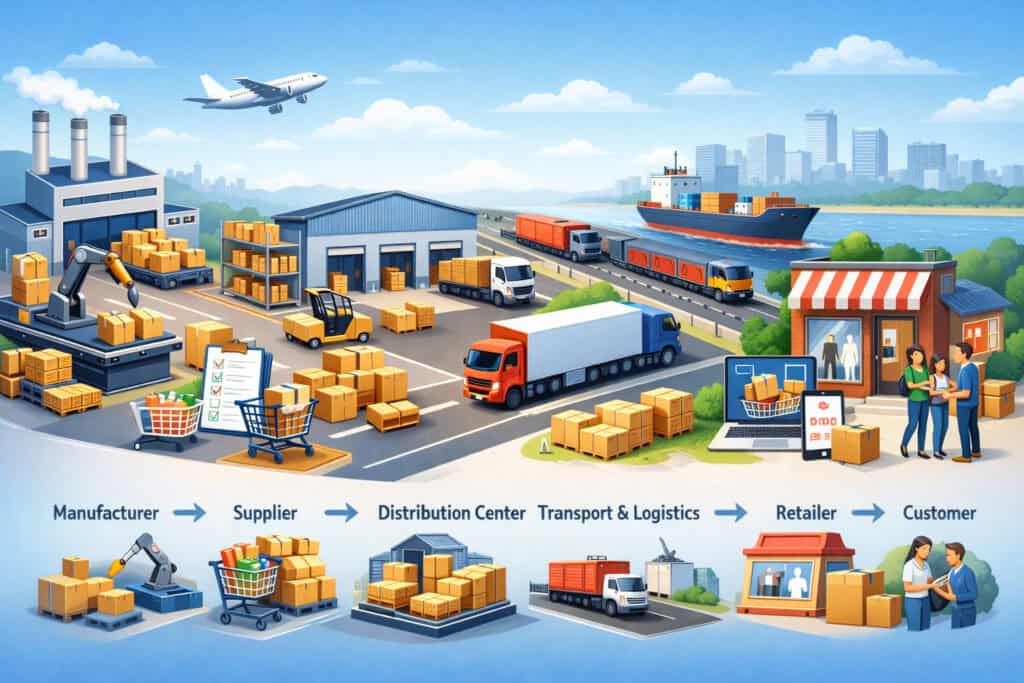
A modern retail supply chain is built to handle variability: promotions, seasonality, vendor lead-time swings, carrier disruptions, and shifting demand between store pickup and home delivery. The strongest operators treat the supply chain as a connected set of capabilities rather than siloed departments.
Planning informs sourcing; sourcing decisions shape inbound logistics; inbound reliability drives warehouse labor plans; warehouse execution impacts transportation cutoffs; transportation performance impacts customer promise dates; and returns quality drives inventory health.
In practice, a strong retail supply chain is managed through a “control tower” mindset: measurable service targets, real-time exception management, and clear ownership of each handoff.
It’s common to formalize this through S&OP (Sales & Operations Planning) or IBP (Integrated Business Planning) with weekly execution cadence and monthly strategic reviews.
A key shift in the last few years is that customers now judge the entire brand experience through fulfillment outcomes: “Was it available? Was it accurate? Was it on time?”
That’s why leaders design their retail supply chain around the customer promise while still protecting cash and profitability. You don’t need perfection everywhere; you need predictable performance where it counts—your A items, key seasons, and priority channels.
Customer promise engineering
Customer promise engineering is the discipline of translating marketing and merchandising goals into operational commitments inside the retail supply chain.
For example, “2-day delivery” isn’t a slogan—it’s a network constraint. To deliver it profitably, you must set rules for order cutoffs, carrier service levels, safety stock placement, pack-out speed, and exception handling.
Retailers who do this well create a service policy by segment: fast movers vs. long tail SKUs, high margin vs. low margin, fragile vs. non-fragile, and store-eligible vs.
DC-only items. A specialty beauty retailer might offer same-day pickup for top SKUs in metro stores while shipping long tail items from a central DC with longer lead times. A home goods retailer might promise “delivery by appointment” for bulky goods and use different carriers and packaging standards.
This is where a strong retail supply chain builds trust. If the promise is accurate, customers plan around it. If the promise is optimistic, your support team becomes a fulfillment hotline, refunds rise, and reviews turn negative.
Operationally, promise engineering requires tight integration between OMS (order management), inventory availability rules, and transportation capacity planning. It also demands disciplined change control: promotions must be vetted for fulfillment capacity, not just gross sales lift.
End-to-end visibility as a competitive advantage
Visibility isn’t just tracking shipments—it’s knowing what is likely to happen next. In a strong retail supply chain, visibility means you can answer, quickly and accurately: “Where is my inventory, in what condition, and when will it be sellable?”
That requires data discipline across purchase orders, ASNs (advance ship notices), receiving, putaway, cycle counts, transfers, and returns disposition.
A practical way to improve visibility is to standardize identifiers and events. Use consistent item masters, location codes, and logistics events (departed supplier, arrived port, departed port, arrived DC, received, available, allocated).
When leaders build this event model, they reduce “black holes” where inventory disappears into spreadsheets and email threads.
Visibility also improves decisions. If inbound containers are delayed, your retail supply chain can reallocate available inventory to top stores, throttle promotions, or switch fulfillment nodes before customer promises fail.
This becomes even more important as the industry moves toward richer product data embedded in 2D barcodes, enabling better traceability and item-level information flows.
Network design and distribution strategy

Network design is the foundation of a strong retail supply chain. It answers big questions that determine cost and speed for years: how many distribution centers you need, where they should be located, which stores can ship, what cross-dock points exist, and how inventory should be positioned across the network.
Many retailers try to “fix” performance through expediting and overtime when the real issue is structural: the network can’t support the promise.
A balanced network design aligns three forces: customer geography, product characteristics, and service expectations. If your customers are concentrated in a few metro areas, you can centralize distribution and still be fast.
If demand is spread nationwide and you’re competing on speed, you may need multi-node fulfillment. If your assortment includes temperature-sensitive goods, you may need specialized facilities and compliant handling processes.
The best operators revisit network design regularly using scenario planning: fuel cost changes, carrier rate shifts, store closures/openings, marketplace growth, and new compliance requirements. A strong retail supply chain is not static—it adapts while keeping complexity under control.
Centralized DCs vs. regional fulfillment nodes
Centralized DCs often win on inventory efficiency: fewer locations mean lower safety stock, better labor pooling, and simpler replenishment. But centralized models can struggle with speed and shipping cost when customers are far from the DC. Regional nodes improve delivery times and reduce parcel zones, but they increase fixed costs and inventory duplication.
A common “strong retail supply chain” approach is a hybrid: a central DC for slow movers and reserve stock, paired with regional nodes (or 3PL facilities) for fast movers and peak season capacity.
Apparel retailers often centralize core inventory but use regional nodes during holidays to protect ship times. Grocery-adjacent retailers may rely on local distribution because freshness and shrink risk demand shorter cycles.
Decision-making should be data-driven: run a network optimization model that considers demand by ZIP, product cube/weight, shipping mode mix, inventory carrying cost, and service targets. Then stress test with peak volumes.
Too many network decisions fail because they were modeled on average weeks, not peak weeks. A strong retail supply chain plans for peak and designs the network to degrade gracefully under stress—meaning it still functions with manageable exception volumes.
Store-as-node strategy and micro-fulfillment
Store-as-node turns retail locations into fulfillment points for ship-from-store, pickup, and local delivery. Done well, it reduces last-mile distance, increases inventory turns, and improves customer experience. Done poorly, it creates chaos: inaccurate store inventory, labor conflicts, and high cancellation rates.
To make store-as-node work in a strong retail supply chain, you need: high inventory accuracy (cycle counts, RFID where feasible), pick/pack workflows, clear priority rules (walk-in customers vs. ecommerce picks), and packaging standards.
Many retailers also use micro-fulfillment—automated or semi-automated picking systems in or near dense markets—to accelerate order assembly while reducing store labor disruption.
A real-world example: a specialty electronics retailer may allow ship-from-store only for high-value SKUs with controlled storage, while routing low-value accessories to the DC to avoid excessive store picking.
A health and beauty chain might prioritize BOPIS (buy online, pick up in store) because it drives foot traffic, then offer ship-from-store selectively for oversupply locations.
In the next few years, expect more “inventory pooling” logic across channels: the retail supply chain will treat store inventory as a shared asset but with guardrails to protect the in-store experience.
Demand planning and inventory optimization

Inventory is where most retail cash is trapped. A strong retail supply chain manages inventory as a portfolio: different strategies for different products, with service levels tied to margin and customer impact.
The goal is not to eliminate stockouts entirely—that can be impossibly expensive—but to reduce avoidable stockouts while lowering excess and obsolescence.
Best-in-class planning combines forecasting, replenishment logic, and exception management. Forecasting alone isn’t enough; you also need clean lead times, supplier reliability metrics, and accurate inventory records. When forecasting errors happen, the system should detect it and adjust quickly through safety stock recalibration and allocation.
Retailers that win in inventory build a cadence: weekly forecast review for key categories, daily exception management for high-volume SKUs, and monthly policy reviews. In a strong retail supply chain, inventory decisions are not a quarterly event—they’re an operational rhythm.
Forecasting methods that retailers actually use
In practice, retailers use a mix of statistical forecasts and business overrides. Statistical models handle baseline patterns (seasonality, trend, holiday effects), while planners apply overrides for promotions, product launches, assortment changes, and competitor moves.
The danger is too many overrides; it can turn planning into opinion wars. A strong retail supply chain uses structured override governance: who can override, by how much, and with what evidence.
For example, a grocery retailer planning for a holiday promotion will incorporate ad lift, store clustering, and vendor constraints, then create a “promotional buy” separate from base replenishment. An apparel retailer planning seasonal drops will use size curve logic, allocation rules by store tier, and markdown planning to avoid late-season overhang.
Better retailers also measure forecast accuracy in a way that supports action. Instead of one global MAPE number, they track accuracy by product segment and selling channel.
They also focus on bias (consistent over-forecasting or under-forecasting), because bias destroys working capital or service levels. This is how a strong retail supply chain converts forecasting from reporting into control.
Safety stock, reorder points, and multi-echelon planning
Safety stock is a buffer against uncertainty, but it must be computed with real variability data—not guesses. In a strong retail supply chain, safety stock considers demand variability, lead-time variability, and desired service level.
Reorder points and order quantities are then set based on that buffer plus the expected demand during replenishment lead time.
Multi-echelon inventory optimization (MEIO) takes this further by coordinating inventory across multiple levels—supplier, DC, and store—so you don’t over-buffer everywhere. This is especially valuable for omnichannel retailers where inventory can be used across store and ecommerce demand.
A practical example: a home improvement retailer may hold bulk inventory at regional DCs while allowing stores to hold only presentation quantities for slow movers. For fast movers, stores hold more because shelf availability drives sales and customer trust. For ecommerce-only SKUs, the DC carries the buffer, and stores never see it.
Over the next few years, expect more AI-driven policy tuning, but the fundamentals won’t change: a strong retail supply chain still needs accurate lead times, supplier reliability tracking, and tight inventory record accuracy to make any optimization “stick.”
Strategic sourcing and supplier performance management

Suppliers are not interchangeable in a strong retail supply chain. Even if two factories produce similar items, their reliability, transparency, compliance posture, and responsiveness can be wildly different. Strong retailers treat suppliers as a managed ecosystem with segmentation, scorecards, and joint improvement plans.
Supplier management starts with clear expectations: lead times, fill rates, packaging standards, labeling and barcode standards, quality tolerances, and documentation requirements.
It then becomes operational through performance measurement—OTIF (On Time In Full), defect rates, ASN accuracy, and dispute cycle times. When suppliers miss targets, leaders don’t just “yell louder”; they diagnose root causes and address them with structured corrective actions.
If you want a strong retail supply chain, you must also manage vendor risk: geopolitical exposure, single-source dependencies, financial stability, and compliance risks. This is increasingly important as enforcement around forced-labor due diligence and traceability expectations grows.
Supplier segmentation and scorecards
Not all suppliers deserve the same management intensity. A strong retail supply chain segments suppliers by criticality and risk. For example:
- Strategic suppliers: top revenue drivers, unique products, or long lead times
- Leverage suppliers: many alternatives available; focus on cost and service
- Bottleneck suppliers: constrained capacity or specialized compliance needs
- Transactional suppliers: low risk, low complexity
Scorecards should match the segment. For strategic suppliers, track OTIF, lead-time adherence, quality, responsiveness, and joint forecasting alignment. For transactional suppliers, focus on basic compliance, labeling accuracy, and consistent lead times.
A real example: a specialty food retailer may treat certain producers as strategic because of seasonal supply constraints. They collaborate on harvest forecasts, allocate production capacity early, and invest in traceability. Meanwhile, packaging suppliers may be leverage suppliers with competitive bidding but strict spec compliance.
Scorecards only work when consequences exist. A strong retail supply chain ties performance to allocation decisions, promotional opportunities, and supplier development investments. It also creates a “single version of truth” in a supplier portal so that disputes are resolved with shared data, not email chains.
Contracting, lead times, and resilience clauses
Contracts are operational tools. In a strong retail supply chain, contracts specify lead-time definitions (order-to-ship vs. order-to-deliver), penalties or chargebacks for noncompliance, packaging and labeling standards, and dispute resolution timelines.
They also include resilience clauses: capacity reservations for peak season, alternative routing options, and escalation procedures.
Many retailers now include explicit requirements for supply chain transparency and documentation to support compliance, especially when importing.
Programs like C-TPAT (a voluntary supply chain security program) outline security expectations across trade partners, and aligning your supplier requirements to such frameworks reduces risk and delays.
A practical contracting move is to define incoterms clearly and align ownership transfer with operational control. If you’re responsible for freight, you can control routing and visibility, but you also assume risk. If the supplier controls freight, you may lose visibility and face delays that harm service.
Future-facing retailers will also contract for data: ASNs with standardized identifiers, item-level serialization where needed, and readiness for 2D barcode transitions that expand product data capabilities at checkout and in the supply chain.
Warehouse operations and inventory accuracy
Warehouses are where plans become reality. A strong retail supply chain uses warehouse execution to protect inventory accuracy, shorten cycle times, and control labor costs. The most common warehouse failure patterns are predictable: inaccurate receipts, poor slotting, uncontrolled substitutions, and “heroic” workarounds that hide system issues.
Strong operators build discipline into the flow: inbound appointment scheduling, standardized receiving, QA checks, directed putaway, cycle counting, and clear pick-path strategies. They also prioritize safety and ergonomics—because injury rates destroy capacity faster than almost any other factor during peak season.
Warehouse excellence isn’t about buying robots on day one. It’s about getting fundamentals right, then automating selectively where ROI is real. A strong retail supply chain invests in WMS configuration, process training, and measurement before scaling technology complexity.
WMS, slotting, and labor engineering
A Warehouse Management System (WMS) is the execution brain of the DC. But the system only works if the item master is clean and processes are consistent. A strong retail supply chain uses the WMS to enforce scan compliance, reduce manual touches, and create traceable inventory moves.
Slotting is a major performance lever. Fast movers should be placed in pick-friendly locations close to packing stations, while bulky or slow movers can be stored in higher-density zones. Re-slotting should be part of the operational cadence—especially after assortment changes or seasonal transitions.
Labor engineering adds predictability. By measuring standard times for receiving, picking, packing, and loading, leaders can plan staffing, set realistic productivity expectations, and spot bottlenecks early.
A real-world example: an apparel DC may shift labor from single-piece picks to batch picking during peak, then use sortation to speed packout. A hard goods retailer may use zone picking to reduce travel time for large items.
In the next few years, more warehouses will adopt “assistive automation”: pick-to-light, wearable scanning, AI-based slotting recommendations, and robotics for specific tasks like goods-to-person for high-velocity small items.
Cycle counting, shrink control, and auditability
Inventory record accuracy is the hidden core of a strong retail supply chain. If your system says you have 10 units but you physically have 6, your OMS will promise orders you can’t fulfill, triggering cancellations and customer distrust. Record accuracy also affects replenishment: errors create phantom stock, which suppresses reorder signals and causes stockouts.
Cycle counting is the best practice for maintaining accuracy. Rather than shutting down for annual physical counts only, strong operators count continuously based on risk: high-value items, high-movement locations, and discrepancy-prone zones are counted more frequently.
Shrink control adds controls such as restricted access, camera coverage, and exception reporting for unusual adjustments.
Auditability matters more than ever. Retailers increasingly need clean documentation trails for compliance, recalls, and dispute resolution. Traceable warehouse events—who moved what, when, and why—help build defensible operations.
This intersects with broader traceability initiatives in food and other regulated categories where enhanced recordkeeping is becoming a priority.
Transportation, last-mile delivery, and freight cost control
Transportation is often the second-largest cost center after the cost of goods sold. A strong retail supply chain manages transportation as a portfolio: inbound ocean/air (when applicable), domestic linehaul, parcel, LTL/FTL, and final-mile delivery. The goal is to hit service targets without “buying speed” everywhere.
Strong operators build carrier strategy: core carriers for stability, flex carriers for peak, and clear routing guides that automate decisions. They also monitor accessorial charges, dimensional weight impacts, and claims management.
Transportation performance feeds directly into customer promise accuracy, so it must be measured and managed like a revenue-protecting function.
A practical reality: many retail leaders over-focus on rate negotiation while ignoring operational drivers like cartonization, packaging standards, and zone-skipping opportunities. A strong retail supply chain addresses both pricing and the underlying shipment profile.
Carrier strategy, routing guides, and TMS discipline
A Transportation Management System (TMS) helps plan, tender, and track shipments. But the win comes from discipline: accurate shipment data, consistent packaging dimensions, and correct service level selection.
A strong retail supply chain builds a routing guide that automatically chooses carriers and service levels based on promised delivery date, cost, and risk.
For example, a specialty retailer can reserve premium air services only for VIP customers or urgent replacement shipments, while routing most orders via ground with intelligent cutoff times. A grocery-adjacent retailer can use temperature-controlled carriers for sensitive goods and enforce strict dwell-time limits at cross-docks.
Routing discipline also helps with peak season. When capacity tightens, you need pre-negotiated surge options, clear tender acceptance rules, and contingency plans (like alternate hubs).
Strong teams hold weekly carrier performance reviews during peak and daily exception huddles when disruption hits.
Over time, transportation becomes a data advantage: you learn which lanes are risky, which carriers miss appointments, and which packaging creates damage claims—then you redesign the system.
Parcel optimization, zone skipping, and delivery experience
Parcel shipping costs are heavily influenced by zones, weight, and dimensions. A strong retail supply chain reduces parcel cost through packaging right-sizing, cartonization logic, and consolidation.
Zone skipping—moving consolidated freight closer to customers before injecting into parcel networks—can reduce cost and improve delivery times for dense regions.
Delivery experience is also part of brand perception. Proactive tracking notifications, accurate delivery windows, and fast resolution on exceptions reduce support volume and increase repeat purchases. Many retailers now measure “delivery NPS” or post-delivery satisfaction as a supply chain KPI.
For bulky goods, final-mile delivery becomes a specialized capability: appointment scheduling, damage prevention, and returns handling. Strong operators use specialized carriers, improved packaging, and customer communication workflows to reduce failed deliveries.
Omnichannel fulfillment and order management excellence
Customers don’t think in channels. They think, “I want it now, in the way that fits my life.” A strong retail supply chain supports this through omnichannel fulfillment: ship-to-home, BOPIS, curbside, ship-to-store, and marketplace fulfillment where applicable.
The operational challenge is orchestration. You must decide the best fulfillment node for each order while balancing inventory availability, labor capacity, cost, and customer promise.
That requires a capable OMS and clear business rules. Many retailers fail here by offering too many options without operational readiness, leading to cancellations, substitutions, and inconsistent service.
Strong omnichannel execution also drives revenue. BOPIS can reduce last-mile cost and increase in-store add-on purchases. Ship-from-store can reduce markdowns by selling down overstocked store inventory. But only a strong retail supply chain can deliver those benefits without wrecking store operations.
OMS rules, allocation logic, and ATP accuracy
Allocation logic determines whether an order ships from a DC, store, or 3PL. Strong OMS configuration uses ATP (Available-to-Promise) calculations that consider on-hand inventory, reserved inventory, inbound receipts, and store safety thresholds. Without accurate ATP, your system becomes a promise generator detached from reality.
A typical strategy: allocate from DC for most ecommerce orders, then use stores for faster delivery in dense regions or to sell through store-specific overstock. Reserve store inventory for walk-in demand on core items, and allow ship-from-store only when inventory accuracy is high enough.
Real-world example: a footwear retailer might allow store shipping for common sizes but restrict limited releases to the DC to reduce shrink and mispicks. A cosmetics retailer might use BOPIS heavily but only enable ship-from-store in locations with dedicated pickers.
In a strong retail supply chain, OMS rules are reviewed regularly based on performance data: cancellation rates, pick times, store workload, and customer satisfaction.
Returns, reverse logistics, and recovery value
Returns are a major cost driver, especially in apparel and ecommerce-heavy categories. A strong retail supply chain treats reverse logistics as a profit recovery system, not just a cost center. The key is speed: the faster returned goods are inspected and made sellable, the more value you recover.
Strong retailers segment returns: resell as new, resell as open-box, refurbish, liquidate, recycle, or dispose. They use standardized disposition rules and route returns to the best processing point (store, returns center, or 3PL) depending on cost and category.
Operational examples include offering in-store returns for ecommerce to reduce shipping costs and increase cross-sell, or using centralized returns centers for high-return categories to improve processing quality. Many also invest in fraud detection and policy management to reduce return abuse.
Data standards, traceability, and compliance readiness
Data is the connective tissue of a strong retail supply chain. Without consistent product identification, location coding, and standardized logistics messages, visibility collapses. That’s why industry standards matter: they reduce friction between retailers, suppliers, carriers, and regulators.
A major trend is the shift toward richer product identification through 2D barcodes. Industry initiatives aim for readiness by the end of 2027, enabling more data at scanning events—like batch/lot, expiration dates, and product attributes that support traceability and customer engagement.
Regulated categories add another layer. For certain foods, enhanced traceability recordkeeping requirements have been a major focus, with enforcement timing and compliance dates being closely watched by retailers and suppliers.
GS1, EDI, and the shift to 2D barcodes
Many retail supply chains already rely on GS1 identifiers (like GTINs) and EDI messages (purchase orders, ASNs, invoices). The move toward 2D barcodes extends this ecosystem by enabling more information to travel with the product, not just in back-end systems.
GS1 US describes Sunrise 2027 as an industry effort to prepare retailers and brands for 2D barcode use at point-of-sale.
Practically, this impacts scanners, POS software, item master data, packaging artwork, and supplier onboarding requirements. A strong retail supply chain starts early: audit scanning hardware, validate labeling compliance with suppliers, and define data governance rules for new fields.
Retailers can also use 2D codes to improve receiving accuracy and reduce shrink by adding better verification signals at scan points.
A real example: a fresh foods retailer can reduce waste by scanning expiration data more reliably, improving rotation. A health retailer can improve recall response by linking batch/lot information to sales events.
Food traceability expectations and recordkeeping discipline
Food retailers and distributors increasingly need strong traceability practices: clear linkages between receiving, transformation (if applicable), shipping, and sales.
Regulatory expectations around additional traceability records for certain foods have driven many operators to modernize their recordkeeping and event capture. FDA information notes the compliance timeline and enforcement direction related to the Food Traceability Rule, including a non-enforcement period tied to July 20, 2028.
Even outside regulated lists, the operational benefits are real. When a quality issue arises, a strong retail supply chain can isolate affected lots fast, remove product from sale, and minimize customer impact. Without good records, recalls become blunt instruments—pulling far more product than necessary and damaging supplier relationships.
To prepare, retailers should standardize lot/batch capture at receiving, ensure ASNs include needed detail, and train teams on exception processes when data is missing. Technology helps—WMS and traceability platforms can automate event capture—but process discipline is still the foundation.
Risk management, security, and ethical sourcing
A strong retail supply chain is resilient: it anticipates disruption and reduces the blast radius when things go wrong. Risk management covers operational disruption (weather, labor shortages, port congestion), security threats (theft, tampering, cyberattacks), and compliance exposure (forced labor, import delays, documentation failures).
Security programs like C-TPAT outline minimum security criteria across supply chain partners and encourage robust risk assessment and controls. Ethical sourcing expectations have also expanded, including forced-labor due diligence requirements and enforcement activity that can detain shipments when documentation is insufficient.
Retailers who treat these as “legal-only” problems often get surprised. In a strong retail supply chain, compliance is operationalized: documented processes, trained teams, supplier requirements, and auditable records.
Supply chain security programs and cargo integrity
Cargo theft and tampering are persistent threats. A strong retail supply chain protects cargo through layered controls: secure facilities, vetted carriers, seal management, route risk analysis, and real-time tracking for high-value loads. Partner alignment matters; if your supplier or logistics provider has weak security practices, your risk increases.
C-TPAT is a voluntary program that focuses on supply chain security practices and criteria across different partner types (importers, carriers, brokers, manufacturers, and others). It provides a framework retailers can use to strengthen partner requirements and reduce security-related disruptions.
Operationally, retailers can create lane-level risk tiers. High-risk lanes get stronger controls: two-driver requirements, geo-fencing, higher insurance coverage, and tighter appointment windows. High-value SKUs receive stricter chain-of-custody controls.
Cybersecurity also matters because the retail supply chain is connected via EDI, portals, and APIs. Many retailers align controls to recognized cybersecurity frameworks (like NIST-based practices) and require vendors to meet baseline security standards.
Forced-labor due diligence and import compliance discipline
Ethical sourcing is now a measurable operational requirement. Retailers importing goods must be ready to demonstrate supply chain transparency, mapping, and documentation. Government strategy updates have highlighted expansion of enforcement focus and entity lists over time, reinforcing the need for defensible due diligence programs.
A strong retail supply chain builds due diligence into supplier onboarding and ongoing monitoring: requiring origin documentation, tracing raw material sources where relevant, conducting audits, training internal teams, and maintaining an organized evidence repository.
Legal guidance commonly emphasizes mapping supply chains and maintaining documentation that supports claims about sourcing and labor practices.
This isn’t just about avoiding penalties—it’s about avoiding supply disruptions. Detained shipments can wipe out seasonal sales. Strong retailers build “compliance lead time” into planning: they assume documentation checks take time and they reduce single-source dependency in higher-risk categories.
Sustainability, waste reduction, and circular supply chains
Sustainability has moved from marketing to operations. A strong retail supply chain reduces waste because waste is cost: excess inventory, damages, inefficient transportation, energy-heavy warehousing, and returns that end up liquidated. Retailers improve sustainability most effectively when they treat it as process improvement tied to measurable cost drivers.
Inventory and forecasting improvements reduce markdowns and obsolescence. Packaging optimization reduces dimensional weight and damages. Transportation consolidation reduces miles per unit shipped. Returns optimization increases recovery value and reduces landfill.
Sustainability also influences supplier selection. Retailers increasingly prefer suppliers who can document material sourcing, demonstrate responsible practices, and provide data needed for reporting. Even when not strictly required, customer expectations and investor scrutiny push retailers toward better measurement.
The best approach is to embed sustainability KPIs into the retail supply chain scorecard rather than creating a separate “green” initiative that competes for attention during peak season.
Packaging, damage reduction, and freight efficiency
Packaging drives both cost and customer experience. A strong retail supply chain designs packaging to reduce damage, reduce void fill, and lower dimensional weight charges. This requires testing—not assumptions. Many retailers run packaging labs or pilot programs to validate new materials and carton sizes.
Damage reduction is a major profit lever. Every damaged unit creates reverse logistics cost, replacement shipments, and customer dissatisfaction. Strong operators track damage by carrier, lane, carton type, and product category.
They then make targeted changes: stronger corrugate for heavy items, improved corner protection, or different pallet patterns for store replenishment.
Freight efficiency also improves with packaging right-sizing. Reducing average carton size can lower shipping costs and increase trailer utilization. For store replenishment, better pallet building reduces handling time and improves safety.
Circular models, refurbishment, and resale channels
Circular supply chains keep products in use longer through refurbishment, repair, resale, or recycling. For retailers, circular models can unlock new revenue and improve inventory recovery—especially for electronics, appliances, and certain hard goods.
A strong retail supply chain enables circularity by designing reverse logistics flows that separate items early: resale-ready, refurbishable, parts salvage, or recycle. It also requires quality grading standards, refurbishment capacity planning, and channel strategy (in-store outlet, online resale, or third-party marketplaces).
A practical example: a consumer electronics retailer can refurbish returned devices and sell them as certified pre-owned, protecting margins while meeting customers who want lower price points. A home goods retailer may resell open-box items locally to avoid shipping bulky returns across long distances.
KPIs, governance, and continuous improvement
You can’t manage what you can’t measure. A strong retail supply chain runs on a focused KPI set tied to service, cost, and cash. Too many metrics create noise; too few hide problems.
The best teams use a tiered KPI model: executive metrics (service and cash), operational metrics (warehouse and transportation performance), and diagnostic metrics (root-cause indicators).
Governance matters as much as metrics. KPI reviews must trigger actions, not just slides. Leaders should run weekly operations reviews with clear owners, due dates, and escalation paths. Many retailers also use “A3” problem-solving or similar continuous improvement methods to address recurring issues systematically.
A strong retail supply chain also invests in capability building: training, standard work, and process documentation. Technology upgrades fail when teams aren’t trained to use them consistently.
Service, cost, and cash: the KPI triad
The KPI triad keeps the retail supply chain balanced:
- Service: on-shelf availability, OTIF, order fill rate, perfect order rate, delivery on-time performance
- Cost: cost per order shipped, warehouse cost per unit, transportation cost per unit, returns cost rate
- Cash: inventory turns, weeks of supply, aged inventory %, markdown rate, shrink rate
A strong practice is to tie KPIs to product segments. For A items, you may target higher service levels and accept more buffer stock. For long tail items, you may accept longer lead times or drop-ship models.
Real-world example: a specialty retailer might set 98% in-stock targets on top 500 SKUs but allow 92–94% on long tail SKUs while using substitution or alternative recommendations to protect conversion.
Continuous improvement systems that stick
Continuous improvement only works when it’s baked into operations. A strong retail supply chain uses structured root-cause analysis: why did a stockout happen (forecast error, supplier miss, DC receiving delay, inventory inaccuracy, allocation rule)? Why did a late delivery happen (missed cutoff, carrier delay, wrong service level, pick delay)?
Leaders then implement countermeasures with ownership and measurement. For example, if ASN accuracy is low, you enforce supplier compliance and block repeat offenders. If cycle counts reveal repeated shrink in one zone, you improve controls and retrain.
Standard work is underrated. Documented processes for receiving, returning grading, and store fulfillment reduce variability and speed training. During peak season, standard work prevents “make it happen” heroics from turning into permanent bad habits.
Future trends shaping the retail supply chain through 2028 and beyond
The next phase of the retail supply chain will be defined by three forces: richer data (especially product identification), smarter automation, and tougher expectations around transparency and resilience. Retailers that build flexible systems now will adapt faster than those that rely on brittle workarounds.
One of the biggest near-term shifts is the industry drive toward 2D barcode readiness by the end of 2027, which can unlock better product data flows at checkout and through the supply chain.
Another is evolving traceability and documentation expectations in regulated and high-scrutiny categories, where compliance timelines and enforcement focus shape investment priorities.
Winning retailers will not chase every trend. They’ll invest in foundational capabilities—clean data, integrated planning, disciplined execution—then layer technology where it amplifies those fundamentals.
AI planning, digital twins, and autonomous execution
AI is improving forecasting, replenishment tuning, and exception management. The best applications are targeted: anomaly detection (when demand deviates), lead-time risk prediction, and dynamic safety stock adjustments. But AI only helps a strong retail supply chain when data quality is high and decisions are operationalized through clear workflows.
Digital twins—simulation models of the supply chain—will become more common. They let retailers test network changes, promotion impacts, and disruption scenarios before committing. This reduces risk and improves agility.
Autonomous execution will expand too: automated picking, robotic sortation, and dynamic routing. However, most retailers will adopt these in phases, starting with high-ROI areas like high-volume picking zones, automated cartonization, and smarter labor scheduling.
Data-rich compliance and the rise of “proof-ready” supply chains
Compliance isn’t slowing down. Retailers are being pushed toward “proof-ready” operations: the ability to show traceability, sourcing documentation, and security controls quickly when challenged. This affects supplier onboarding, documentation storage, and event capture across the retail supply chain.
As enforcement expectations evolve, retailers that can map multi-tier supply chains and maintain documentation will face fewer disruptions and protect brand reputation. Strategy updates and guidance emphasize the importance of due diligence and transparency.
FAQs
Q.1: What are the main pillars of a strong retail supply chain?
Answer: A strong retail supply chain rests on five pillars: (1) network design that matches customer geography and service promises, (2) inventory planning that balances service and cash, (3) reliable suppliers with measurable performance, (4) execution excellence in warehousing and transportation, and (5) data governance that enables visibility and compliance.
Retailers often over-invest in one pillar while neglecting others. For example, buying automation without improving inventory accuracy can speed up the wrong outcomes. Or negotiating better freight rates without fixing packaging and cartonization leaves major savings on the table.
The strongest teams treat the retail supply chain as a system and improve constraints in the right sequence: data → process discipline → system configuration → selective automation.
If you’re prioritizing improvements, start with the biggest pain points that affect customers: stockouts, late deliveries, cancellations, and returns delays.
Then map those issues back to root causes across forecasting, supplier reliability, warehouse execution, and transportation. That’s how you build strength that lasts, rather than short-term fixes that fade after peak season.
Q.2: How can I reduce stockouts without overbuying inventory?
Answer: To reduce stockouts without inflating inventory, a strong retail supply chain focuses on accuracy and variability management. First, improve inventory record accuracy with cycle counting and disciplined receiving.
Many “stockouts” are actually data errors. Next, measure lead-time variability and supplier reliability; if lead times swing widely, safety stock must increase unless you stabilize suppliers.
Then segment inventory policies. Raise service levels (and buffers) only for high-impact SKUs—the ones that drive traffic, repeat purchases, or category trust. For long tail SKUs, consider alternate tactics: DC-only fulfillment, vendor drop-ship, or longer customer promise windows.
Finally, build exception management. If forecasts are wrong, detect it quickly through demand sensing and adjust replenishment signals. Retailers that win don’t forecast perfectly—they recover faster. That’s the hallmark of a strong retail supply chain: fewer surprises and faster correction when surprises happen.
Q.3: What technology stack supports omnichannel supply chain performance?
Answer: A typical modern retail supply chain stack includes: ERP for financials and purchasing, OMS for order orchestration and promise management, WMS for warehouse execution and inventory control, TMS for transportation planning and tracking, and a BI/analytics layer for visibility and KPIs. Many retailers also use supplier portals, demand planning tools, and returns management systems.
The key is integration and data governance. If item masters differ across systems or if location inventory isn’t synchronized, the OMS will promise what the WMS can’t fulfill. Strong operators define a “single source of truth” for item data and inventory availability rules.
Technology selection should be driven by use cases. If your biggest pain is cancellations, prioritize OMS/ATP accuracy and inventory synchronization. If your biggest pain is labor cost, prioritize WMS configuration and slotting optimization.
If your biggest pain is freight cost, prioritize packaging data accuracy and TMS routing discipline. A strong retail supply chain stack is less about brand names and more about tight process-to-system alignment.
Q.4: How should retailers prepare for 2D barcodes and new traceability expectations?
Answer: Retailers should treat 2D barcode readiness as both a front-end and back-end initiative. On the front end, audit POS scanners and ensure they can read 2D codes reliably.
On the back end, define what data you want to capture and how it maps to your item master, receiving workflows, and recall/quality processes. Industry initiatives are pushing for readiness by the end of 2027, so early planning reduces last-minute disruption.
For traceability, focus on event capture discipline: receiving accuracy, lot/batch capture where relevant, and clean ASNs. If you operate in regulated or high-scrutiny categories, ensure recordkeeping processes are auditable and staff are trained to handle missing or incorrect data.
A strong retail supply chain doesn’t wait for a deadline panic. It builds capabilities that improve everyday operations—better receiving accuracy, faster returns disposition, lower shrink—while also positioning the business to meet rising traceability expectations.
Q.5: What compliance areas most often disrupt retail supply chains?
Answer: Common disruptors include import documentation gaps, forced-labor due diligence weaknesses, and security failures that lead to delays, detentions, or reputational damage.
Retailers importing goods must be prepared with supply chain mapping and evidence that supports sourcing claims, especially as enforcement strategies evolve and focus areas expand.
Security-related disruptions include cargo theft, tampering, and cyber incidents involving logistics partners. Programs like C-TPAT outline security expectations and can guide partner requirements and risk controls.
The best prevention is operationalization: embed compliance into supplier onboarding, contract requirements, documentation workflows, and audit-ready storage. When compliance is “someone else’s job,” the retail supply chain gets hit with emergency work, missed seasons, and avoidable costs.
Q.6: What are the most important retail supply chain KPIs?
Answer: A strong retail supply chain tracks a balanced set of KPIs across service, cost, and cash. Service KPIs include in-stock rate, OTIF, perfect order rate, and on-time delivery. Cost KPIs include cost per shipped order, transportation cost per unit, warehouse cost per unit, and returns cost rate. Cash KPIs include inventory turns, weeks of supply, aged inventory %, shrink rate, and markdown rate.
The trick is segmentation. Your KPI targets should differ by product and channel. Fast movers and core SKUs deserve higher service targets. Long tail SKUs can have lower service targets if the promise is set correctly and customers are informed.
KPIs should also drive actions. If OTIF drops, you should quickly see whether the root cause is supplier misses, inbound delays, warehouse throughput constraints, or carrier failures. That’s how measurement becomes management—and how a strong retail supply chain improves month after month.
Conclusion
Building a strong retail supply chain is not a single project—it’s a capability you compound over time. The retailers that consistently win do a few things exceptionally well: they design networks that match their promise, manage inventory as a segmented portfolio, hold suppliers accountable through measurable performance, execute warehousing and transportation with discipline, and invest in clean data and standards that enable visibility.
They also prepare early for what’s next. The shift toward 2D barcode readiness by 2027 is a real operational milestone that will influence scanners, item data, supplier labeling, and traceability workflows.
Traceability and documentation expectations in regulated and high-scrutiny categories are also shaping how retailers build auditable processes and evidence-ready operations.
If you want your retail supply chain to be stronger within the next 90 days, start with the fundamentals: inventory accuracy, supplier OTIF measurement, warehouse scan compliance, routing discipline, and OMS promise accuracy.
Then scale improvements through standard work, KPI governance, and targeted automation. That’s how you build a strong retail supply chain that protects customer trust, controls cost, and grows with the business.