Retail Email Marketing Tips That Drive Sales
Retail email marketing is still one of the most reliable ways to drive direct, trackable sales for retail brands. Done well, it becomes a revenue engine that supports both online and in-store purchases, powers loyalty, and keeps your brand top-of-mind without burning out your list.
In this guide, you’ll learn practical retail email marketing tips that drive sales today and position your brand for where email is headed next.
We’ll cover strategy, list growth, copy and design, automation, personalization, compliance, analytics, and future trends like AI and privacy-first marketing—while keeping everything easy to understand and actionable.
Understanding Retail Email Marketing and Why It Still Drives Sales
Retail email marketing is the practice of using email campaigns to promote products, boost store traffic, and increase customer lifetime value. It sits at the center of a retailer’s owned-channel strategy because you control the audience, the message, and the timing.
Unlike paid ads, you aren’t renting attention from an algorithm—you’re speaking directly to people who have already shown interest in your brand.
One of the most important retail email marketing tips that drive sales is to treat email as a long-term relationship channel, not just a discount machine. When you only send coupons, customers learn to wait for the next deal and ignore everything else.
When you mix offers with education, inspiration, styling tips, how-to content, and invitations to in-store experiences, your emails become useful and welcome. Over time, that consistent value builds trust and repeat purchase behavior.
Email is also incredibly measurable. You can see who opened, who clicked, what they bought, how much revenue a campaign generated, and how email influences other channels. This makes retail email marketing ideal for testing and optimization.
As AI-driven personalization and automation tools become more accessible, email can now react in near real time to customer behavior—showing the right product or promotion to the right person at the right moment.
Finally, email remains resilient despite changing social algorithms, rising ad costs, and privacy updates. While the way we measure opens and clicks has evolved, retailers who invest in list quality, relevant content, and a clear strategy consistently see a strong return on investment from email.
How Email Fits Into the Modern Retail Customer Journey
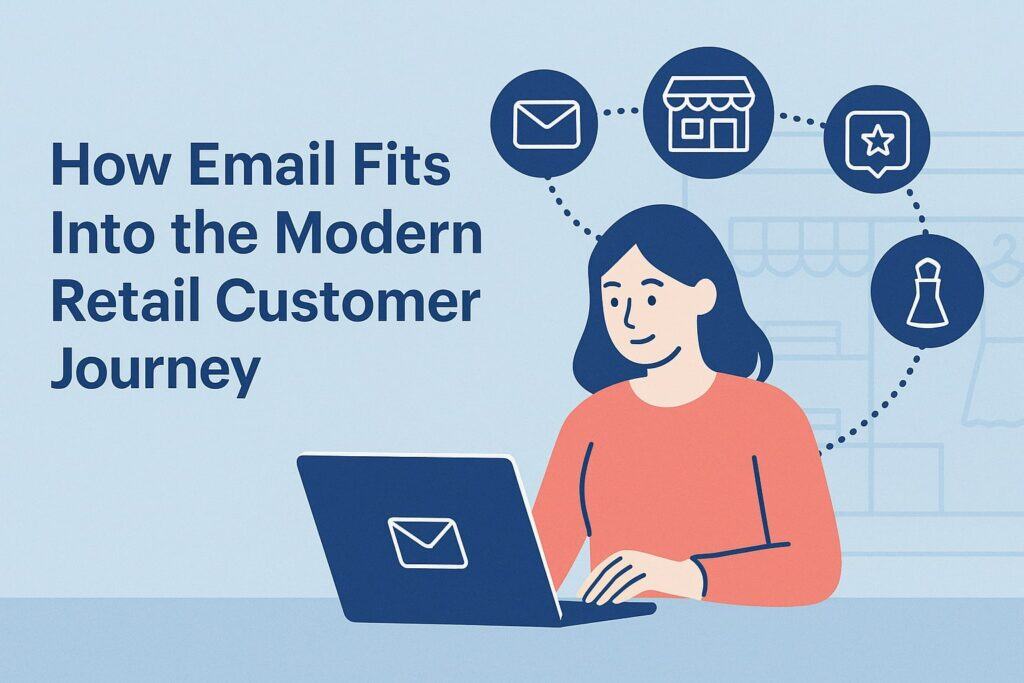
In a modern retail journey, customers rarely move in a straight line from awareness to purchase. They see an ad on social media, browse your website on mobile, visit your store, follow you on a marketplace, and maybe abandon a cart on desktop. Retail email marketing bridges these touchpoints and nudges people toward the next best action.
After someone discovers your brand, email is often the first owned channel they join. A welcome series introduces your story, your value proposition, and what makes your products different.
Later, browse, cart, and wish-list triggers remind them of items they considered. Post-purchase flows turn a one-time buyer into a repeat shopper with care tips, cross-sell recommendations, and loyalty rewards.
One of the most effective retail email marketing tips that drive sales is to map your emails to specific stages of the journey.
Think about: discovery, consideration, purchase, post-purchase, and re-engagement. For each stage, define what the customer is thinking, what they need to know, and what you want them to do. Then build campaigns and flows that support those steps.
Email also plays a key role in omnichannel behavior. You can use it to promote in-store events, new store openings, local offers, and buy-online-pick-up-in-store (BOPIS) options. When people interact with your store associates or call customer service, follow-up emails can collect feedback and keep the relationship warm.
As AI and retail personalization tools advance, email will increasingly become a real-time companion to the customer journey, reacting dynamically to context, history, and preferences, instead of relying solely on a fixed calendar of campaigns.
Key Metrics That Show Email’s Impact on Retail Revenue
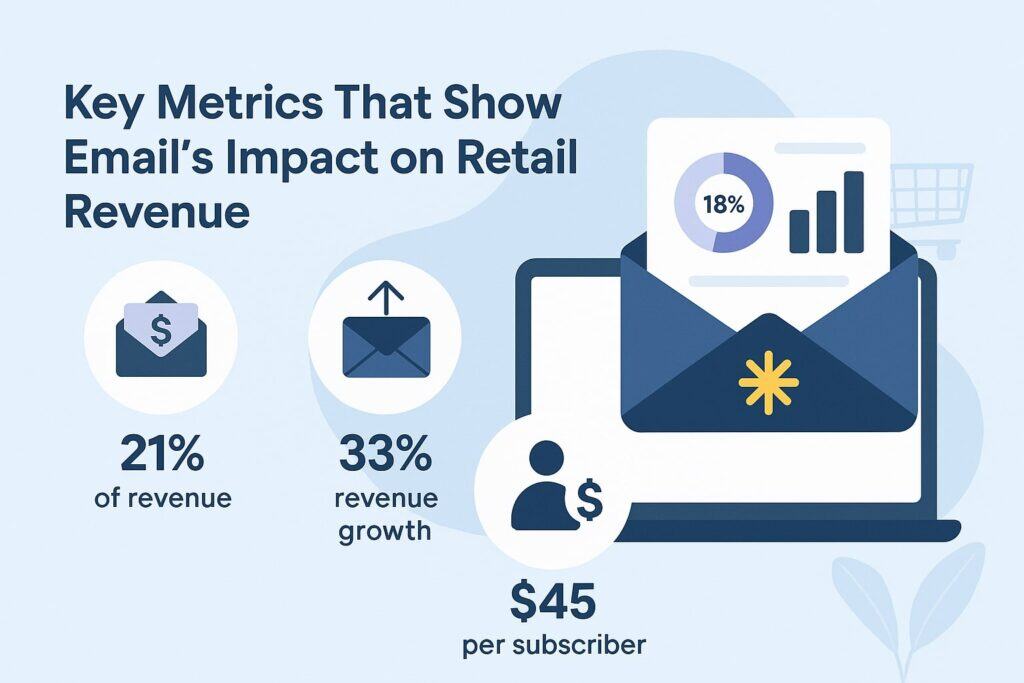
To use retail email marketing tips that drive sales effectively, you need to measure the right numbers. Vanity metrics like total list size or raw open rate are less useful than metrics tied to revenue and customer behavior.
Core performance metrics include:
- Open rate and click-through rate (CTR): These show whether your subject lines, preview text, and content are compelling. While open tracking is less precise due to privacy changes, trends over time still matter.
- Click-to-open rate (CTOR): This measures how many people clicked out of those who opened, giving a cleaner read on content quality.
- Conversion rate and revenue per recipient (RPR): These are critical for retailers. They show how well emails actually turn engagement into sales. Email platforms increasingly highlight RPR and revenue attribution to help you prioritize the most profitable campaigns.
- Average order value (AOV) from email: Useful for measuring upsell and cross-sell tactics.
- List growth and list churn: Track new subscribers, unsubscribes, and spam complaints to understand list health.
Longer-term metrics matter even more. Monitor customer lifetime value (CLV) by acquisition source and segment, and compare the lifetime value of subscribers who engaged with certain flows (like welcome series or loyalty emails) vs. those who didn’t.
This helps you quantify how specific retail email marketing strategies contribute to retention and repeat purchases.
Going forward, expect more platforms to offer multi-touch attribution, incrementality tests, and predictive metrics, estimating how much revenue future email engagement will drive.
Retailers who build their strategy around these deeper metrics will make smarter budget and content decisions than those who optimize only for short-term opens or click spikes.
Retail Email Marketing Strategy: Foundations for Sustainable Growth
Before you worry about templates and subject lines, you need a clear retail email marketing strategy. A strong strategy is one of the most overlooked retail email marketing tips that drive sales, because it forces you to decide who you serve, what you send, and why it matters.
Start with your brand positioning. Are you premium, value-driven, sustainable, or trend-focused? Your email tone, design, and offers should reinforce that positioning, not contradict it.
A highly discounted, “always on sale” email calendar may hurt a premium brand more than it helps. Instead, you might emphasize exclusivity, early access, and curated collections.
Next, define your customer segments at a high level: new visitors, first-time buyers, repeat purchasers, high-value customers, and lapsing customers. Your overall strategy should specify how you’ll move people from one group to the next.
For example, you might invest heavily in welcome education and first purchase incentives, then use loyalty points and VIP perks to retain high-value segments.
It’s also crucial to balance campaigns vs. automations. Campaigns are one-off sends based on your retail calendar—seasonal drops, sales, back-to-school, gifting, and more.
Automations are triggered flows that run continuously based on behavior (sign-ups, carts, purchases). A sustainable strategy uses both: campaigns for big brand moments, and automations for always-on revenue.
Finally, your strategy must align with your inventory, operations, and data. Email promises need to match what you can deliver: shipping times, return policies, stock levels, and customer service capacity.
As personalization and AI tools get more powerful, the brands that win will be those that combine data-driven targeting with operational excellence, not just flashy templates.
Defining Clear Goals and KPIs for Retail Email Campaigns
One of the core retail email marketing tips that drive sales is to define a clear goal for each campaign and flow. “Send a newsletter every week” is not a goal. “Increase new-customer repeat purchase rate by 15% over the next quarter through post-purchase education campaigns” is a goal.
At a program level, typical goals include:
- Increasing revenue per subscriber
- Improving first-to-second purchase rate
- Growing loyalty enrollment and repeat purchase frequency
- Driving in-store traffic during key periods
- Reducing churn among high-value customers
For each goal, pick a small set of KPIs. For example, if your goal is to increase repeat purchases, you might track: repeat purchase rate, CLV over six months, and post-purchase flow conversion rate. If your goal is to drive store traffic, track redemptions of in-store coupons, engagement from local segments, and day-of traffic lift.
On a campaign level, define the “one thing” you want subscribers to do. Is it shop a new collection, redeem a limited-time discount, attend an event, or join your loyalty program? Every element in the email—subject line, hero image, copy, and CTAs—should support that primary goal.
As AI-driven analytics become more accessible, you’ll also be able to set goals around predicted outcomes, such as increasing the number of customers likely to become high-value segments or reducing predicted churn.
Platforms are already using machine learning to suggest send times, subject line variants, and best segments to target to achieve a specific revenue goal.
Choosing the Right Email Service Provider and Tech Stack
Your email service provider (ESP) is the engine behind your retail email marketing. Choosing the right platform is another foundational retail email marketing tip that drives sales, because it determines what you can automate, how you measure performance, and how well you can personalize at scale.
Key things to evaluate:
- Integration with your ecommerce platform and POS: You need real-time access to orders, products, inventory, and customer profiles to build effective automations and segments.
- Automation and journey builders: Look for visual flows that support complex triggers, splits, and conditional logic, including behavior like browse history, purchase frequency, and predicted values.
- Personalization and AI features: Many leading platforms now offer product recommendation engines, send-time optimization, subject line generation, and content personalization, powered by AI.
- Segmentation and data flexibility: You should be able to segment on events, attributes, and custom properties (for example: product category affinity, average discount level, or in-store vs. online shopper).
- Deliverability tools: Built-in spam testing, list cleaning tools, and sender reputation monitoring are important for long-term success.
Beyond the ESP, your tech stack may include a customer data platform (CDP), loyalty platform, review software, and on-site personalization tools.
Over the next few years, expect deeper integrations between these systems, with AI managing more of the real-time decisioning—deciding which message, offer, or product to show each individual based on a unified customer profile.
Growing a Profitable Retail Email List (Without Hurting Deliverability)
A healthy, engaged email list is the foundation of all retail email marketing tips that drive sales. More is not always better—quality matters more than raw numbers. An over-aggressive list-growth strategy that adds uninterested shoppers will harm your deliverability, reduce engagement rates, and lower revenue per send.
Focus on attracting high-intent subscribers who actually want to hear from you. That means clear value propositions, transparent expectations (how often you’ll email), and easy ways to manage preferences. It also means never buying lists or scraping email addresses, which can devastate your sender reputation.
An optimized list-growth strategy should cover your website, checkout, in-store experience, and post-purchase journey. Use A/B testing to refine timing (for example, portal vs. exit-intent), incentive size, and message framing.
Over time, track not just sign-up rate but revenue per subscriber from each source to identify your highest-value acquisition tactics.
As privacy regulations and consumer expectations evolve, building a clean, permission-based list is becoming even more important. People are more aware of how their data is used, and they expect brands to respect that.
Retailers that clearly explain why they collect email addresses and how they will use them will earn more trust and long-term engagement.
High-Intent List Building at Checkout, In-Store, and Online
One of the most practical retail email marketing tips that drive sales is to capture emails when customers are already engaged. These high-intent moments include:
- Checkout pop-ups and footer forms: Offer reasons beyond discounts, such as new arrivals notifications, restock alerts, and loyalty benefits. Make it easy to sign up with one or two fields.
- Account creation and loyalty enrollment: Encourage shoppers to create an account or join your rewards program with clear benefits: points, birthday perks, faster checkout, or personalized recommendations.
- In-store sign-ups: Train associates to invite customers to join your list during checkout. Use tablets, QR codes, or SMS shortcodes so people can securely enter their own information. Ask permission explicitly—and explain what kind of emails they’ll receive.
To keep list growth sustainable, monitor the performance of each source over time. Subscribers captured in-store may behave differently from those acquired via social lead ads or blog content. Segment them by acquisition channel and personalize welcome flows based on what they were promised.
From a future perspective, expect more retailers to use interactive sign-up experiences such as quizzes (“Find your perfect fit,” “Discover your style persona”) and gamified elements (spin-to-win, scratch-off reveals) to capture both email and zero-party data—information customers willingly share about their preferences.
This type of data will become even more valuable as third-party cookies fade out, making direct relationships and explicit preferences the core of personalization.
Using Incentives, Loyalty Programs, and SMS to Boost Sign-Ups
Incentives are powerful but must be used thoughtfully. A common retail email marketing tip that drives sales is to offer a first-order discount for joining the list. This can work well, but if overused, it trains shoppers to only buy with coupons. Consider mixing discount and non-discount incentives, such as:
- Early access to new collections or limited drops
- Entry into monthly giveaways
- Insider content, styling guides, or how-to tutorials
- Loyalty points or bonus rewards for subscribing
Loyalty programs play a central role here. When customers see email as the primary way to earn and track rewards, they’re more likely to stay subscribed and engaged. Integrate loyalty status and point balances directly into your emails and segments, using them to drive repeat purchases and tier upgrades.
SMS can also boost sign-ups and engagement when used responsibly. Many retailers offer a combined incentive: “Sign up for email and SMS to get X% off.” Just be careful not to overwhelm new subscribers with messages on both channels. Set expectations clearly, and allow people to choose their preferred channel.
Looking ahead, expect more cross-channel preference centers where customers can control email frequency, content categories, and channel preferences in one place. Brands that give subscribers this control will see better long-term engagement, fewer unsubscribes, and stronger performance from all their retail email marketing tips that drive sales.
Retail Email Marketing Tips That Drive Sales: Crafting Content That Sells
Your content is where all your retail email marketing tips that drive sales finally become real for customers. Even with a strong strategy and healthy list, weak content will underperform. Content must be relevant, easy to skim, mobile-friendly, and aligned with a clear offer or story.
Start by clarifying the purpose of each email. Are you showcasing a new collection, clearing seasonal inventory, highlighting a specific category, or telling a brand story? Choose one primary message and keep everything else secondary. Confusing, cluttered emails lead to fewer clicks and lower conversions.
Balance promotional and value-driven content. If every subject line screams “Sale,” customers tune out. Mix in lookbooks, styling ideas, product care tips, stories behind your products, and user-generated content. This approach deepens emotional connection and makes your brand feel helpful, not just transactional.
Remember that many subscribers open emails on mobile devices. Use short, scannable sections, clear headlines, and obvious buttons. Test different image styles, product counts, and layouts to see what drives higher click-throughs and revenue per recipient.
In the future, AI will increasingly assist with content creation—suggesting product combinations, generating copy variants, and personalizing content blocks based on each subscriber’s interests.
Retailers who combine human creativity with AI-driven optimization will produce email content that feels both on-brand and uniquely relevant.
Writing Subject Lines and Copy That Drive Opens and Clicks
Subject lines are the front door of your campaigns. A simple but powerful retail email marketing tip that drives sales is to spend real time crafting, testing, and optimizing them.
Best practices include:
- Be clear before clever: “New arrivals in denim” usually outperforms vague mystery.
- Highlight value or benefit: “Free 2-day shipping this weekend” or “Outfits that make mornings easier.”
- Use urgency sparingly: Time-bound offers (“Ends tonight”) can work, but overuse leads to fatigue.
- Personalization: When used thoughtfully, including a name or product category can increase opens, especially when it aligns with the content inside.
Inside the email, write a copy that speaks to the shopper’s needs, not just product features. Focus on outcomes (comfort, confidence, convenience, savings), social proof (reviews, ratings, UGC), and clarity (what to do next). Use short paragraphs, bullets, and bold text to break up copy and guide the eye.
A/B test subject lines regularly and review performance by segment (new vs. returning, high vs. low spenders). Over time, build a library of winning patterns you can reuse and adapt.
As AI-powered tools mature, they’ll increasingly suggest subject line and copy variants based on predicted open and click behavior for each segment. This will make subject line testing more dynamic and personalized, rather than one-size-fits-all.
Visual Merchandising in the Inbox: Images, Layout, and CTAs
Think of your email as a mini-storefront. Visual merchandising is one of the most underestimated retail email marketing tips that drive sales. Your visuals should make it easy to understand what’s on offer and why it matters.
Use a clear hierarchy:
- A strong hero image and headline to communicate the main message.
- Supporting sections that highlight key categories, benefits, or collections.
- Product grids with concise titles, prices, and star ratings where appropriate.
Ensure product images are consistent and high quality. Lifestyle images can create desire and tell a story, while simple product shots help with quick comparison. Use alt text so screen readers can describe images and to provide context when images don’t load.
Buttons should be obvious, descriptive, and tappable on mobile. Instead of “Shop now,” test more specific CTAs like “Shop new sneakers” or “Claim your reward.” Use white space generously so the email doesn’t feel overwhelming.
Looking ahead, more retailers will experiment with interactive email elements such as carousels, quizzes, or mini lookbooks inside the email itself.
While full interactivity can depend on email client support, even small touches like hover effects, animated GIFs, and dynamic product blocks based on inventory or preferences will help your visual merchandising stand out and drive clicks.
Personalization and Segmentation: Turning Data Into Revenue
Personalization is no longer just “Hi, [First Name].” Advanced personalization and segmentation are now core retail email marketing tips that drive sales—and research shows that well-executed personalization can significantly increase revenue and return on ad spend.
Segmentation starts with dividing your list into meaningful groups, then sending tailored messages to each. Instead of blasting the same campaign to everyone, you adjust product picks, offers, and messaging by behavior, demographics, and lifecycle stage. This reduces irrelevance and boosts engagement.
Modern email platforms, often supported by AI, make segmentation easier by surfacing patterns in customer data—such as product category affinity, discount sensitivity, or timing preferences.
Over the next few years, expect more tools that automatically create and update segments in real time based on predicted value and churn risk, further increasing the effectiveness of these retail email marketing tips that drive sales.
Smart Segments Based on Behavior, Value, and Lifecycle Stage
Effective segments for retailers often include:
- New subscribers vs. loyal buyers: Tailor welcome content to new sign-ups and VIP perks to high-value customers.
- Category or brand affinity: If someone buys mostly footwear, they should see more shoes in campaigns and recommendations.
- Discount sensitivity: Some subscribers only buy on sale; others buy full price. Vary your offers accordingly.
- Purchase frequency and recency: Create win-back campaigns for those who haven’t purchased recently, and “like clockwork” reminders for those who buy on predictable cycles (for example, consumables).
One of the best retail email marketing tips that drive sales is to combine these dimensions. For instance, you might create a segment of “high-value customers who haven’t purchased in 90 days but used to buy at full price.” They may respond well to early access or exclusive drops rather than simple discounts.
Lifecycle-based segmentation ensures each customer receives content that matches where they are in the journey: onboarding, building habit, loyalty, or at risk of churn.
As AI advances, more retailers will adopt next-best-action engines that automatically choose the most relevant offer or content for each person based on a combination of rules and machine learning.
Dynamic Content, Product Recommendations, and AI Personalization
Dynamic content changes based on who is viewing the email. This might include personalized product recommendations, location-specific banners, or loyalty status. These tactics are some of the most powerful retail email marketing tips that drive sales because they make each email feel individually curated.
Common dynamic elements include:
- Recently viewed or related products
- Top sellers in a category the customer likes
- Refill reminders based on past purchases
- Personalized offers based on spending level or loyalty tier
AI-powered recommendation engines use browsing and purchase history to predict which products a customer is most likely to buy next. Studies and industry reports show that retailers using AI personalization see notable uplift in engagement and revenue.
In the near future, personalization will go beyond product suggestions. AI models can already generate tailored offers, dynamic copy variants, and even entire email layouts optimized for each micro-segment. Research into AI-based offer generation suggests that personalization at this level can significantly increase offer acceptance rates and conversion.
To stay ahead, retailers should start small—adding personalized blocks to high-impact emails like welcome series and cart recovery—then gradually expand personalization as they gain comfort with the tools and data.
Automation Flows That Retailers Need to Set Up Today
While campaigns drive big moments, automation flows are the quiet workhorses of retail email marketing. They run 24/7, responding to behavior and lifecycle events. Setting up these flows is one of the highest-ROI retail email marketing tips that drive sales, because once built, they generate revenue automatically with relatively little ongoing effort.
Key flows include welcome series, browse and cart abandonment, post-purchase sequences, and win-back campaigns. As your program matures, you can add more niche flows like price-drop alerts, back-in-stock notifications, review requests, and loyalty milestone celebrations.
Automation also reduces manual workload for your team. Instead of scrambling to create new campaigns every week, you can invest in optimizing existing flows through testing, personalization, and updated creative.
Over time, flows typically account for a large share of email revenue despite representing a small share of sends.
Essential Lifecycle Flows: Welcome, Abandoned Cart, Win-Back, and More
The welcome series is your first impression. Use it to introduce your brand story, highlight your best-selling categories, and set expectations for what subscribers will receive. If you offer an incentive for sign-up, make it easy to redeem and remind people about it in follow-up messages.
Abandoned cart emails are among the most important retail email marketing tips that drive sales because they target high-intent shoppers. A strong flow might include:
- A reminder of the items left behind
- Social proof and reviews
- A sense of urgency (limited stock, shipping cutoffs)
- A carefully tested incentive, used selectively
Browse abandonment targets people who viewed products but didn’t add to cart. These emails can highlight related items, recently viewed products, or editorial content that helps them decide.
Win-back flows aim to re-engage customers who haven’t purchased in a while. Start with helpful content, new arrivals, or loyalty perks before resorting to steep discounts. Monitor performance closely and remove chronically inactive subscribers to protect deliverability.
Other valuable flows include wish-list reminders, birthday or anniversary emails, and lapsed loyalty tier nudges. As AI becomes more integrated, expect automation builders that automatically suggest new flows based on identified revenue opportunities in your data.
Post-Purchase, Upsell, and Loyalty Automations That Increase CLV
Post-purchase emails are where you turn a one-time buyer into a repeat customer. A strong post-purchase sequence is one of the most underused retail email marketing tips that drive sales and long-term loyalty.
Immediately after purchase, send an order confirmation and shipping updates that are clear and reassuring. Then, follow up with:
- Product education: How to use, style, or care for what they purchased.
- Cross-sell suggestions: Complementary items based on the product (for example, accessories for apparel or refills for consumables).
- Review requests: Ask for feedback once they’ve had time to use the product. Include photos or UGC from other customers.
Tie these flows into your loyalty program. Award points for reviews, referrals, or social sharing. Celebrate milestones like moving up a tier or hitting a certain number of orders. These automations reinforce the feeling that being on your list—and buying repeatedly—comes with real benefits.
Looking ahead, expect even more predictive post-purchase flows. AI can forecast when a customer is likely to run out of a product or be ready for an upgrade.
You’ll see more replenishment reminders, trade-in offers, and personalized renewal suggestions that feel helpful rather than pushy, further amplifying the impact of your retail email marketing tips that drive sales.
Measuring, Testing, and Optimizing Retail Email Performance
Optimization is where your retail email marketing tips that drive sales become compounding gains. Instead of guessing, you use data, testing, and analytics to improve results over time.
Start by establishing benchmarks for your key metrics: opens, clicks, conversions, revenue per recipient, and unsubscribe rates by campaign type and flow. Compare similar campaigns (for example, holiday promotions year over year) rather than every send against every other send.
Regular testing helps you understand what actually works for your audience. Test subject lines, hero images, CTAs, layouts, product counts, discounts, and send times. Change one variable at a time, and make sure sample sizes are large enough to be meaningful.
As your program matures, move beyond basic A/B tests to multivariate and AI-assisted testing, where platforms automatically explore multiple variants and allocate more traffic to winners in real time.
Key Tests to Run Regularly (From Subject Lines to Send Time)
Some tests are especially useful for retailers:
- Subject line framing: Compare benefit-driven vs. curiosity-driven headlines.
- Discount framing: Percentage off vs. dollar amount vs. free shipping.
- Product assortment: Few featured items vs. larger grids, curated vs. most-popular.
- Send times and frequency: Morning vs. evening, weekday vs. weekend, one vs. two sends per week for different segments.
One of the evergreen retail email marketing tips that drive sales is to test your hypotheses on a small portion of your list before sending to everyone. Let the data decide which variant wins.
Over time, document your learnings: which subject line patterns perform best, which categories drive the most revenue, which incentives produce profitable orders, and how frequency affects unsubscribes.
This learning library becomes a strategic asset that informs everything from future campaigns to broader merchandising and pricing decisions.
In the near future, many of these tests will be partially automated. AI systems will generate variants, predict likely winners, and continually refine campaigns based on observed behavior, leaving your team to focus on creative direction and strategy.
Advanced Analytics, Attribution, and Forecasting Email Revenue
As retail email programs grow, measuring performance gets more complex. Customers interact with multiple channels before purchasing, and email may play a supporting role rather than the final click. Relying only on last-click attribution can undervalue email.
More advanced programs use:
- Multi-touch attribution models: To see how email and other channels work together.
- Holdout tests: Comparing groups that receive emails vs. those who don’t to measure incremental lift.
- Segment-level CLV analysis: To understand the long-term value of subscribers acquired via different campaigns or offers.
Retailers are also beginning to use predictive analytics to forecast revenue from email based on current trends and historical behavior. This helps plan inventory, staffing, and marketing budgets more accurately.
Expect future tools to offer dashboards that link email activity with in-store behavior, loyalty engagement, and even support interactions. This full-journey view will make your retail email marketing tips that drive sales even more powerful, because you’ll understand not just what works in the inbox, but how email drives overall customer relationships.
Compliance, Deliverability, and Privacy-First Retail Email
All the retail email marketing tips that drive sales depend on one thing: your emails must reach the inbox and maintain subscriber trust. That means respecting regulations, honoring preferences, and protecting data.
Compliance includes obtaining proper consent, clearly identifying your brand, including physical contact details where required, and providing a visible, one-click unsubscribe option in every email. Failing to do so can lead to complaints, legal risk, and blocked emails.
Deliverability is about how mailbox providers view your sending behavior. Consistently low engagement, high spam complaints, and sending to invalid addresses can hurt your sender reputation and keep you out of the inbox.
Privacy is increasingly central. Consumers are more aware of how brands use their data, and they reward companies that are transparent and respectful. Privacy-first practices—clear disclosures, easy preference controls, and data minimization—are now strategic advantages, not just legal boxes to tick.
Staying Compliant With Consent, Unsubscribes, and Data Regulations
To keep your retail email marketing tips that drive sales safe and sustainable, follow these practices:
- Use explicit opt-in: Avoid pre-checked boxes. Make it clear that subscribers are signing up for marketing emails and what they can expect.
- Honor unsubscribes promptly: When someone opts out, stop sending marketing emails right away. Consider offering a preference center where they can choose fewer emails instead of leaving entirely.
- Be transparent about data usage: Explain why you collect certain data (for example, birthdays for special offers, preferences to personalize content) and how it benefits the subscriber.
- Store consent records: Keep logs of when and how each subscriber opted in.
Regulations and interpretations continue to evolve, especially around data transfers and third-party tracking. Retailers that take a conservative, customer-first approach—collecting only what they need and being upfront about it—will build more trust and brand equity over time.
Protecting Sender Reputation and Avoiding the Spam Folder
Sender reputation is like a credit score for your email program. To protect it:
- Clean your list regularly: Remove hard bounces and chronically inactive subscribers.
- Warm up new sending domains: When changing domains or IPs, start with smaller sends to engaged segments.
- Watch spam complaints: Keep complaint rates very low; if a campaign triggers unusual complaints, analyze why and adjust.
- Segment by engagement: Send more frequently to engaged subscribers and less often to those who rarely open.
A key retail email marketing tip that drives sales is to gradually build consistency. Sudden spikes in volume, especially to unengaged subscribers, can hurt deliverability.
Looking ahead, mailbox providers will likely lean even more on engagement and authentication signals (like SPF, DKIM, and DMARC) to decide what reaches the inbox. Retailers who prioritize list health, relevant content, and strong authentication will enjoy better deliverability and more reliable results from all their retail email marketing tips that drive sales.
The Future of Retail Email Marketing: Trends, Predictions, and Next Steps
Email is evolving quickly. To keep your retail email marketing tips that drive sales effective, you need to watch where the channel is headed. Several major trends are shaping the future: AI-driven personalization, omnichannel orchestration, and a shift toward first-party and zero-party data.
AI will increasingly handle repetitive tasks like segmentation, send-time optimization, and variant testing, as well as more advanced roles like generating personalized offers and content for each subscriber. Human marketers will focus more on brand strategy, creative direction, and ethical oversight.
Omnichannel orchestration will deepen. Email will be tightly coordinated with SMS, push notifications, direct mail, and in-store experiences, with unified profiles determining which channel gets which message at which time.
Data privacy and regulations will push brands to rely more on data they collect directly and willingly from customers, rather than third-party trackers. This will make list quality, trust, and value exchange even more important.
AI, Omnichannel, and Real-Time Personalization
AI is rapidly reshaping how retailers personalize marketing, turning email into a dynamic, context-aware channel rather than a static broadcast tool.
You can expect AI to:
- Continuously update customer profiles with predicted interests and lifetime value.
- Select the best product recommendations, offers, and content blocks for each individual.
- Generate copy and subject line variants tailored to micro-segments.
- Optimize send time and frequency at the individual level to maximize engagement without causing fatigue.
In an omnichannel world, email will work alongside other channels as part of real-time decision engines. For example, if a customer ignores an email, the system may trigger a more personalized follow-up or switch to a different channel. If they engage heavily, it might trigger VIP treatment or early access offers.
Retailers who embrace AI thoughtfully—maintaining transparency, fairness, and human oversight—will unlock new levels of effectiveness from their retail email marketing tips that drive sales, while avoiding the pitfalls of over-automation or creepy targeting.
Preparing for a Cookieless, First-Party Data Future
Third-party cookies and traditional tracking methods are fading. This shift makes your email list and the data attached to it more valuable than ever. Building robust first-party and zero-party data strategies is now a critical retail email marketing tip that drives sales in the long term.
Focus on:
- Collecting meaningful preferences at sign-up and over time: Ask about style, categories of interest, sizes, or use cases when it’s relevant and useful to the customer.
- Linking online and offline behavior: Encourage customers to use loyalty identifiers in-store so you can connect email engagement with physical purchases.
- Offering clear value for data: When you ask for more information, explain how it helps you serve them better (more relevant recommendations, fewer irrelevant emails, better rewards).
As cookie-based targeting becomes less effective, retailers who own a strong, engaged email audience and a rich set of permission-based data will be better positioned to succeed. Their retail email marketing tips that drive sales will be rooted in direct relationships rather than rented attention.
FAQs
Q.1: How often should retailers send marketing emails?
Answer: There’s no universal perfect frequency, but a practical retail email marketing tip that drives sales is to start with one to two campaigns per week, plus essential automations, then adjust based on engagement.
Some brands with highly engaged audiences and frequent new arrivals can send more often. Others with slower product cycles may find that weekly or even bi-weekly campaigns work best.
Watch your unsubscribe and spam complaint rates. If they spike after increasing frequency, scale back or refine your targeting. Consider using engagement-based segments: send more frequently to subscribers who open and click regularly, and less often to those who interact rarely.
Also, think seasonally. During peak times like major holidays or big sales events, your audience may expect more frequent emails. In quieter seasons, a slower cadence with richer content (style guides, educational pieces) can keep engagement healthy without overwhelming inboxes.
Over time, AI will help optimize frequency at an individual level, sending more to people who are likely to engage and less to those who show signs of fatigue. This individualized approach will make frequency one of the smarter retail email marketing tips that drive sales, rather than a one-size-fits-all guesswork exercise.
Q.2: What types of emails drive the most revenue for retailers?
Answer: For many retailers, the top revenue-driving emails are triggered automations like abandoned cart, browse recovery, and post-purchase flows, even though they represent a smaller share of total sends.
These emails reach people who are already engaged and close to buying, so conversion rates and revenue per recipient are often much higher than standard campaigns.
Seasonal and promotional campaigns still matter, especially around major retail moments. New collection launches, category spotlights, and limited-time offers can generate strong sales when they’re targeted and well-timed. However, they work best when layered on top of a solid foundation of always-on flows.
Longer term, loyalty and VIP emails can be massive revenue drivers. Exclusive offers, early access, and personalized recommendations for top customers tend to have high response rates. Building a dedicated strategy for high-value segments is one of the most impactful retail email marketing tips that drive sales and CLV.
Q.3: How can small retailers compete with big brands in email marketing?
Answer: Small retailers may not have huge teams or budgets, but they have a powerful advantage: authenticity and agility. One of the best retail email marketing tips that drive sales for smaller brands is to lean into what makes you unique—your story, your expertise, your community—and reflect that in your emails.
Use automation and templates to save time. A simple stack with a good ecommerce integration and visual journey builder can handle welcome, cart recovery, and post-purchase flows. Start with a few essential flows and a manageable campaign cadence, then optimize as you grow.
You don’t need cutting-edge AI on day one. Focus first on basics: clear value propositions, strong product imagery, honest copy, and helpful content. As your list and revenue grow, you can layer in more advanced features like personalization and recommendation engines.
Finally, treat your list like a VIP club. Share behind-the-scenes looks, early access, and real stories from your team or customers. This kind of direct, human connection can outperform big-budget campaigns from larger retailers and is a powerful foundation for retail email marketing tips that drive sales.
Q.4: What’s the best way to improve email open and click-through rates?
Answer: Improving opens and clicks comes down to relevance and clarity. Some of the most reliable retail email marketing tips that drive sales and engagement include:
- Refining subject lines and preview text: Make them specific, benefit-oriented, and aligned with what’s inside.
- Tightening audience targeting: Send fewer, more relevant emails to the right segments instead of blasting everyone.
- Improving mobile design: Ensure emails are easy to skim and tap on small screens.
- Featuring stronger offers or clearer value: If people don’t see a compelling reason to open, they won’t.
Test different angles—price, product, story, urgency, social proof—and track what resonates over time. Combine these tests with segmentation, and your open and click rates will typically rise as your emails become more tailored to each subscriber’s interests.
Conclusion
Retail email marketing remains one of the most controllable, measurable, and profitable channels for retailers. When you combine strategic planning, ethical list growth, relevant content, smart personalization, and disciplined testing, your email program becomes a core revenue driver—and a key part of the customer experience.
The most important retail email marketing tips that drive sales are simple but powerful: respect your subscribers’ attention, provide real value in every send, and align your emails with the entire customer journey. Build strong automation flows, measure outcomes carefully, and use insights to guide future campaigns.
As AI, privacy, and omnichannel experiences evolve, email will only become more central to how retailers build and maintain customer relationships. Brands that embrace a privacy-first, customer-centric, and data-informed approach will see email continue to deliver strong returns, even as the broader marketing landscape shifts.
If you focus on list quality, thoughtful content, and continuous optimization, your retail email marketing tips that drive sales won’t just boost short-term revenue—they’ll help you build a loyal customer base that supports your business for years to come.