How to Create a Retail Operations Manual
A well-built retail operations manual is the blueprint for how your store runs every day, with or without you on the floor. It documents how you open and close, serve customers, handle cash, manage inventory, merchandise, and stay compliant.
Done right, it reduces chaos, improves training, and makes your brand experience consistent across every location and shift. In a world of rising labor costs, high staff turnover, and increasingly demanding shoppers, a clear retail operations manual is one of the most powerful—and underrated—tools you can create.
What Is a Retail Operations Manual and Why It Matters
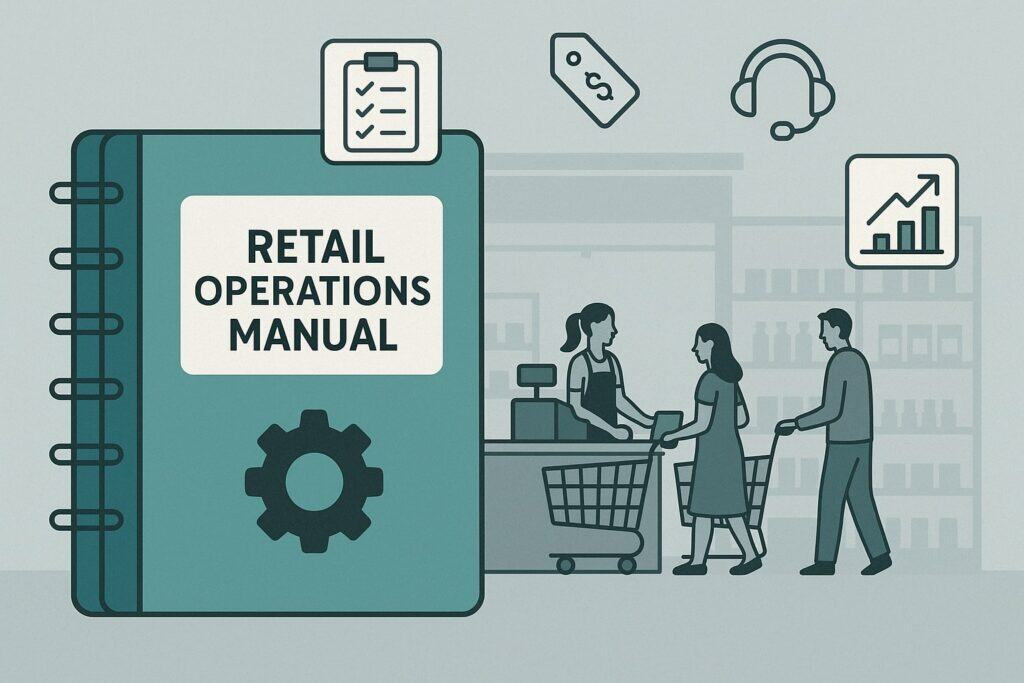
A retail operations manual is a structured collection of standard operating procedures (SOPs), checklists, policies, and guidelines that explain exactly how your store should operate.
It covers daily routines like opening and closing, customer service, inventory control, cash handling, safety, and security. In many ways, it’s the “playbook” that translates your strategy, brand standards, and values into day-to-day actions.
Modern retail SOP guides emphasize that written procedures help standardize tasks, improve compliance, reduce errors, and maintain a predictable customer experience across locations.
For example, clearly defined SOPs describe who does what, when tasks are done, and how to respond to exceptions such as stockouts or customer complaints. When those SOPs are compiled into a retail operations manual, your managers and associates no longer rely on memory, guesswork, or inconsistent “tribal knowledge.”
A strong retail operations manual also speeds up onboarding. New hires have a central source of truth instead of learning everything verbally. That improves productivity and reduces costly mistakes during the first weeks on the job.
For multi-store operators, the retail operations manual is essential to brand consistency. It ensures that a customer receives similar service, store standards, and merchandising from one branch to another, regardless of which manager is on duty.
Looking ahead, the retail operations manual is shifting from a static binder to a dynamic, digital system with interactive checklists, embedded media, and data-driven updates.
Retailers that treat the manual as a living document—reviewed regularly and connected to store technology—will be better positioned to adapt to new retail trends, regulations, and customer expectations.
Laying the Foundation: Define Scope, Goals, and Store Profile

Before you write your first page of the retail operations manual, you need a clear foundation. Start by defining the scope: which stores, departments, and processes will this manual cover? A single location may need one comprehensive document.
A chain may need a master manual with store-type variations for convenience stores, specialty boutiques, or big-box formats.
Clarify your goals. Ask what you want this retail operations manual to achieve in practical terms. Common goals include faster onboarding, fewer operational errors, improved customer satisfaction, and greater consistency in merchandising and store standards.
Tie these goals to measurable outcomes like reduced shrink, higher mystery-shop scores, or improved labor productivity. This helps you later justify the time and investment in building and maintaining the manual.
Next, document your store profile. Capture your typical operating hours, peak traffic times, product categories, staffing model, and service expectations. These details shape your procedures.
For instance, a high-volume convenience store will emphasize queue management and cash security, while a specialty fashion retailer will emphasize fitting-room etiquette and styling consultations. Your retail operations manual should reflect your actual operational reality, not a generic template.
Finally, decide who owns the manual. Identify a project lead (often operations, HR, or a senior store manager) plus key subject matter experts—such as loss prevention, merchandising, and store support. This cross-functional team will ensure the retail operations manual is accurate, realistic, and aligned with your brand and compliance requirements.
Clarify Vision, Brand Standards, and Customer Experience

Every retail operations manual should begin with your brand vision and customer experience promise. This translates your mission statement into concrete behaviors for front-line staff.
Describe how you want customers to feel when they enter, shop, and leave your store: welcomed, informed, confident, and eager to return. Then connect this to specific standards for greeting customers, offering assistance, handling complaints, and closing interactions.
Include brand standards such as tone of voice, dress code, body language, and merchandising principles. For example, your retail operations manual might state that associates greet customers within 30 seconds, maintain open body posture, and use specific phrases that align with your brand personality.
Visual standards can include examples of acceptable and unacceptable displays, signage placement, and cleanliness criteria.
Link the customer experience to operational routines. Explain how opening checklists ensure the store is “customer-ready” from the first minute of trading: lights set correctly, music at proper volume, clean floors, stocked shelves, accurate pricing, and functioning POS systems.
Many modern retail SOP guides emphasize that operational checklists are critical to achieving consistent store standards. When your retail operations manual ties these tasks back to your customer promise, employees understand the “why,” not just the “what.”
As you update your retail operations manual over time, ensure that any change in brand positioning or customer expectations (such as new omnichannel services, loyalty programs, or sustainability commitments) is reflected in both your vision section and your detailed procedures.
Map Retail Processes and Risk Areas
Before you write detailed SOPs, map the key processes that your retail operations manual must cover. Create a high-level process map from the moment the store prepares to open through closing and post-closing admin.
Include supplier deliveries, stockroom operations, merchandising resets, promotions, customer interactions, returns, and digital or omnichannel processes such as BOPIS (buy online, pick up in store).
Process mapping helps you identify risk areas where mistakes are common, costly, or risky to customers and employees. For example, receiving and inventory processes carry shrink and compliance risks, while cash handling and refund procedures carry fraud and financial risks.
Safety-critical processes such as emergency evacuation and incident reporting require especially clear and compliant steps.
Use tools like swimlane diagrams, flowcharts, and RACI matrices (responsible, accountable, consulted, informed) to clarify roles in each process. Many operations-manual frameworks recommend defining responsibilities, scope, and related documents for each SOP section.
Once you map the processes, you can prioritize which parts of the retail operations manual to write first based on risk and impact.
By mapping processes up front, you also future-proof your retail operations manual. When you add new services—like self-checkout, curbside pickup, or appointment-based selling—you can quickly see where those processes plug into existing workflows and what new SOPs and checklists you need.
Core Components of a Retail Operations Manual
While no two retailers are identical, most retail operations manuals share a set of core sections. These are the areas that drive day-to-day efficiency, safety, and customer satisfaction. By structuring your manual around proven components, you make it easier for managers and associates to find what they need and for leadership to review and update content.
At minimum, your retail operations manual should include: store opening and closing procedures; cash handling and POS operations; inventory management and stockroom operations; merchandising and visual standards; customer service and selling behaviors; omnichannel and digital services; safety, security, and incident response; HR and people processes; and compliance and audit guidelines. Modern SOP checklists and templates for retail tend to focus on these same domains.
Organize each section in a consistent way. Start with a brief purpose statement, then define scope, responsibilities, step-by-step procedures, required tools or forms, safety notes, exception handling, and references to related policies. This structure helps your retail operations manual feel predictable, making it easier for associates to learn and refer back to.
Over time, you can add specialized sections for unique aspects of your business, such as food safety, in-store services (repairs, alterations, appointments), or special seasonal operations like holiday pop-ups and promotional events.
Store Opening and Closing Procedures
Opening and closing procedures are among the most frequently used sections of any retail operations manual. They ensure your store starts the day ready for customers and ends the day secure, reconciled, and compliant.
Clear, checklist-based SOPs reduce the risk of missed tasks, security breaches, or rushed store setups that harm the customer experience.
Your opening SOP should cover disarming alarm systems, unlocking doors with proper dual-control procedures if required, switching on lights, HVAC, and equipment, checking POS systems, and verifying that the store is clean, stocked, and visually aligned with planograms and promotional calendars.
Retail checklists often emphasize reviewing signage, price labels, window displays, and safety equipment at the start of the day. Include time estimates so managers can schedule openers appropriately.
Closing procedures in the retail operations manual should be just as detailed. Outline steps for stopping customer entry at a set time, securing merchandise (especially high-value items), reconciling cash drawers, closing out POS batches, generating required reports, backing up data if not automated, cleaning, and resetting the store for the next day.
Security steps such as final walkthroughs, checking exits, confirming safe and cash drops, and arming alarms should be documented with clear responsibilities and sign-offs.
As retail technology evolves, integrate new tools into these opening and closing SOPs. For example, include steps for updating digital signage, checking self-checkout terminals, verifying mobile POS devices, or synchronizing online order queues.
In the future, expect more automated checks and IoT-based alerts to be built into your retail operations manual as standard practice.
Cash Handling, POS, and Financial Controls
Cash handling and POS operations are high-risk areas, so your retail operations manual must provide precise and non-negotiable procedures.
These SOPs protect your revenue, reduce shrink, and support accurate financial reporting. Modern retail SOP frameworks highlight cash handling and credit card security as critical domains for detailed guidance.
Your manual should describe how to set up cash drawers at opening, including float amounts, denomination mix, and required documentation. Define who is authorized to handle cash, perform refunds, accept checks or alternative payments, and access the safe.
Include step-by-step instructions for processing sales, discounts, promos, gift cards, and loyalty redemptions in your POS system, with screenshots or callouts if possible.
Document procedures for managing cash throughout the day: mid-shift cash counts, cash drops to the safe, handling large bills, and managing overages or shortages.
Your retail operations manual should spell out how often reconciliations occur, who verifies them, and how discrepancies are escalated and investigated. For card transactions, include compliance practices related to data security and fraud prevention.
End-of-day financial SOPs should cover closing each register, reconciling cash totals with POS reports, preparing bank deposits, handling store credit or vouchers, and transmitting sales data to headquarters or accounting systems.
As payment technology evolves—mobile wallets, tap-to-pay, buy now pay later (BNPL)—update your retail operations manual so associates know exactly how to process, verify, and troubleshoot each method.
In the future, expect more automation and AI-driven fraud detection, but a clear manual will still be essential for exceptions and escalations.
Inventory, Merchandising, and Visual Standards
Inventory management and merchandising are where your retail operations manual directly affects sales and customer satisfaction. Poorly managed stock leads to empty shelves, overstocks, and lost revenue.
Weak visual standards create confusing, unappealing shopping environments. A strong manual provides SOPs and checklists that keep both inventory and displays under control.
In the inventory section, document how to receive goods, verify quantities and conditions, manage discrepancies, and record data in your inventory system. Retail SOP guides stress that receiving and stockroom procedures must prevent shrink, mis-locations, and safety hazards.
Include guidelines for labeling, shelf allocation, back-stock organization, cycle counting, and managing returns to vendors or damaged goods.
Merchandising SOPs in your retail operations manual should define how planograms are implemented, how often displays are refreshed, and how seasonal or promotional changes are executed.
Explain the hierarchy of displays (feature tables, endcaps, wall bays), how to maintain brand consistency across stores, and how to ensure pricing and signage accuracy. Include visual examples or links to image libraries so managers can see what “good” looks like.
Your manual should also describe how inventory data drives decisions, such as replenishment levels, markdown schedules, and space allocation.
As AI-driven demand forecasting and computer vision become more common, future versions of your retail operations manual may include guidelines for using these tools, interpreting their outputs, and responding to alerts about low stock, out-of-stocks, or visual merchandising issues.
Customer Service, Sales, and Loyalty Programs
Customer service and selling behaviors are the heart of your brand, so your retail operations manual must give associates clear, practical guidance on how to interact with shoppers. Start by defining your service model—high-touch, self-service with support, or a hybrid—and how it should play out in different areas of the store.
Document greeting protocols, engagement techniques, needs-analysis questions, product knowledge expectations, and upselling or cross-selling guidelines.
Many retailers use simple frameworks like “GREET, DISCOVER, RECOMMEND, CLOSE, THANK” and describe each step in detail. Your retail operations manual can turn these frameworks into scripts, examples, and do’s and don’ts, while encouraging associates to remain authentic.
Include SOPs for handling price questions, complaints, returns, exchanges, and warranty issues. Make sure the manual aligns with your official policies on refunds, store credit, and exception approvals.
Cover digital interactions too, such as assisting customers with your website or app, helping them check online inventory, or placing ship-to-home orders from the store.
Loyalty programs deserve their own section in the retail operations manual. Explain how customers enroll, what benefits they receive, how points or rewards are earned and redeemed, and how associates should promote the program at checkout or during service interactions.
As personalization, CRM, and omnichannel data become more central to retail, future versions of your manual may include guidelines for using customer profiles, preferences, and purchase history to deliver more tailored recommendations without crossing privacy lines.
Safety, Security, and Compliance
Safety, security, and compliance form one of the most critical sections in any retail operations manual. This part protects employees, customers, and your business from accidents, incidents, and legal or regulatory penalties. Retail SOP checklists commonly include safety inspections, emergency equipment checks, and incident reporting processes.
Your manual should outline general safety practices such as lifting techniques, handling sharp objects or cleaning chemicals, and keeping aisles clear. Include store-specific risks, such as refrigeration equipment, escalators, or heavy fixtures.
Document procedures for reporting and responding to accidents, near-misses, and unsafe conditions, along with required forms and escalation paths.
Security SOPs should cover shoplifting prevention, internal theft controls, CCTV usage, secure storage of high-value items, key and access control, alarm procedures, and incident management with law enforcement or security providers.
In the retail operations manual, be precise about who does what during a suspected theft or aggressive customer incident, focusing on safety first.
Compliance includes labor law adherence, privacy and data protection, product safety standards, age-restricted sales, and any industry-specific regulations. Your retail operations manual should reference your official policies and training requirements, while explaining how associates implement them day-to-day.
As regulations evolve—such as data protection rules or new labor standards—you must update this section promptly and communicate those updates to all locations.
Step-by-Step Process to Create Your Retail Operations Manual
Creating a retail operations manual can feel overwhelming, but a structured process makes it manageable. Rather than trying to document everything at once, you can follow a logical sequence that starts with planning, moves into drafting, and ends with testing and implementation.
First, assemble your project team and define your scope, goals, and timeline. Next, audit your existing materials—training guides, checklists, policy documents, and memos—and decide what can be reused or updated.
Then map your core processes and prioritize which ones to document first based on risk and frequency. Many operations-manual frameworks recommend starting with daily tasks and high-risk areas like cash handling and safety.
As you draft content, focus on clarity, consistency, and real-world practicality. Use a simple, direct writing style with short paragraphs and bulleted lists where appropriate. The retail operations manual should be easy to read on both paper and screens.
After drafting, review content with managers and front-line staff, pilot it in one or two stores, gather feedback, and refine before rolling it out widely.
Once approved, create a versioning and update schedule. Treat the retail operations manual as a living document, not a one-time project. Set expectations that procedures will evolve as your business, technology, and customer expectations change.
Choose the Right Format and Tools
Format matters. The tools you use to create and deliver your retail operations manual directly affect whether it gets read and used. Historically, manuals lived in binders or PDF files. Today, best-in-class retailers are shifting to digital platforms with searchable content, mobile access, interactive checklists, and embedded media.
Decide whether your manual will be primarily digital, printed, or a hybrid. A digital-first approach enables faster updates, search functionality, links between procedures, and multimedia such as short training videos and images.
It also integrates well with store apps and task management tools. Paper copies may still be useful at certain workstations or for compliance audits, but they should reflect the latest version controlled centrally.
Choose a tool that supports structured content. That may be an operations-manual platform, a knowledge-base system, a learning management system (LMS), or a collaboration tool with strong document and permission controls.
Your retail operations manual needs clear navigation, role-based access (for example, managers vs. associates), and the ability to track who has acknowledged or completed required reading.
When planning future updates, consider how emerging tools like AI assistants, chatbots, and voice search can make the retail operations manual even more accessible.
For example, staff might eventually ask a voice-enabled device, “What’s the procedure for handling online returns?” and receive a step-by-step answer pulled directly from your manual.
Document Procedures with Checklists, Flowcharts, and SOPs
The heart of your retail operations manual is its detailed procedures. To make them usable, turn each critical process into a clear standard operating procedure supported by checklists and visuals.
SOP frameworks for retail recommend including elements like purpose, scope, responsibilities, definitions, step-by-step instructions, safety warnings, quality standards, and references.
Write procedures in the order tasks are actually performed. Use numbered steps, action verbs (“Check,” “Scan,” “Verify,” “Log”), and if-then notes for common exceptions.
For complex processes, include flowcharts or decision trees that show how to handle variations, such as different types of returns or multiple payment methods. For repetitive daily tasks like opening checks or floor walks, convert procedures into checklists that associates or managers can complete and log.
Your retail operations manual should also standardize forms and templates. This includes incident reports, maintenance logs, cycle-count sheets, promotional execution checklists, and audit forms.
Link or embed templates directly in the appropriate SOP sections. Over time, you may digitize these forms into mobile apps so staff can complete them on phones or tablets, with data feeding into dashboards for regional or corporate teams.
Aim to keep each procedure concise but complete. If a section becomes too long, break it into smaller SOPs and link them. That way, associates can quickly find exactly the piece of the retail operations manual that they need at the moment of use.
Review, Test, and Iterate with Your Store Team
No retail operations manual is perfect on the first draft. The most effective manuals are co-created and refined with input from the people who actually run the store. After drafting each major section, share it with a pilot group of managers and associates.
Ask them to walk through the procedures while doing their jobs and note any confusion, missing steps, or impractical instructions.
Encourage honest feedback: if a procedure in the retail operations manual sounds good on paper but slows down the checkout line or complicates receiving, you need to adjust it.
During this testing phase, watch for opportunities to simplify steps, clarify responsibilities, or add visual aids. Many SOP creation guides recommend a cycle of drafting, peer review, testing, revising, and formal approval before full rollout.
Once your pilot stores sign off, finalize the content, assign version numbers, and roll out the manual across all locations with a supportive training plan. Continue gathering feedback through periodic surveys, audits, and manager meetings.
As your retail operations manual matures, build a formal change-request process so staff can propose improvements and operations leaders can evaluate and implement changes in a structured way.
Implementing Your Retail Operations Manual in Daily Store Life
A retail operations manual only adds value if it is used every day. Implementation is about embedding the manual into the rhythms of the store, not just posting a link or dropping off a binder.
Start by positioning the manual as the single source of truth for store operations. Leaders should model this behavior by referencing it in meetings, training, and daily decision-making.
Integrate the retail operations manual into daily and weekly routines. For example, managers can conduct morning huddles that reference specific SOPs for upcoming promotions or safety reminders.
Weekly walk-throughs and checklists can be tied directly back to procedures in the manual. When new scenarios arise, managers should document the agreed-upon approach and then update or add the relevant SOP.
Use the manual to support coaching and performance management. When an associate struggles with a process, direct them to the relevant section of the retail operations manual, review it together, and practice the steps.
This reinforces that performance expectations are grounded in clear, accessible documentation rather than informal preferences that vary by manager.
As you implement, track usage where possible. Digital platforms may provide analytics on which pages are viewed, which checklists are completed, and where staff spend the most time. These insights help you improve both the content and the way you surface key sections in the store environment.
Training, Onboarding, and Micro-Learning
Training and onboarding are prime opportunities to embed the retail operations manual into your culture. Instead of treating the manual as a static reference, build it into structured learning experiences for new hires and ongoing development for existing staff.
For onboarding, design a curriculum that walks new associates through the most important sections of the retail operations manual they’ll use in their role. Combine self-guided reading with instructor-led sessions and on-the-floor practice.
For example, a cashier training path might include the POS operations, cash handling, customer service, and refund procedures from the manual, paired with supervised practice shifts.
Micro-learning—short, focused training sessions—is especially effective in retail environments. Convert parts of the retail operations manual into quick modules: one SOP per five-minute lesson, a short quiz, or a short demonstration video.
Modern retail SOP platforms and training tools are increasingly integrating micro-learning and performance support into digital manuals and checklists.
For existing staff, use the retail operations manual as the basis for refresher training, cross-training into new roles, and preparation for promotions to key-holder or management positions.
When you update the manual, accompany changes with targeted training so employees understand what is new, why it matters, and how to apply it on the sales floor or in the stockroom.
Keeping the Manual Accessible and Actionable
Accessibility is a major success factor for any retail operations manual. If associates can’t quickly find the procedure they need while on the job, they will revert to memory or improvisation. To avoid this, design your manual with ease-of-access as a core requirement.
Use clear navigation, search, and labeling. Group SOPs by function—store operations, customer service, inventory, safety—and use intuitive titles. In a digital manual, add tags, keywords, and cross-links so similar procedures are easy to locate. For printed manuals, provide a detailed index and clear section dividers.
Make sure the retail operations manual is accessible on the devices employees already use, whether that’s shared tablets, kiosks in back-of-house areas, or handheld devices. For complex tasks like receiving or visual merchandising, consider placing QR codes near workstations that link directly to the relevant SOP section.
To keep the manual actionable, align it with your task management and audit processes. When managers assign tasks for a promotion setup, for example, link directly to the applicable merchandising SOP.
When auditors review store standards, reference the sections of the retail operations manual that define those standards. Over time, this integration will train employees to see the manual as a living, practical tool, not just a compliance document.
Measuring Impact and Updating Your Retail Operations Manual
Once your retail operations manual is in use, you should measure its impact on key performance indicators (KPIs). This helps you justify ongoing investment and identify areas for improvement. Start by defining metrics related to consistency, efficiency, and compliance.
These can include shrink rates, mystery-shop scores, safety incidents, training completion, audit results, and productivity measures like items per labor hour.
Connect these metrics to specific sections of the retail operations manual. For instance, improvements in inventory accuracy after implementing new receiving SOPs suggest that section is effective.
Increases in customer satisfaction scores following a refresh of service standards indicate your customer-experience procedures are working. Many retail checklist and operations-audit tools emphasize linking daily checklists and SOP compliance to store performance outcomes.
Use both quantitative and qualitative data. Combine KPI trends with feedback from store managers and associates about which parts of the manual are most helpful, confusing, or outdated.
This feedback loop ensures that the retail operations manual continues to reflect reality rather than becoming detached from the store’s day-to-day challenges.
Finally, make impact reporting part of your regular business rhythm. Review results in district or regional meetings, highlight success stories where strong SOP adherence improved performance, and recognize stores or teams that excel at using the manual.
KPIs, Store Audits, and Compliance Checks
KPIs, audits, and compliance checks are the primary mechanisms for validating that your retail operations manual is being followed. Start by linking each major section of the manual to specific audit items and performance measures.
For example, opening procedures can be checked via surprise visits or digital checklists; merchandising standards can be evaluated through photo audits; safety compliance can be verified via regular inspections.
Your retail operations manual should define the audit process. Describe who conducts audits, how often they occur, what tools they use (digital forms, mobile apps), and how results are scored and reported.
Many retail operations checklist tools provide templates for such audits, covering cleanliness, visual merchandising, customer service, and safety protocols. Reference these audits directly in the manual and make clear that they reflect the standards laid out in your SOPs.
Compliance checks should also extend to training and acknowledgment of the manual itself. Track which employees have completed training or signed off on new or updated SOPs. If non-compliance issues arise, use the retail operations manual as the first reference point when coaching or taking corrective action.
Over time, audit and compliance data can highlight which parts of the retail operations manual need clarification, simplification, or additional training. Use these insights to prioritize updates and ensure that the manual evolves with your business and regulatory environment.
Continuous Improvement and Version Control
A retail operations manual is never “done.” Continuous improvement is essential to keep your procedures relevant and effective. Establish a formal governance process for reviewing, updating, and approving changes.
Assign an owner or committee responsible for operations documentation, with clear roles for subject matter experts, store representatives, and leadership.
Implement a version-control system so every change to the retail operations manual is tracked with dates, authors, and a summary of what changed. This is especially important for safety, security, and compliance-related procedures. Digital platforms make version control easier by providing change logs and automated notifications.
Encourage a culture where front-line staff feel comfortable proposing improvements. Provide channels—such as feedback forms, surveys, or dedicated email addresses—where associates and managers can submit suggestions when they encounter friction, ambiguity, or new opportunities. Regularly review these suggestions and incorporate the best ones into the retail operations manual.
From a future-oriented perspective, expect continuous improvement to become more data-driven. As AI and analytics tools monitor store operations, they may identify patterns of errors or inefficiency and suggest specific SOP changes.
Your manual will increasingly be updated based not just on anecdotal feedback but also on real-time performance insights.
Future of the Retail Operations Manual: AI, Omnichannel, and Automation
The retail operations manual is evolving rapidly in response to technological change and shifting consumer behavior. What used to be a static document is becoming a dynamic, integrated part of the store’s digital ecosystem.
Retail SOP experts are already emphasizing digital execution, real-time tracking, and multi-channel consistency as the new standard.
AI will play a growing role. Intelligent assistants can help employees find the right procedure instantly, answer how-to questions in plain language, and even recommend corrective actions based on live data.
For example, if shrink trends suggest a problem at a certain time of day, AI could flag the relevant sections of the retail operations manual and prompt managers to review cash handling or loss-prevention SOPs with their teams.
Omnichannel operations are also reshaping manuals. Your retail operations manual must cover processes for click-and-collect, ship-from-store, returns of online purchases, digital payments, and unified loyalty programs.
Procedures will increasingly bridge physical and digital, ensuring that customers get a seamless experience regardless of channel.
Automation and IoT will further influence future manuals. As more tasks—like counting inventory, monitoring temperature, or tracking foot traffic—become automated, the retail operations manual will focus more on exception handling, oversight, and system management.
Associates will need clear SOPs for responding to automated alerts, maintaining equipment, and interpreting dashboards.
Finally, sustainability and social responsibility will likely become more prominent sections in future retail operations manuals. Procedures related to waste reduction, recycling, energy management, ethical sourcing communication, and community engagement will be integrated into daily store routines.
Digital SOP Platforms, Mobile Checklists, and Real-Time Data
Digital SOP platforms and mobile checklists are already transforming how retail operations manuals are created, delivered, and enforced. Many tools now offer built-in templates, task management, photo evidence capture, and analytics dashboards for store operations.
These platforms turn static procedures into interactive workflows. For example, instead of reading a long SOP for opening the store, an associate works through a guided checklist on a mobile device, marking tasks complete and attaching photos where necessary.
If an issue arises—like a broken fixture or missing signage—the system can automatically create a follow-up task or escalation.
Real-time data from these tools feeds back into your retail operations manual strategy. You can see which checklists often fail, where tasks are consistently overdue, or which stores excel at compliance. This information helps you refine SOPs and tailor training to specific needs.
As you design or update your retail operations manual, think in terms of digital execution from the start. Write procedures in a way that can be easily converted into step-by-step checklists or app-based workflows.
Structure content so that key steps, decision points, and required evidence are clearly defined. This will make it easier to leverage the next generation of retail operations platforms.
Adapting to Emerging Retail Trends and Customer Behavior
The retail landscape will keep changing, and your retail operations manual must change with it. Emerging trends like experiential retail, contactless service, same-day delivery, and personalized shopping journeys will require new SOPs and refinements of existing ones.
For example, experiential events in-store—workshops, demos, or community gatherings—will need procedures for setup, staffing, safety, crowd management, and follow-up.
Contactless service options may call for SOPs around mobile self-checkout, QR-code menus, or staff-assisted digital ordering. Same-day delivery from stores demands coordination between inventory accuracy, picking, packing, and last-mile partners.
Customer behavior is also shifting in expectations of transparency, sustainability, and social impact. Your retail operations manual can codify how associates communicate about product origins, materials, and brand values; how they handle questions about social or environmental commitments; and how the store implements practical steps like waste sorting, donation of unsold goods, or energy-saving practices.
By monitoring trends and adjusting your retail operations manual regularly, you ensure that your store operations remain relevant, resilient, and aligned with what customers care about now and in the future.
FAQs
Q.1: How long should a retail operations manual be?
Answer: There is no fixed length for a retail operations manual; it should be as long as necessary to cover your critical processes clearly but no longer than needed. A small single-store retailer might have a manual of 40–80 pages, while a multi-store chain may need several hundred pages plus appendices and digital resources.
Focus on clarity, organization, and usability rather than page count. It’s better to create a concise manual that employees actually use than an enormous document they never open. Over time, you can expand sections as your operations become more sophisticated.
Remember that a modern retail operations manual can be modular, with separate sections or “playbooks” for different roles, store formats, or departments, making it easier to navigate.
Q.2: Who should write the retail operations manual?
Answer: Ideally, the retail operations manual is created by a cross-functional team rather than a single person. Operations leaders typically drive the project, but they should collaborate closely with store managers, HR, loss prevention, merchandising, finance, and training teams.
Front-line associates should also provide input, because they know the realities of daily work and can spot impractical or unclear steps. In some cases, retailers work with external consultants or use templates and SOP frameworks as a starting point, then customize them heavily.
Regardless of who drafts the content, final approval should rest with leadership responsible for operations and compliance. That way, everyone trusts that the retail operations manual reflects official policy and expectations.
Q.3: How often should the retail operations manual be updated?
Answer: A retail operations manual should be treated as a living document, reviewed regularly and updated whenever processes, technology, or regulations change. At minimum, schedule a comprehensive review annually or semi-annually, but expect more frequent updates to individual sections.
For example, you might update promotional execution procedures each season, cash handling protocols when payment options change, or safety sections when new equipment is installed. Digital formats make updates easier; you can roll out new versions and require staff to acknowledge changes.
Ideally, you’ll also monitor feedback, audit results, and performance data to identify where the manual is outdated or unclear. The goal is to keep your retail operations manual always aligned with how you actually operate and what customers and regulators expect.
Q.4: Do small retailers really need a full retail operations manual?
Answer: Yes. Even small retailers benefit significantly from a retail operations manual, though it can be simpler than those used by large chains. Small businesses often rely heavily on a few experienced employees who hold key knowledge in their heads.
If those people are absent or leave, operations can quickly deteriorate. A basic manual that covers opening and closing, cash handling, customer service, inventory, and safety provides continuity and reduces dependence on individuals.
It also helps when you hire seasonal or part-time staff who need to become productive quickly. As your business grows, you can expand the manual into more detailed SOPs and checklists. Starting small now creates a foundation you can build on instead of scrambling to document everything later.
Q.5: Can I use templates to create a retail operations manual?
Answer: Templates can be very helpful when creating a retail operations manual, as long as you customize them thoroughly. Many SOP and operations-manual templates are available from software providers, consultants, and industry resources, covering areas such as daily store operations, inventory, and safety.
These templates provide structure, headings, and sometimes example procedures, saving you time and ensuring you don’t overlook major sections. However, every retail business is unique in layout, product mix, brand positioning, technology stack, and customer expectations.
You must adapt templates to reflect your actual processes, responsibilities, terminology, and policies. The best approach is to use templates as a starting framework, then involve your team in customizing and validating each SOP so the final retail operations manual truly fits your store.
Conclusion
Creating a retail operations manual is one of the most impactful investments you can make in your store’s long-term success. It turns scattered know-how into a structured, accessible playbook that guides daily operations, training, and decision-making.
By defining your scope and goals, mapping key processes, documenting clear SOPs, and choosing the right digital tools, you build a manual that supports consistent execution, protects against risk, and delivers a better customer experience.
Implementation and continuous improvement are just as important as initial creation. When you integrate the retail operations manual into training, daily routines, audits, and performance management, it becomes part of your culture rather than a forgotten document. Regular updates keep it aligned with evolving technology, regulations, and customer expectations.
Looking ahead, the retail operations manual will continue to evolve—becoming more digital, data-driven, and AI-assisted. Retailers who embrace this evolution and treat their manual as a living, strategic asset will be better equipped to navigate future challenges and opportunities.
Start building or upgrading your retail operations manual now, and you’ll lay a strong operational foundation for growth, resilience, and consistently excellent customer experiences.