Best Retail Customer Retention Strategies
Retention is where retail profit really lives. The best retail customer retention strategies turn casual shoppers into repeat buyers, brand advocates, and long-term sources of predictable revenue. When done right, retention drives higher lifetime value, smoother cash flow, and lower dependence on expensive acquisition channels.
Research consistently shows that acquiring a new customer can cost 5–7 times more than retaining an existing one. Even a small 5% increase in customer retention can boost profits by up to 75%, because loyal shoppers buy more often and are less price-sensitive.
In today’s retail landscape, customers move fluidly between stores, mobile, and online. They expect seamless journeys, personalized offers, easy returns, and honest communication. At the same time, loyalty is more fragile. Shoppers will switch brands for better value, better experiences, or values that align more closely with their own.
This guide walks through the best retail customer retention strategies you can implement now, based on the latest data and trends, plus where things are heading over the next five years.
Why Retail Customer Retention Matters More Than Ever

Customer retention has always been important, but several trends have pushed it to the top of the retail agenda. Rising acquisition costs, crowded digital channels, and increasingly fickle shoppers mean it is no longer sustainable to rely heavily on “new customer” growth alone.
The average customer retention rate across industries now sits around 75.5%, but retailers that push beyond this benchmark usually see outsized profitability and brand equity.
The best retail customer retention strategies go beyond generic discounts. They focus on lifetime value, relationship-building, and relevance.
Instead of asking “How do we get more people through the door?” leading retailers ask “How do we get the right people to come back more often, and spend more when they do?” This shift from volume to value changes how you design marketing, loyalty, merchandising, and service.
Post-pandemic, shoppers have become more digital, more informed, and more selective. They compare prices instantly, read reviews, and expect a brand to remember them across channels. Inflation and economic pressure have also made people more value-conscious.
They still want experiences and emotional connections, but they are less forgiving when brands waste their time, misuse their data, or deliver inconsistent service.
In this environment, the best retail customer retention strategies are data-driven, omnichannel, and powered by both technology and human service. They prioritize trust, transparency, and frictionless journeys while leveraging AI and analytics to deliver hyper-relevant content and offers.
Over the next few years, retailers that master retention will adapt more quickly to changing tastes, protect margins, and shield themselves from algorithm changes on social and search platforms.
The Economics of Retention vs Acquisition
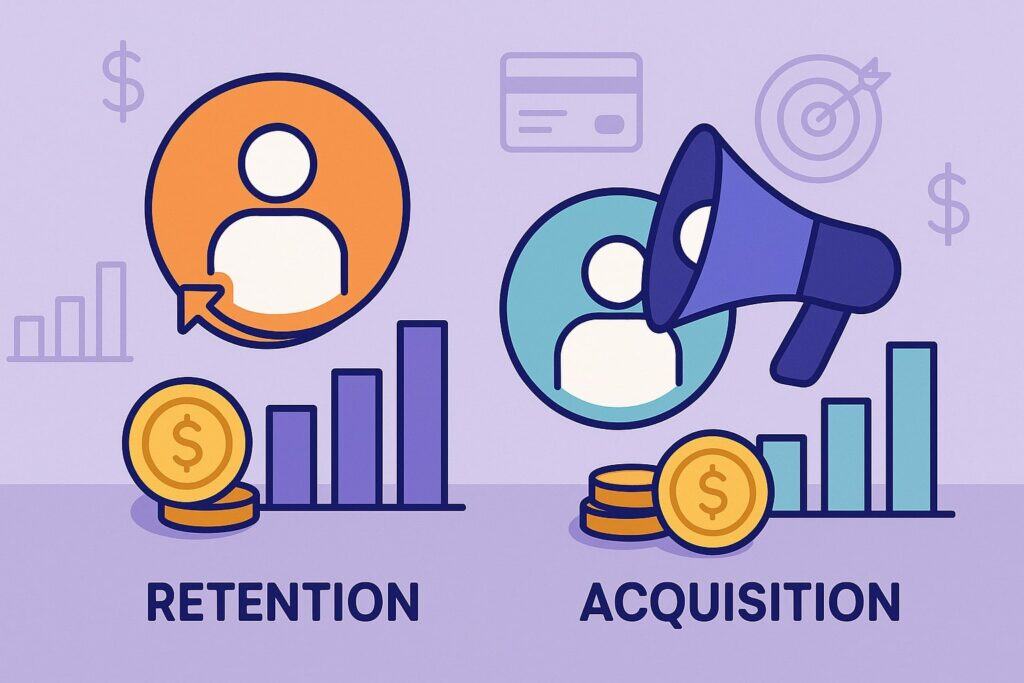
From a financial perspective, focusing on retention is one of the highest-ROI decisions retail leaders can make. Studies repeatedly show that most businesses still spend more on acquisition than on retention, even though the majority of revenue often comes from repeat customers.
In many cases, about 65% of business comes from existing customers, yet only 18% of companies say they prioritize retention over acquisition.
Think of each shopper as an annuity instead of a one-time transaction. A first purchase may barely break even after ad spend and discounts, but the second, third, and fourth purchases often carry much higher margins.
The best retail customer retention strategies aim to accelerate this journey. For example, by encouraging a second purchase within 30–60 days, you can lock in habit and increase the chance of long-term loyalty.
Retention also stabilizes revenue forecasting. When a large percentage of sales comes from known, repeat buyers, your demand planning, inventory, and staffing become more predictable.
This reduces markdowns and stockouts, which further improves customer satisfaction and profit. Over time, loyal customers also refer friends, leave positive reviews, and engage with your social content, which reduces acquisition costs indirectly.
Looking forward, as paid media becomes more expensive and privacy regulations limit third-party data, retailers will increasingly depend on first-party data gathered from existing customers.
That means the best retail customer retention strategies will double as your best data strategies, giving you the insight to design more efficient acquisition campaigns and more profitable product assortments.
How Changing Shopper Behavior Raises the Retention Bar

Today’s buyer journey is nonlinear. A shopper might discover your brand on TikTok, visit your website, check prices on a marketplace, and then buy in-store after talking to a sales associate.
If any step is frustrating—slow site, missing inventory, rude associate—they may never return. The best retail customer retention strategies therefore focus on consistency and convenience at every touchpoint.
Younger shoppers, especially Gen Z, are less brand-loyal but more experience-driven. They want authenticity, community, and value. They research obsessively, hunt for “dupes,” and are comfortable switching brands if they feel overcharged or misled.
At the same time, they enjoy curated in-store experiences and social shopping, contributing to a revival of physical retail spaces as social hubs rather than just transactional locations.
This combination raises the bar. To keep customers coming back, retailers must:
- Provide transparent pricing and clear return policies
- Honor promotions consistently across channels
- Make discovery fun and intuitive, both online and in-store
- Communicate in the customer’s preferred channel with relevant content
The best retail customer retention strategies acknowledge that loyalty is now earned in micro-moments: a fast answer from chat support, an accurate AI-powered recommendation, a friendly associate who remembers a shopper’s preferences, or a thoughtful post-purchase email.
Over the next decade, retailers that orchestrate these micro-moments with precision will outperform those that rely solely on big campaigns or generic promotions.
Know Your Customers Deeply with Data and Segmentation
You can’t retain who you don’t understand. At the core of the best retail customer retention strategies is a deep, accurate, and constantly updated understanding of your customers. This means bringing together data from POS systems, e-commerce platforms, mobile apps, email, and loyalty programs into a unified customer profile.
Many retailers still operate in silos: marketing has one view of the customer, store ops has another, and e-commerce has a third. This fragmentation leads to disjointed experiences—like sending an email promoting a product that’s out of stock in the shopper’s usual store, or offering a discount to a customer who just paid full price.
A unified data layer, often implemented via a customer data platform (CDP) or advanced CRM, is therefore a foundation for effective retention.
Once data is centralized, segmentation becomes powerful. Instead of blasting the same message to everyone, you can segment by behavior (frequency, recency, spend), preferences (categories, brands), lifecycle stage (new, active, lapsing, churned), and even channels (store-focused vs digital-first).
The best retail customer retention strategies use these segments to tailor communication, offers, and experiences that feel personally relevant.
Over the next few years, zero-party data—information customers proactively share about their preferences—will become increasingly important as privacy norms tighten.
Simple tools like preference centers, style quizzes, and post-purchase surveys help you collect this data ethically. Shoppers who feel in control of their data and see clear value in sharing it are more likely to stick with your brand.
Building a Unified Customer View
Building a single view of the customer may sound complex, but you can start with pragmatic steps. First, ensure that every key system—POS, e-commerce, email, SMS, loyalty, helpdesk—uses a common customer identifier. This avoids duplicate profiles and lets you map transactions and interactions back to real people.
Next, bring these data feeds into a central repository. For some retailers, this will be a full CDP; for others, it might be a well-designed data warehouse plus marketing tools that can read from it.
The goal is to create profiles that include demographics, purchase history, browsing behavior, engagement with campaigns, and support interactions. With this foundation, the best retail customer retention strategies become far easier to execute, because your teams are working from the same truth.
Then, define key lifecycle stages and triggers. For example:
- New customer: made first purchase in last 30 days
- Active loyal: 3+ purchases in last 6 months
- At-risk: no purchase in 90 days but historically frequent
- Churned: no purchase in 12 months
By mapping your customer base into these stages, you can design specific playbooks: welcome flows, activation campaigns, save-the-sale discounts, and win-back sequences. The best retail customer retention strategies treat these lifecycle stages as living segments that update daily, feeding into automated campaigns and personalized experiences.
Smart Segmentation for High-Value Shoppers
Not all customers contribute equally to your revenue. A small percentage—often 20%—may generate 60–80% of sales. That’s why the best retail customer retention strategies devote special attention to high-value shoppers while also nurturing the wider base.
Start by calculating metrics like Customer Lifetime Value (CLV), average order value, and purchase frequency. Identify your “VIP” and “champion” segments based on a mix of high spend, frequent purchases, and high engagement (e.g., opening emails, using the app, referring friends).
For these segments, you can create dedicated benefits: priority customer service, early access to drops, exclusive events, and personalized styling or product recommendations.
At the same time, use segmentation to discover potential “up-and-coming” loyalists—customers whose recent behavior suggests they’re warming up.
Maybe they’ve made two purchases in a short period or are heavily engaged with your content. Sending them a tailored thank-you note, a modest loyalty bonus, or a curated recommendation can push them into long-term loyalty.
Over time, as AI tools become more sophisticated, segmentation will become more predictive. Models will identify which customers are likely to churn, which are likely to respond to a promotion, and which might upgrade to a paid membership.
Integrating these predictions into your marketing and service workflows will be a hallmark of the best retail customer retention strategies in the next decade.
Personalization and AI: The New Engine of Retail Loyalty
Personalization has moved from “nice to have” to core expectation. Shoppers want product recommendations that make sense, offers that reflect their interests, and content that feels relevant to their life stage and lifestyle.
AI now makes this level of personalization scalable, and the best retail customer retention strategies are aggressively integrating AI to serve customers better.
AI-driven personalization is already showing strong returns. Leading retailers report 10–25% increases in return on ad spend and meaningful gains in revenue by using AI to tailor content, offers, and experiences for each shopper.
During peak seasons, AI-powered chatbots and recommendation engines are influencing a significant share of online orders and helping customers find the right products faster.
Over the next few years, AI will move deeper into store operations as well, powering intelligent kiosks, guided selling tools for associates, and dynamic in-store merchandising. The best retail customer retention strategies will blend these AI capabilities with human insight, creating experiences that are efficient yet still empathetic and human.
AI-Driven Recommendations and Dynamic Experiences
At the most basic level, AI helps retailers recommend the right products at the right time. Instead of static “bestsellers,” AI engines analyze browsing history, past purchases, price sensitivity, and even real-time signals like session behavior. They then surface items with the highest probability of interest or conversion.
For example, a shopper who frequently buys eco-friendly beauty products might see a curated “sustainable favorites” gallery on the homepage, targeted emails featuring refills, and in-app alerts about a recycling program.
Another shopper who regularly buys kids’ shoes might see personalized back-to-school bundles or reminders when popular sizes restock.
The best retail customer retention strategies take this further by personalizing:
- Search results and category sorting
- On-site content and banners
- Timing and channel of outreach (push vs email vs SMS)
- Promotions based on predicted sensitivity rather than blanket discounts
As AI models improve, they can also personalize post-purchase journeys—suggesting complementary products, care tips, or tutorials to help customers get more value from what they bought. This not only drives repeat purchases but also reduces returns and dissatisfaction.
Using Automation Without Losing the Human Touch
One risk of heavy automation is losing the warmth and authenticity that shoppers crave. The best retail customer retention strategies deliberately design AI systems to augment, not replace, human service and storytelling.
For instance, AI chatbots can handle routine questions—order status, return policies, basic product info—24/7, while routing complex issues to trained humans who can show empathy and judgment. Routing can use sentiment analysis to detect frustration and escalate early.
Similarly, AI can help store associates. Tablets or mobile apps can surface customer profiles, wish lists, and recommended products, empowering associates to have smarter, more personal conversations. Instead of pushing random items, they can say, “I see you usually buy this brand—would you like to try their new collection?”
To keep automation human-centered:
- Be transparent when customers are interacting with AI.
- Offer easy access to human help.
- Give customers control over frequency and channels of communication.
- Review AI outputs regularly to avoid biased or tone-deaf messages.
In the future, retailers that win loyalty will use AI to remove friction and add relevance while investing in people to deliver empathy and creativity. That balance will define the best retail customer retention strategies through 2030.
Omnichannel Experiences That Actually Feel Seamless
Modern shoppers don’t think in “channels”—they just think about your brand. They expect to start a journey in one place and finish it somewhere else without friction. The best retail customer retention strategies therefore prioritize omnichannel experiences where inventory, data, and communication are synchronized.
Omnichannel shoppers tend to be more valuable and more loyal. They often spend more per trip and shop more frequently because they can interact with the brand in whatever way is most convenient at the moment.
Leading retailers are building fully integrated experiences where stores, websites, apps, social commerce, and marketplaces all feel like one interconnected ecosystem.
This requires investment in unified inventory, order management, and customer data visibility. But once in place, it unlocks retention tactics that are hard for competitors to copy, such as “buy online, pick up in store,” seamless returns, and consistent loyalty recognition across all touchpoints.
Connecting Online, Mobile, and Store Journeys
The first step is mapping the customer journey across channels: discovery, research, purchase, post-purchase, and advocacy. Identify where customers are most likely to switch between channels and how you can make those transitions smoother.
For example, a customer might:
- See a product on social media
- Tap through to the website to explore details
- Save the item in the app wish list
- Visit the store to try it on
- Complete the purchase in-store with rewards applied
If each step uses different IDs and systems, this journey will feel broken—no saved items, no offer recognition, no continuity. The best retail customer retention strategies ensure that wish lists, carts, loyalty points, and order history are accessible across channels.
Retailers are increasingly using QR codes, mobile wallets, and app-based IDs so shoppers can identify themselves quickly in-store and online. Some are adding features like “store mode” in their apps to help customers navigate physical locations, see real-time inventory, and access personal offers while they shop.
These features deepen engagement and make the brand feel like a cohesive experience rather than separate platforms.
Click-and-Collect, Returns, and Post-Purchase Experience
Post-purchase experiences are where loyalty is either cemented or lost. The best retail customer retention strategies treat fulfillment, returns, and support as key loyalty moments, not just operational tasks.
Click-and-collect (BOPIS) and curbside pickup are now baseline expectations for many customers. Done well, they offer convenience and reduce shipping costs. Done poorly—long waits, lost orders, rude staff—they push customers to competitors. Invest in operational excellence and communication: clear pickup windows, easy instructions, and real-time updates.
Returns are another loyalty trigger. Generous and transparent return policies can actually increase retention because customers feel safer buying. Retailers using AI and analytics are beginning to predict which items are likely to be returned and proactively adjust recommendations or sizing advice to reduce disappointment and protect margins.
After purchase, keep adding value. Send setup guides, styling tips, or usage ideas. Ask for feedback and reviews. Invite customers to join your loyalty program or community if they haven’t already. Rather than immediately pushing another sale, focus first on helping them love what they just bought. Over time, this builds trust and makes them more receptive to future offers.
Modern Loyalty Programs That Go Beyond Points
Traditional points-for-purchases programs are no longer enough on their own. Shoppers are overloaded: the average person belongs to more than 15 loyalty programs, and engagement is declining as memberships rise. The best retail customer retention strategies now use loyalty as a strategic ecosystem, not just a discount mechanic.
Modern loyalty programs focus on value, relevance, and emotional connection. They reward not only purchases but also engagement—reviews, referrals, content creation, attendance at events, and sustainable behaviors like recycling or repairs.
Some retailers are experimenting with subscription or paid membership models that offer guaranteed benefits like free shipping, exclusive sales, or services, which deepen commitment and improve predictability of revenue.
To stand out, loyalty programs must be easy to understand and use. They should integrate seamlessly across channels, with clear earning and redemption paths. The best programs are “always-on” engines for retention, not just promo vehicles during sales events.
Tiered, Paid, and Value-Based Loyalty Models
Tiered loyalty programs create a sense of progression and status. As customers cross spending or engagement thresholds, they unlock better rewards—early access, special services, higher point multipliers. This structure encourages increased frequency and spend as people work toward the next tier.
Paid memberships take this a step further. By charging a fee, you signal that customers will receive meaningful, ongoing value—often through shipping benefits, services, or exclusive savings. Members tend to shop more often and across more categories, making these programs powerful components of the best retail customer retention strategies.
Value-based programs extend beyond money. Some customers care deeply about social impact or sustainability. You can let them direct a portion of their spend to charitable causes, plant trees, or support local initiatives.
Others might prefer experiential rewards like styling sessions, classes, or members-only events. These emotional and experiential benefits differentiate your brand and make loyalty sticky, even when competitors run aggressive discounts.
In the future, expect loyalty programs to become more modular and personalized. AI will tailor what “loyalty” looks like for each customer—more points for some, more experiences for others—based on observed behavior and stated preferences.
Gamification, Communities, and Exclusive Experiences
Gamification taps into people’s enjoyment of progress, challenge, and reward. Simple elements like badges, streaks, challenges, or surprise bonuses can make loyalty feel fun instead of transactional.
For example, you might create seasonal challenges (“buy from three different categories this month to unlock a mystery reward”) or micro-goals (“visit the store twice this quarter to earn bonus points”).
Communities are another powerful retention lever. The best retail customer retention strategies now include private groups, member-only forums, or social communities where shoppers share looks, tips, or product hacks. Retailers that cultivate these spaces gain user-generated content, peer recommendations, and valuable feedback.
Exclusive experiences—launch parties, preview nights, workshops, pop-up events—turn loyal customers into insiders. These experiences don’t always need to be expensive; they simply need to feel special and aligned with the brand. In a world where shoppers can buy almost anything online with a few taps, experiences become a key differentiator.
Over the next five years, expect more “phygital” loyalty moments that blend digital triggers with in-store experiences, like app challenges that unlock in-store surprises, AR try-ons that grant loyalty bonuses, or location-based quests in shopping districts.
Service, Store Experience, and Employee Empowerment
No matter how advanced your technology, customer-facing employees remain central to the best retail customer retention strategies. A single positive interaction with a knowledgeable, friendly associate can turn a one-time shopper into a loyal fan. Conversely, negative experiences with staff are among the fastest ways to lose customers.
Leading retailers therefore invest heavily in training, tools, and culture for frontline teams. They view associates as experienced designers and relationship-builders, not just transactional cashiers. AI and data can provide context, but people deliver empathy, creativity, and problem-solving in real time.
Store design and atmosphere also matter. Music, lighting, layout, and signage all contribute to how a shopper feels. With younger shoppers viewing malls and stores as social spaces, retailers have an opportunity to create environments that invite exploration, content creation, and social sharing.
Training Frontline Teams as Loyalty Builders
To turn associates into loyalty builders, give them:
- Training on product knowledge, empathy, and conflict resolution
- Tools like clienteling apps that show customer history, preferences, and wish lists
- Autonomy to make small gestures—like offering a one-time discount, free alteration, or small gift to resolve issues
Make sure everyone understands how their behavior ties into the best retail customer retention strategies. Share customer stories and testimonials in team meetings. Celebrate examples where employees went above and beyond to save a relationship or delight a customer.
In the future, frontline teams will work alongside AI copilots that suggest next-best actions, product recommendations, or talking points based on customer profiles.
Training will therefore shift toward using these tools effectively while keeping interactions human and genuine. Retailers that manage this transition thoughtfully will create in-store experiences that digital-only competitors struggle to match.
In-Store Experiences That Make Visits Memorable
In-store experiences should give customers a reason to visit beyond simply picking up products. This can include:
- Interactive displays and try-on experiences
- Services like repairs, alterations, or personal styling
- Events, workshops, or collaborations with creators and local partners
- Spaces for socializing, co-working, or content creation
Even small touches—complimentary refreshments, charging stations, or photo-worthy corners—can create memorable moments. Make sure that loyalty recognition is built into these experiences; members might get early access to events, priority booking for services, or exclusive product previews.
The best retail customer retention strategies treat stores as hubs for community, storytelling, and multi-channel engagement. Expect to see more stores acting as mini fulfillment centers, content studios, and event venues in the years ahead, blending commerce with culture and community.
Proactive Communication, Feedback Loops, and Win-Backs
Retention doesn’t just happen; it’s nurtured through ongoing communication and continuous improvement. The best retail customer retention strategies use proactive outreach, structured feedback loops, and targeted win-back campaigns to keep relationships healthy.
Proactive communication means anticipating needs and checking in before problems escalate. For example, sending reminders when consumable products are likely to run out, alerting customers about price drops on saved items, or notifying them about changes to store hours or policies.
Lifecycle marketing flows—welcome, onboarding, post-purchase, reactivation—ensure that customers never feel ignored.
Feedback loops are essential for understanding why customers stay, why they leave, and what they wish you’d do differently. Collect feedback across channels: in-store surveys, email NPS, app ratings, and social listening. But don’t just collect—respond. Let customers know what you changed because of their input.
Retention-Focused Marketing and Lifecycle Journeys
Traditional campaigns often chase short-term sales. Retention-focused marketing takes a longer view, designing journeys that guide customers from first awareness through advocacy. Key flows include:
- Welcome series: Introduce your brand story, values, and key products. Encourage account creation and loyalty sign-ups.
- Onboarding: Educate new customers on how to use products, care instructions, or fit guidance to reduce returns and disappointments.
- Nurture sequences: Share content that adds value—style guides, how-to videos, inspiration—rather than constant discounts.
- Replenishment and reminder flows: For products with natural repurchase cycles, gently remind customers at the right time.
- Reactivation: Reach out when customers go quiet with a compelling reason to return, like fresh arrivals, personalized picks, or a loyalty bonus.
These flows should be channel-agnostic: email, SMS, app push, and even direct mail can all play a role based on customer preferences. AI helps optimize timing and content, making journeys more relevant and increasing their contribution to the best retail customer retention strategies.
Handling Complaints, Churn Signals, and Win-Back Offers
Every complaint is a retention opportunity. When customers take the time to tell you something went wrong, they are giving you a chance to fix it. Train support teams to respond quickly, apologize sincerely, and offer fair resolutions. Track recurring issues and fix root causes, not just symptoms.
Use data to detect churn signals: declining purchase frequency, lower engagement, negative feedback, or rising return rates. When you see these patterns, intervene with personalized outreach—perhaps a check-in email from a store manager, a service call, or a tailored offer.
Win-back campaigns target customers who have already churned. These should be respectful and value-focused rather than pushy. Show them what’s new, highlight improvements, and consider offering a one-time incentive.
The best retail customer retention strategies treat win-back as an ongoing program, not a one-off blast, constantly testing messages, incentives, and timing for different segments.
Over time, as AI models improve, they will become better at predicting who can be profitably won back and who is unlikely to return. This will help retailers allocate retention budgets more efficiently.
Measuring and Optimizing Retail Customer Retention
You can’t manage what you don’t measure. The best retail customer retention strategies rely on clear metrics, dashboards, and experimentation frameworks. Instead of treating retention as a vague goal, leading retailers track it as rigorously as acquisition, with targets, owners, and regular reviews.
Key retention metrics include:
- Repeat purchase rate
- Customer retention rate over different time windows
- Churn rate
- Customer lifetime value (CLV)
- Average order value (AOV)
- Purchase frequency
- Net Promoter Score (NPS) and other satisfaction metrics
Benchmark your performance against yourself first. Then, use industry benchmarks as a reference, understanding that product categories and price points will influence what “good” looks like.
Key Metrics, Benchmarks, and Dashboards
Build dashboards that show retention metrics at multiple levels: overall, by segment, by channel, and by cohort (e.g., customers acquired in a specific month or from a specific campaign). Cohort analysis is particularly useful for seeing how retention changes after you implement new initiatives, like launching a loyalty program or improving your returns process.
Monitor not just whether customers come back, but how they come back. Are loyal customers shifting from in-store to online, or vice versa? Are they buying more categories over time? Are discounts becoming a larger share of their purchase behavior?
These insights help you refine pricing, promotions, and assortment as part of the best retail customer retention strategies.
Integrate qualitative feedback into your dashboards as well. For example, track themes from reviews and NPS surveys over time. If negative mentions about shipping or staff behavior spike, you can address those issues before they erode loyalty.
Experimentation, A/B Testing, and Continuous Improvement
Retention is not a “set it and forget it” game. Consumer expectations and competitive landscapes are constantly shifting, so the best retail customer retention strategies treat everything as a test.
Use A/B testing to experiment with:
- Subject lines, send times, and channels
- Loyalty earning and redemption rules
- Onboarding and reactivation flows
- Content types—educational vs promotional vs inspirational
- In-store experiences, signage, and service scripts
Make sure tests are well-designed, with clear hypotheses and success metrics. Use holdout groups when possible to measure the true incremental lift of your retention tactics. Over time, this culture of experimentation will compound, revealing what works for your unique customer base.
Looking ahead, AI will increasingly automate test design and analysis, suggesting new experiments and adjusting experiences in near real-time. Retailers that embrace this data-driven approach will be able to adapt quickly to new trends and maintain strong retention even as consumer behavior evolves.
The Future of Retail Customer Retention: 2025–2030 Predictions
The next five years will be transformative for retail loyalty. AI, privacy shifts, rising customer expectations, and economic uncertainty will reshape what “good” looks like. The best retail customer retention strategies of the future will be:
- Hyper-personalized: AI will tailor not only offers but also experiences, content, and timing at an individual level. Retailers will move from broad segments to “segments of one” for many interactions.
- Privacy-respectful and value-driven: As third-party cookies disappear and regulations tighten, customers will share data only when they see clear, immediate value. Zero-party data and transparent practices will be central to retention.
- Omnichannel by default: The line between digital and physical will blur further, with unified inventories, shared loyalty currencies, and experiences that travel with the customer across devices and locations.
- Experience-led: Stores will act as community hubs, content studios, and event spaces. Loyalty will increasingly be earned through shared experiences and values rather than discounts alone.
- AI-augmented yet human-centered: AI agents will handle routine tasks and provide insights, while humans focus on complex service and relationship-building. Retailers that maintain a human heartbeat in their brand will stand out.
Retailers who treat retention as a strategic pillar—supported by technology, culture, and process—will be best positioned to thrive. Those who cling to one-off promotions and shallow loyalty programs will find it increasingly hard to keep customers from drifting away.
FAQs
Q1. What is a good customer retention rate for retailers?
Answer: A “good” retention rate varies by category, price point, and business model, but recent data puts the average customer retention rate across industries at about 75.5%. Retailers selling frequently purchased items (like beauty or grocery) should target higher rates than retailers selling infrequent big-ticket items.
Instead of chasing a single magic number, track your retention by cohort and segment. Ask questions like: Are customers acquired through social ads more likely to churn than those acquired in-store? Do loyalty members retain at significantly higher rates than non-members? The best retail customer retention strategies focus on continuous improvement rather than hitting a generic benchmark.
Q2. How often should retailers communicate with customers without causing fatigue?
Answer: There’s no universal rule, but relevance matters more than raw frequency. A brand sending three highly relevant messages per week may see better engagement than a brand sending one generic blast. Use behavioral signals—opens, clicks, unsubscribes—to calibrate. Give customers control via preference centers where they can choose topics and frequencies.
The best retail customer retention strategies segment communication cadences. High-engagement customers may welcome frequent updates, while low-engagement customers might benefit from a slower, more curated approach. Use AI to help optimize send times and content for each individual when possible.
Q3. Are discounts necessary for effective customer retention?
Answer: Discounts can play a role, especially in competitive categories, but they shouldn’t be your primary retention lever. Over-reliance on discounts trains customers to wait for sales and erodes margins.
Modern loyalty and retention strategies blend financial incentives with experiential and emotional value: early access, exclusive products, community experiences, and exceptional service.
The best retail customer retention strategies use targeted, data-driven discounts only when they drive incremental behavior—such as reactivating lapsing customers or nudging first-time buyers to make a second purchase—rather than blanket promotions.
Q4. How can small retailers implement advanced retention strategies without huge budgets?
Answer: You don’t need enterprise-level tools to adopt the best retail customer retention strategies. Start small and scrappy:
- Collect emails and phone numbers at checkout with clear permission.
- Use affordable email/SMS tools to set up basic welcome, post-purchase, and reactivation flows.
- Track simple metrics like repeat purchase rate and average days between purchases.
- Offer a straightforward punch-card or digital loyalty program.
- Train staff to greet regulars by name and remember preferences.
As you grow, you can gradually add more sophisticated tools like CDPs, AI-based recommendation engines, and integrated POS/e-commerce platforms. The key is to think retention-first from day one.
Q5. How will AI change customer retention in the next five years?
Answer: AI will increasingly sit at the center of the best retail customer retention strategies. It will:
- Analyze massive datasets in real time to predict churn, recommend next-best actions, and personalize experiences.
- Power conversational agents that handle routine support, freeing humans for high-impact interactions.
- Help optimize inventory and pricing to reduce stockouts and overstocks that frustrate customers.
However, AI will not replace the need for human judgment, creativity, and empathy. The most successful retailers will use AI as a copilot—enhancing their ability to understand and serve customers while keeping relationships warm, ethical, and trustworthy.
Conclusion
The best retail customer retention strategies are no longer just about points, punch cards, or occasional coupons. They form an integrated system that spans data, personalization, omnichannel experiences, loyalty design, service, and measurement.
Retailers that win on retention:
- Know their customers deeply, using unified data and smart segmentation.
- Deliver consistently excellent experiences across online, mobile, and store.
- Use AI and automation thoughtfully to personalize at scale without losing humanity.
- Build modern loyalty ecosystems that reward purchases, engagement, and shared values.
- Continuously measure and improve, treating retention as a core performance metric.
As acquisition costs rise and competition intensifies, retention becomes your most reliable growth engine.
By embracing the best retail customer retention strategies now—and evolving them with new technologies and customer expectations—you can transform casual shoppers into loyal fans who choose your brand again and again, even in a world full of alternatives.