
Executive’s Guide to Generative AI in Merchandising
Merchandising has always been a blend of art, timing, customer insight, and operational discipline. What has changed is the speed at which leaders now need to make decisions.
Consumer demand shifts faster, product catalogs grow larger, margins face more pressure, and teams are expected to personalize experiences across every channel without slowing the business down.
That is why generative AI in merchandising has moved from an interesting innovation to a serious leadership priority. It is not just about creating copy faster or automating routine tasks. It is about improving the quality of merchandising decisions, increasing organizational responsiveness, and helping teams turn data into action at scale.
For executives, the real opportunity is strategic. Generative AI can support better assortment planning, richer product storytelling, stronger personalization, faster campaign execution, sharper pricing decisions, and more adaptive inventory management. It can help merchandising teams work with greater confidence while freeing human expertise for higher-value judgment.
At the same time, adoption needs to be disciplined. Not every use case deserves immediate investment, and not every platform will fit your operating model. The strongest outcomes come from leaders who connect AI initiatives to commercial priorities, governance standards, and measurable business impact.
This guide explains what generative AI means in a merchandising context, where it creates value, what risks deserve executive attention, and how to build a practical roadmap that moves from experimentation to enterprise advantage.
What Generative AI Means in a Merchandising Context
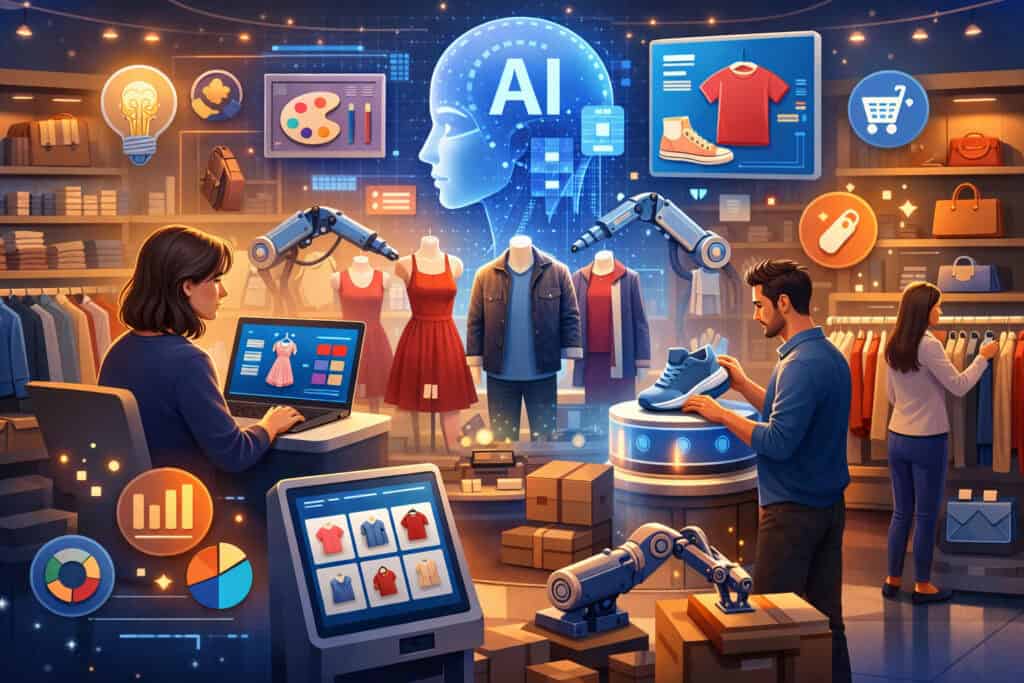
Generative AI refers to systems that can create new content, recommendations, scenarios, and decision support outputs based on existing data, rules, and patterns. In merchandising, that capability goes far beyond writing product descriptions.
It can help teams generate assortment ideas, create customer-facing content, simulate pricing responses, summarize trend signals, and surface options that would take humans much longer to build manually.
Traditional analytics tells teams what happened and, in some cases, what is likely to happen next. Generative AI adds another layer by helping teams produce outputs they can use immediately.
A merchant can ask for draft category narratives, a planner can request scenario-based demand assumptions, and an ecommerce manager can generate tailored product bundles for different customer segments. That shift matters because it reduces the distance between insight and execution.
This is also why generative AI for retail merchandising should not be viewed as a narrow marketing tool. Its real value sits at the intersection of planning, content, decision support, and workflow acceleration.
Merchandising teams deal with a high volume of repetitive yet business-critical work. When AI can take on part of that load, teams gain more time for strategic prioritization, cross-functional coordination, and margin management.
Another important distinction is that generative AI works best when paired with structured retail data. Product attributes, margin data, inventory status, sales history, customer behavior, vendor details, promotional calendars, and channel performance all improve the relevance of AI outputs.
Without strong data inputs, even impressive models can produce results that look polished but lack commercial value.
How generative AI differs from traditional retail analytics
Traditional retail analytics is built to report, forecast, and optimize based on established models. It can identify top-performing products, show sell-through by channel, or estimate future demand using historical patterns. Those capabilities remain essential, but they often require specialists to interpret results and convert them into action.
Generative AI changes the interaction model. Instead of waiting for analysts or manually stitching together multiple reports, leaders and operators can engage with data more directly.
A merchandising vice president might ask for a summary of category underperformance, draft actions to improve conversion, and alternative promotional themes for the next launch window. In that sense, AI is not just providing analysis. It is helping produce working outputs that teams can refine and deploy.
This matters because many merchandising organizations are overloaded with decision friction. The challenge is not only access to data. It is the time required to convert signals into plans, messages, and next steps. Generative AI can reduce that lag by accelerating workflows that sit between insight and action.
Still, traditional analytics and generative AI are complements, not rivals. Strong demand models, pricing systems, and inventory logic remain the foundation. Generative AI adds speed, adaptability, and usability on top of those systems. Executives should view it as a force multiplier for existing retail intelligence rather than a replacement for analytical rigor.
Why merchandising is especially suited to AI augmentation
Merchandising is one of the most AI-ready functions in retail because it combines large data volumes with repeatable workflows and constant pressure for better decisions.
Teams must manage product breadth, changing demand, seasonality, customer preferences, vendor constraints, margin targets, and omnichannel execution all at once. That creates a perfect environment for intelligent support.
Many merchandising activities are also highly content-driven. Product naming, attribute enrichment, category copy, promotional messaging, bundle suggestions, visual themes, and recommendation logic all benefit from systems that can generate and refine outputs quickly. Even where final approval stays with people, the productivity gains are significant.
In addition, merchandising decisions are rarely isolated. A change in assortment affects inventory, marketing, conversion, labor planning, and customer experience.
Because generative AI can connect multiple signals and present options in context, it helps leaders evaluate trade-offs more efficiently. That makes AI in retail decision making more practical, especially when speed matters.
The final reason merchandising is a strong fit is scale. Human teams cannot manually personalize every experience, rewrite every product page, or model every scenario across a large catalog.
AI can. That ability to scale relevance, while still supporting merchant oversight, is what makes AI merchandising strategies so compelling for growth-minded retail leaders.
Why Generative AI Has Become a Strategic Priority for Retail Leaders

The rise of generative AI is not happening in a vacuum. Retail leaders are responding to a tougher operating environment where complexity keeps rising.
Product options expand, digital shelves move faster, customer expectations become more individualized, and competitive differentiation is harder to sustain. Under those conditions, legacy merchandising processes often become too slow, too manual, and too fragmented.
Executives are increasingly recognizing that speed alone is not enough. Teams need better decision support, not just more dashboards.
They need tools that help synthesize information, reduce repetitive work, and improve the quality of execution across planning, content, and customer engagement. Generative AI addresses those needs by turning data and prompts into usable outputs that accelerate commercial action.
Another reason this technology matters is organizational leverage. Many retailers are trying to grow without adding proportional headcount. They want merchants, planners, ecommerce teams, and marketers to do more with the same resources.
Generative AI supports this by handling tasks that are high-volume but not always high-value for humans to perform from scratch. That includes content generation, first-draft analysis, product grouping suggestions, and scenario modeling support.
The strategic importance also ties to customer experience. Shoppers increasingly expect relevance. They want products, messages, and offers that reflect their intent, not generic merchandising.
AI makes AI personalization in merchandising more achievable because it helps tailor experiences across product discovery, recommendations, search, and content presentation. Retailers that cannot meet these expectations risk appearing slow, generic, or disconnected from customer behavior.
For leadership teams, the implication is clear. Generative AI is no longer a side project for innovation labs. It is a serious tool for improving the core economics and agility of merchandising operations.
The connection between AI and retail decision speed
Retail has always rewarded good judgment, but it increasingly rewards fast judgment. Trends emerge quickly, promotions can lift or hurt profitability within days, and inventory risks compound when teams react too slowly. Decision latency has become a silent cost in many organizations.
Generative AI helps reduce that cost by shortening the time between signal detection and operational response. Instead of requiring multiple meetings, manual report reviews, and separate content creation steps, teams can move from insight to action in a more connected way.
For example, if a category sees unexpected momentum, AI can help summarize the drivers, suggest content updates, recommend cross-sell logic, and propose replenishment priorities within the same workflow.
This speed is not just a convenience. It can directly affect revenue, sell-through, promotional efficiency, and customer satisfaction.
Merchandising leaders who respond faster to demand shifts are better positioned to capitalize on winning products and reduce exposure on underperforming inventory. In many cases, the commercial advantage comes not from having more data, but from converting data into action sooner.
That is where retail AI transformation becomes a leadership issue. The goal is not to automate decisions blindly. It is to create an operating model where informed teams can act with greater confidence and less delay.
Why customer expectations are driving AI adoption
Customer expectations have become more specific, more dynamic, and less forgiving. People compare experiences across retailers, marketplaces, and digital platforms, not just within a single competitive set. They expect product discovery to feel relevant, search results to be useful, and recommendations to make sense in context.
Meeting those expectations at scale is difficult with manual merchandising alone. Static rules and one-size-fits-all category pages can only go so far.
Generative AI allows retailers to personalize product narratives, recommendation logic, merchandising blocks, and campaign messages in a way that is more responsive to behavior and intent.
That does not mean every interaction needs to be fully customized, but it does mean more experiences can be intelligently tailored.
This is especially important in ecommerce and omnichannel environments, where product choice is abundant and switching costs are low. If the shopping journey feels generic or confusing, customers can leave quickly.
AI can reduce friction by helping surface more relevant products, clarifying value, and supporting more engaging category experiences. Retailers that use AI well are not simply automating. They are making merchandising more useful to the customer.
Where Generative AI Creates the Most Value in Merchandising
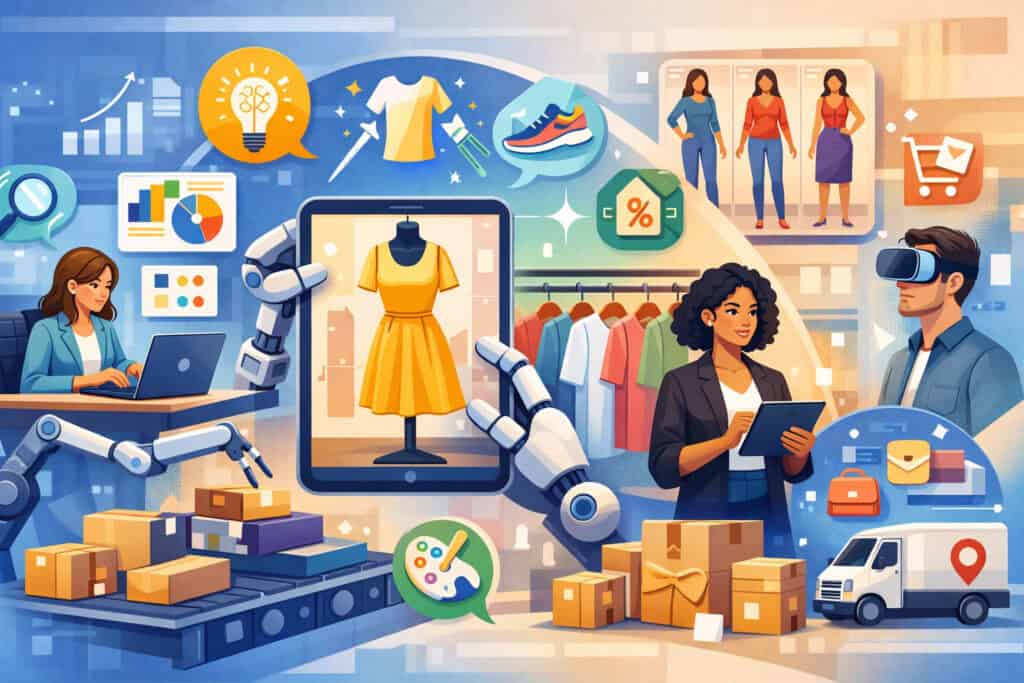
The business value of generative AI becomes much clearer when leaders examine specific merchandising workflows. Not every task needs AI, and not every AI use case deserves equal investment. The highest-value opportunities typically sit where teams face large volumes, tight deadlines, and a constant need for relevance or precision.
One of the most immediate opportunities is content generation. Product titles, descriptions, feature bullets, category page copy, buying guides, and promotional text can all be drafted, localized, refined, and tested faster with AI support. For large catalogs, this alone can reduce bottlenecks and improve product presentation quality.
Another major area is personalization. AI can help determine which products, bundles, messages, and sequences are most relevant to a given shopper or segment.
That creates stronger engagement and can improve conversion, average order value, and repeat purchase behavior. The impact is especially strong when recommendation engines are connected to browsing, purchase, and inventory signals.
Planning functions are also gaining value from AI. AI-driven inventory planning and demand forecasting benefit when teams can combine structured forecasts with AI-generated scenario analysis.
For example, planners can ask what inventory risks may emerge if a campaign exceeds expectations, or how weather, trend momentum, or supplier delays might affect category performance.
Visual merchandising and assortment strategy are additional growth areas. AI can propose collection themes, bundle ideas, page layouts, image variations, and cross-category pairings that align with brand goals and customer behavior.
These use cases do not replace merchant creativity. They make it easier to generate options and move faster from concept to execution.
The following table highlights where many retailers are seeing practical impact.
| Merchandising area | Traditional approach | AI-enhanced approach | Likely business impact |
| Product content | Manual copywriting and updates | AI-generated drafts, enrichment, and testing | Faster launches, stronger conversion |
| Recommendations | Rule-based logic | Behavior-aware, context-rich product suggestions | Higher basket size, better relevance |
| Forecasting | Historical model outputs reviewed manually | Forecasts plus AI-generated scenario narratives | Faster response to demand shifts |
| Inventory planning | Spreadsheet-heavy coordination | AI-supported replenishment insights and exception handling | Lower stockouts, less excess inventory |
| Pricing and promotions | Periodic reviews | AI-assisted simulation of pricing and offer options | Better margin control, sharper promo decisions |
| Visual merchandising | Manual page and collection creation | AI-assisted layouts, bundles, and theme generation | More engaging digital experiences |
| Assortment decisions | Merchant intuition plus reports | Data-driven option generation and scenario analysis | Better alignment to demand and margin |
Product descriptions, attribute enrichment, and catalog storytelling
For many retailers, product content is one of the easiest places to create value quickly. Large assortments often include inconsistent descriptions, missing attributes, duplicated language, and slow update cycles.
Those issues hurt conversion, search relevance, and customer confidence. Generative AI can help produce better first drafts, standardize tone, fill in attribute gaps, and tailor descriptions for different channels.
The executive value here is not just efficiency. Better product content improves the customer’s ability to understand fit, features, benefits, and differences between similar items.
That leads to more informed purchases and can reduce return risk when expectations are set more clearly. AI can also support faster new product onboarding, which matters when speed to market affects revenue.
Catalog storytelling is another overlooked advantage. Merchandising is not only about listing products. It is about presenting them in ways that make sense to the shopper. AI can help build category introductions, curated collection themes, comparison summaries, and bundle narratives that guide decision-making rather than just filling space.
This is especially powerful for ecommerce managers handling broad catalogs with limited content resources. Instead of writing everything from scratch, teams can shift toward review, refinement, and strategic prioritization. That is a more scalable operating model.
Pricing, promotions, and visual merchandising support
Pricing and promotions are areas where speed, context, and discipline matter enormously. Generative AI can help teams simulate offer structures, summarize likely risks, and develop differentiated messaging for specific audiences or channels. It does not replace pricing science, but it can make pricing workflows more responsive and easier to execute.
For example, a merchant team planning a clearance event can ask AI to generate tiered promotional structures, estimate likely trade-offs, and draft messaging variations for premium shoppers versus value-oriented customers. Combined with demand and margin inputs, that creates a more strategic approach to promotional planning.
Visual merchandising also benefits from AI support. On digital shelves, how products are grouped and presented shapes conversion.
Generative systems can propose category page arrangements, product pairings, image order logic, and seasonal storytelling concepts. When connected to performance data, these systems can learn what layouts and combinations help customers discover products more effectively.
In stores, the same principle can extend to signage suggestions, assortment zoning ideas, and campaign concepts, even if final implementation remains human-led. The point is not to automate taste. It is to accelerate the development of commercially useful visual strategies.
AI-Powered Product Recommendations and Personalization at Scale
Personalization has long been a goal in retail, but many organizations have struggled to deliver it consistently. Static segments, generic “you may also like” widgets, and simple rule-based cross-sells often produce only modest gains.
Generative AI changes the equation by enabling richer, more contextual forms of personalization that respond to behavior, intent, product relationships, and inventory realities.
At the center of this shift are AI-powered product recommendations. Instead of relying on basic historical pairings alone, AI can factor in browsing patterns, style similarity, lifecycle stage, margin goals, stock availability, and seasonal context.
It can also generate the language and placement strategy around those recommendations, which is often just as important as the recommendation itself.
For executives, this matters because personalization touches multiple commercial outcomes at once. Better relevance can improve conversion, increase average order value, strengthen repeat engagement, and make category navigation more intuitive. It can also reduce the burden on customers to sort through overwhelming assortments on their own.
Generative AI adds another layer by supporting personalized content around the product itself. The same shopper visiting a product page may benefit from different messages depending on whether they are price-sensitive, shopping for convenience, browsing premium options, or looking for a specific use case. AI helps create those tailored experiences without requiring an army of content creators.
When done well, AI personalization in merchandising makes shopping feel more guided and less transactional. It turns the digital shelf into an adaptive environment rather than a static one. That is a meaningful competitive advantage in crowded categories.
For additional context on personalization and predictive analytics in retail, see this overview of AI in retail, demand forecasting, and personalization and this article on data-driven retail marketing and analytics.
What better recommendations actually look like in practice
Improved recommendations are not only about suggesting more items. They are about suggesting better items in the right context. A shopper browsing a premium cookware set may not need a random list of top sellers. They may respond better to complementary tools, care products, or a curated bundle tied to entertaining at home. Context matters.
Generative AI supports this by combining structured data with narrative logic. It can explain why a recommendation fits, generate a shopper-friendly comparison, or frame a bundle around a use case rather than simply displaying related SKUs. That makes the recommendation feel more intentional and more helpful.
It can also adapt by channel. The ideal recommendation experience on a mobile app may differ from what works in email, onsite search, or a category landing page. AI can support those variations at scale. For ecommerce managers, this reduces the gap between merchandising ambition and execution capacity.
From a leadership perspective, the payoff is stronger commercialization of the catalog. AI helps retailers move beyond basic adjacency logic and toward more thoughtful product discovery experiences that support both customer outcomes and business goals.
Balancing personalization with brand and trust
Personalization can create value, but it can also feel intrusive or inconsistent if it is poorly governed. Executives need to ensure that recommendation and content systems align with brand standards, privacy expectations, and merchandising logic.
A highly personalized experience is not useful if it confuses the customer, undermines brand positioning, or pushes irrelevant products too aggressively.
This is where governance matters. Merchandising teams should define boundaries for how AI recommends products, what data signals are acceptable, and how sensitive attributes are handled. They should also establish rules around explainability and escalation when outputs appear off-brand or commercially weak.
The strongest retailers balance algorithmic relevance with merchant intent. For example, AI may optimize for likely conversion, while merchants ensure the assortment reflects strategic product priorities and brand storytelling. This combination tends to outperform either purely manual or purely automated approaches.
Trust also depends on consistency. If shoppers see wildly different messaging, uneven tone, or recommendations that ignore obvious context, confidence drops. Generative AI works best when paired with clear content guardrails and ongoing performance review.
How Generative AI Supports Merchandising Automation
Automation has always played a role in retail, but much of it has focused on transactions, workflows, and reporting. Generative AI extends automation into areas that used to depend heavily on human drafting, interpretation, and coordination. That is what makes merchandising automation with AI especially interesting for leadership teams.
The first gain is workflow acceleration. AI can help produce first drafts of product copy, summarize weekly category performance, flag assortment gaps, suggest promotional themes, and prepare stakeholder-ready updates.
These are not glamorous tasks, but they consume significant time across merchandising organizations. Automating them creates capacity for more strategic work.
The second gain is consistency. Large teams often struggle with uneven content quality, disconnected planning logic, and manual workarounds that produce variable outcomes. AI can help standardize outputs, enforce templates, and reduce process drift. That matters for both customer-facing execution and internal decision-making.
The third gain is cross-functional coordination. Merchandising sits between planning, marketing, digital, operations, and supplier management. AI can act as a connective layer by translating data into outputs each function can use.
A planner’s forecast shift can trigger AI-generated content updates, revised recommendation logic, or a summary for store operations. That reduces handoff friction.
This is where retail AI transformation becomes real at an operating level. Automation is not only about reducing labor. It is about redesigning how decisions, content, and execution flow through the organization.
High-value automation opportunities for merchandising teams
Not every repetitive task is worth automating, but many merchandising workflows are strong candidates. Product setup is a common example. When new items are added, teams often need descriptions, attributes, search tags, collection placement, and promotional copy. AI can handle a large share of that first-pass work.
Weekly business reviews are another area of value. Instead of manually preparing summaries, teams can use AI to generate performance narratives, identify anomalies, and surface possible actions. Leaders still validate the conclusions, but they begin from a more advanced starting point.
Promotional calendars also benefit from AI support. Teams can generate campaign briefs, test alternative themes, adapt messages by audience, and align copy with inventory priorities more efficiently. This helps especially when multiple categories and channels need coordinated execution.
The point is not to eliminate human ownership. It is to shift humans toward review, refinement, judgment, and exception management, where they add the greatest value.
When automation should stop and human judgment should begin
One of the biggest executive mistakes is assuming more automation always means better performance. In merchandising, that is rarely true. There are many areas where judgment, taste, brand stewardship, and commercial nuance still matter too much to hand over completely.
AI can draft, suggest, summarize, and simulate. It should not automatically decide every promotional action, assortment bet, or customer-facing claim without human oversight. Leaders need to define decision rights clearly.
For example, AI may recommend markdown timing, but merchants approve the action. AI may draft product copy, but brand or category teams review it before publication.
Human intervention is particularly important when stakes are high or context is incomplete. New product launches, sensitive categories, key vendor relationships, and major pricing moves often require judgment that goes beyond pattern recognition. Automation should support those decisions, not quietly make them.
The best model is selective automation with explicit checkpoints. This helps organizations gain speed without losing control, and it builds trust among teams that may otherwise resist adoption.
AI-Driven Inventory Planning and Demand Forecasting
Few merchandising issues affect profitability more directly than inventory decisions. Too much inventory ties up working capital, increases markdown risk, and creates storage pressure. Too little leads to stockouts, missed sales, and weaker customer trust. That is why AI-driven inventory planning has become one of the most compelling applications of AI in retail.
Generative AI does not replace forecasting engines or replenishment systems. Instead, it enhances them by making forecasts easier to interpret, more scenario-aware, and more actionable for decision-makers.
Teams can use AI to summarize forecast changes, explain likely drivers, and model the business implications of different assumptions. That moves forecasting from technical output toward business decision support.
For example, a planner can ask how a category might perform if a viral trend accelerates demand, if a supplier delay affects availability, or if a weather event shifts store traffic. AI can help generate scenario narratives and recommended responses, making planning discussions more concrete and faster to execute.
This is especially useful in environments where historical data alone is not enough. Demand can be shaped by digital trends, campaign timing, competitor moves, and channel shifts that do not fit neatly into older models.
AI can support a more flexible view of demand by synthesizing multiple signals and translating them into planning options. Retailers focused on stronger planning and supply resilience may also benefit from this guide to building a stronger retail supply chain.
For executives, the value comes from reducing costly surprises and improving the speed of inventory decisions. Better planning is not just a supply chain win. It is a merchandising and margin win too.
How AI improves planning beyond historical forecasting
Historical forecasting remains useful, but it has clear limitations in fast-changing categories. It tends to perform best when demand patterns are stable and external variables are limited. Modern retail rarely offers that kind of stability. Promotions, social influence, competitor pricing, macro shifts, and digital behavior can all distort historical baselines.
Generative AI helps bridge that gap by supporting context-rich planning. It can combine forecast data with qualitative signals, such as merchant notes, campaign plans, supplier issues, and emerging search behavior. It can then generate narratives that explain what planners should watch and where intervention may be needed.
This is valuable because many forecast failures are not statistical errors alone. They are communication failures. Teams may have the right signals somewhere in the business, but they are not assembled in time to influence action. AI helps synthesize that information faster.
The result is not a perfect prediction. It is better prepared. That is often the more realistic and more valuable objective in merchandising and planning.
Inventory planning scenarios where generative AI adds value
Consider a seasonal category with rising engagement but uncertain replenishment lead times. A traditional forecast may project growth based on recent sales, but it may not fully account for campaign support, social demand acceleration, or supplier reliability. Generative AI can help planners build multiple scenarios and estimate the operational implications of each.
In another case, a retailer might need to decide whether to push a high-margin product family more aggressively. AI can help evaluate whether inventory position, recommendation placement, and promotional timing are aligned, then surface actions that support the strategy.
Even exception management becomes easier. Rather than forcing teams to scan countless reports, AI can identify products at risk of stockout, items likely to require markdown, or categories where demand assumptions no longer match the latest signals. That allows planners and merchants to focus where intervention matters most.
These are practical, high-value applications because they connect AI directly to working capital, sales capture, and profitability.
Executive Benefits: Efficiency, Growth, Customer Experience, and Decision Quality
The executive case for generative AI in merchandising rests on business outcomes, not novelty. Leaders need to see how AI contributes to growth, efficiency, resilience, and customer value. Fortunately, merchandising is one of the clearest areas where those benefits can be linked to measurable results.
Efficiency is often the first visible gain. Teams spend less time on repetitive drafting, manual synthesis, and content production. That can reduce launch bottlenecks, speed campaign execution, and improve cross-functional responsiveness. Efficiency alone is not enough to justify enterprise attention, but it creates momentum.
Revenue growth is the next major benefit. Stronger personalization, better product presentation, improved recommendations, and faster reaction to demand signals can all increase conversion and basket size. When AI helps surface the right products and messages at the right moment, the sales impact can be meaningful.
Customer experience improves because merchandising becomes more relevant and more navigable. Shoppers benefit from clearer content, better discovery, and fewer dead ends. This matters because experience quality increasingly influences loyalty, especially in digital channels where alternatives are always close at hand.
Decision quality is the often-underestimated advantage. AI does not remove uncertainty, but it can help teams structure decisions better, model more scenarios, and identify gaps faster. That supports stronger AI in retail decision making and helps executives operate with greater clarity when conditions change.
Why the best benefits come from combining use cases
Retailers sometimes start with a single use case, such as product copy generation, and then struggle to build broader strategic momentum. That happens because isolated wins can look tactical rather than transformational. The strongest benefits emerge when multiple AI use cases reinforce one another.
For example, better product content improves conversion, but that effect can multiply when combined with smarter recommendations and more dynamic category presentation. Improved forecasting helps planning, but it creates even more value when connected to promotional timing and inventory-aware personalization.
Executives should therefore think in value chains, not isolated tools. Ask how AI can improve the full flow from product setup to discovery, conversion, replenishment, and post-purchase refinement. That broader perspective is what turns experimentation into competitive advantage.
It also helps with investment logic. When several connected use cases share the same data assets and integration layer, the economics often become more attractive. Rather than funding disconnected pilots, leaders can build a more coherent roadmap.
A realistic example of executive value creation
Imagine an apparel retailer struggling with slow new-product launches, weak digital conversion in key categories, and recurring end-of-season markdown pressure. The company introduces generative AI in three linked areas: product content generation, personalized recommendations, and scenario-based inventory planning.
Product pages go live faster and with richer, more consistent descriptions. Recommendation blocks begin surfacing more relevant outfit pairings and accessories. Planners receive earlier warnings when demand is diverging from expectations, allowing them to adjust buys and marketing exposure.
No single change transforms the business overnight. But together, they improve speed to market, conversion quality, sell-through, and promotional discipline. That is how executive value is typically created with AI: through coordinated gains across multiple decisions, not through one dramatic automation story.
Risks, Governance, and Implementation Challenges Leaders Must Address
Generative AI brings real advantages, but it also introduces real risk. Executives who approach adoption casually can create costly problems, from inaccurate content and biased recommendations to weak governance and disjointed implementation.
Retail leaders need to treat AI as an enterprise capability that requires standards, oversight, and operational discipline.
Data quality is one of the biggest issues. AI outputs are only as useful as the product, customer, and operational data behind them.
If product attributes are incomplete, inventory signals are delayed, or customer data is fragmented, AI may produce polished outputs that are commercially wrong. In merchandising, bad inputs do not just create internal noise. They can damage customer trust.
Governance is equally important. Teams need clear policies for model usage, content review, privacy handling, escalation, and performance monitoring. This matters especially when AI is generating customer-facing copy, influencing recommendation logic, or shaping pricing-related workflows.
Bias and relevance are also major concerns. AI systems can reinforce narrow patterns, over-prioritize certain products, or generate outputs that do not reflect brand or assortment intent. Without oversight, that can distort merchandising decisions and weaken inclusivity, consistency, or fairness.
Implementation complexity should not be underestimated either. AI adoption touches data infrastructure, workflow design, team capability, vendor selection, and change management. Many initiatives fail not because the models are weak, but because the operating environment is not ready to support them. Executives need to lead with realism as well as ambition.
Data quality, bias, and model reliability
Retailers often underestimate how much foundational work AI requires. Product information may live across multiple systems, customer data may be inconsistent, and category taxonomies may vary by channel or brand. When AI interacts with this fragmented environment, reliability suffers.
Bias can appear in several ways. Recommendation systems may overexpose already popular items, leaving emerging or strategic products underrepresented. Content models may favor generic language that fails to reflect brand voice or customer diversity. Scenario outputs may reflect skewed historical patterns rather than current business intent.
Reliability is another critical issue. Generative models can sound confident even when they are wrong. That makes review processes essential, especially for customer-facing merchandising and financially sensitive decisions. Leaders should require testing frameworks, output validation, and clear thresholds for when human review is mandatory.
The takeaway is simple: no matter how sophisticated the tool, weak data and loose controls can undermine value quickly.
Organizational and technical friction points
Beyond data and governance, many AI initiatives stall because the organization is not aligned around ownership. Who is responsible for use case prioritization? Who approves customer-facing outputs? Who manages model performance? Who funds integration work? Without clear accountability, enthusiasm can dissolve into fragmentation.
Technical integration is another common barrier. Merchandising AI is only as useful as its connection to the systems where work actually happens.
That may include PIM platforms, ecommerce engines, CRM tools, pricing systems, analytics environments, and planning applications. If AI remains disconnected from the daily workflow, adoption will be limited.
There is also a people challenge. Teams may worry that AI will reduce their role or override their judgment. Strong leadership communication is essential. Employees need to understand that AI is there to remove low-value friction and strengthen decision support, not erase the value of merchant expertise.
How to Build an AI Merchandising Strategy That Actually Works
An effective AI merchandising strategy starts with business priorities, not technology features. Executives should begin by asking where merchandising performance is constrained today.
Is the business losing speed in product setup? Struggling with generic digital experiences? Missing demand signals? Carrying too much inventory? The answers should shape the AI roadmap.
The best strategies focus on a small number of high-value problems first. Trying to transform every merchandising process at once usually creates confusion and weakens accountability. A better approach is to identify use cases with strong economic relevance, available data, and visible workflow pain. That creates early wins and practical learning.
Leadership alignment is crucial. Merchandising, ecommerce, planning, marketing, IT, legal, and analytics teams all have a stake in how AI is deployed. Without alignment on objectives, governance, and ownership, initiatives become fragmented.
The strategy must define not only what AI will do, but how decisions will be made, how success will be measured, and where human oversight remains essential.
A good strategy also connects use cases across the merchandising value chain. Product content, recommendations, forecasting, pricing support, and inventory logic should not evolve in separate silos forever. Over time, they should become part of a more connected operating model that supports faster, better decisions across the business.
The core elements of a strong strategy
A practical strategy usually includes six elements: business outcomes, use case priorities, data requirements, governance standards, technology architecture, and adoption planning. Missing any one of these weakens execution.
Business outcomes come first because they justify investment and keep teams focused. Use case priorities determine sequencing. Data requirements reveal readiness gaps. Governance standards protect the brand and customer. Technology architecture determines what can scale. Adoption planning ensures teams actually use what is built.
Executives should insist that each AI initiative clearly map to these elements. This prevents projects from becoming disconnected proofs of concept that never influence commercial performance. It also helps leaders compare competing investment ideas more rationally.
The strongest strategies are ambitious but disciplined. They aim for enterprise value while respecting operational reality.
Choosing use cases in the right order
Sequencing matters. Starting with a glamorous but complex initiative can waste time and reduce confidence. In most organizations, the better starting point is a use case that is high-frequency, easy to measure, and tied to an obvious pain point.
Examples include product content generation, recommendation enhancement in a focused category, or AI-assisted performance summaries for weekly business reviews. These create visible value and help teams learn how to govern AI outputs.
Once those capabilities are stable, leaders can expand into areas like scenario-based planning, assortment support, and integrated promotional decisioning. This staged approach reduces risk while building internal credibility.
The goal is not to stay small. It is to scale from a position of control and evidence.
A Step-by-Step Approach to Adoption, Tools, and Team Enablement
Once the strategy is defined, execution needs structure. AI initiatives often fail when organizations jump from excitement to tooling without doing the operational groundwork. A step-by-step approach gives leaders a better chance of achieving durable value.
- Step one: define the business problem: Be clear about what needs to improve, what the current workflow looks like, and why the issue matters commercially. Avoid vague goals like “improve merchandising with AI.”
- Step two: assess data and process readiness: Review product data quality, inventory signal reliability, content standards, and system access. If the foundation is weak, fix critical gaps before scaling.
- Step three: select a limited pilot: Choose a use case with measurable upside and manageable complexity. Define success metrics before launch.
- Step four: choose tools and integration paths: Some retailers will use embedded AI features within existing commerce, analytics, or planning platforms. Others will add specialized vendors or build custom layers. The right path depends on speed, control, data sensitivity, and internal capability.
- Step five: design human oversight: Decide who reviews outputs, what approval steps exist, and how exceptions are escalated.
- Step six: train teams and redesign workflows: AI does not create value if it sits outside daily work. Teams need training, prompts, guidelines, and clarity on how their roles evolve.
- Step seven: measure, refine, and expand: Review impact, fix quality issues, and decide which adjacent use case comes next.
Executives should also think carefully about tools and platforms. Strong options typically connect to product information, customer behavior, recommendation logic, content management, and planning data.
The most important question is not whether a platform has AI. It is whether the AI can work inside the systems and decisions that matter most to your merchandising teams.
What to look for in tools and platforms
When evaluating technology, leaders should focus on integration, governance, usability, and scalability. A tool that generates impressive demos but cannot connect to core merchandising systems will struggle in production.
Look for platforms that can work with product catalogs, inventory feeds, customer behavior signals, and content workflows. Auditability matters too. Teams should be able to understand where outputs came from, how prompts are structured, and what controls exist over publishing or decision support.
Usability is another major factor. If merchants and ecommerce teams need heavy technical support to use the system, adoption will lag. The best tools make AI accessible within familiar workflows.
Finally, think beyond the first pilot. Choose a technology path that can support multiple use cases over time, not just a single narrow solution.
Change management and team adoption
Even strong AI tools can fail if teams do not trust them. Change management should begin early, not after deployment. Leaders need to explain why AI is being introduced, what problems it is solving, and how roles will evolve.
Training should be practical and role-specific. Merchants need to know how to review AI-generated content and use AI for assortment support. Ecommerce teams need guidance on recommendation workflows and content testing. Planners need to understand scenario modeling and exception interpretation.
Celebrate early wins, but also share lessons when outputs fall short. That creates a culture of disciplined experimentation rather than blind enthusiasm. Most importantly, reinforce that human judgment remains central.
AI supports better merchandising; it does not eliminate the need for merchants, planners, and operators who understand the business deeply.
Common Executive Mistakes and How to Measure ROI
AI initiatives often disappoint not because the technology lacks promise, but because leadership approaches the work with the wrong expectations or the wrong operating model. One common mistake is chasing too many use cases at once. This creates fragmented pilots, spreads teams too thin, and makes it difficult to prove business value.
Another mistake is overestimating automation while underinvesting in data and governance. Executives may assume the tool will solve process weakness on its own, when in fact it often exposes existing problems more clearly. Weak product data, poor taxonomy discipline, and unclear workflows can all limit results.
A third mistake is treating AI as a technology project instead of a commercial initiative. If merchandising leaders are not deeply involved in prioritization and design, the outputs may look innovative but fail to improve actual decisions. AI must be grounded in business needs, not isolated inside IT or innovation teams.
There is also a measurement mistake: focusing on vanity metrics. It is easy to celebrate the number of AI-generated descriptions or the volume of prompts used. Those numbers mean little unless they connect to meaningful business outcomes.
To measure ROI, executives should track impact in areas such as:
- Conversion rate improvement
- Average order value
- Recommendation click-through and assisted revenue
- Product launch cycle time
- Content production time and cost
- Forecast accuracy improvement
- Stockout and excess inventory reduction
- Gross margin improvement
- Markdown rate reduction
- Team productivity and decision-cycle speed
The right metric set will vary by use case, but every initiative should have a clear baseline, a target, and a review cadence.
Mistakes that slow or derail adoption
One of the most common leadership errors is assuming the organization will naturally adopt AI once the tool is available. In reality, teams need workflow design, incentives, examples, and trust-building. Without that, usage stays superficial.
Another mistake is applying the same AI model or content logic across very different categories. Merchandising nuance matters. What works for commodity products may not work for premium, seasonal, or highly considered purchases. Leaders should allow category-level adaptation while maintaining overall governance.
Some executives also make the error of demanding immediate enterprise-scale results from a small pilot. AI value typically compounds through iteration. Early pilots should prove feasibility and business relevance, not solve every merchandising issue at once.
Building a credible ROI framework
A credible ROI framework starts with the business problem and the current cost of underperformance. For product content, that might include slow onboarding, inconsistent conversion, and labor hours.
For recommendations, it might involve missed basket expansion and weak engagement. For planning, it could be markdown losses or stockout costs.
Next, define how the AI intervention changes the workflow. What becomes faster, more accurate, or more scalable? Then estimate the value conservatively. Do not assume best-case performance. Model realistic adoption and realistic improvement.
Review results in stages. Some use cases will show leading indicators first, such as faster content creation or better recommendation engagement, before they show full financial impact. Executives should monitor both the early signals and the lagging commercial outcomes.
The point of ROI measurement is not just to defend the investment. It is to guide smarter expansion.
FAQs
Is generative AI only useful for large retailers with massive data sets?
No. Large retailers may have more data and more use cases, but mid-sized and smaller retail organizations can also benefit when they focus on the right problems. Product content generation, recommendation improvement, category storytelling, and AI-assisted planning can all create value without requiring enterprise-scale infrastructure. What matters most is having usable data, a clear business objective, and a focused starting point.
How does generative AI differ from standard recommendation engines?
Standard recommendation engines often rely on fixed rules or behavior-based logic to decide which products to show. Generative AI can work alongside those systems by adding richer context, more adaptive recommendations, and personalized content around the products being suggested. Instead of only showing related items, it can also help explain why those items fit together and tailor the experience to different customer needs.
What is the best first use case for most merchandising organizations?
The best first use case is usually one that is repetitive, measurable, and tied to a clear business outcome. Product content generation is often a strong starting point because it improves speed to market, catalog quality, and team productivity. AI-assisted performance summaries and focused recommendation optimization can also be effective entry points when they address obvious workflow pain.
Will generative AI replace merchants and planners?
No. Generative AI is more likely to change how merchants and planners work than remove the need for them. Retail still depends on judgment, brand understanding, commercial instinct, supplier knowledge, and cross-functional coordination. AI helps reduce repetitive manual work, speeds up analysis, and expands decision support, allowing teams to focus more on strategy, prioritization, and higher-value decisions.
How long does it usually take to see measurable value from generative AI in merchandising?
Some merchandising use cases can show operational value quickly, especially when AI reduces manual effort or speeds up content production. Broader commercial results such as conversion improvements, stronger recommendations, or better inventory performance may take longer because they depend on testing, adoption, and workflow integration. Most organizations see value in stages, starting with efficiency gains and expanding into revenue and margin impact over time.
What should executives watch most closely as AI use expands?
Executives should monitor data quality, governance, team adoption, and measurable business impact. It is important to ensure that AI outputs are accurate, useful, and aligned with merchandising goals. Leaders should also watch for unintended effects such as weak recommendations, overly generic content, or overreliance on AI without proper human review. Strong oversight helps protect both performance and customer trust.
Conclusion
Generative AI is changing merchandising because it helps retail organizations work in a more adaptive, data-informed, and scalable way.
It can improve product storytelling, sharpen personalization, support faster decisions, strengthen planning, and reduce the manual burden that slows commercial execution. For executives, that combination is powerful because it touches the core drivers of performance: growth, margin, speed, and customer relevance.
But success does not come from adopting AI for its own sake. It comes from selecting the right use cases, building the right governance, integrating AI into real workflows, and keeping human judgment at the center.
Retailers that approach this thoughtfully can turn generative AI in merchandising into a meaningful strategic advantage rather than another disconnected experiment.
The opportunity is no longer theoretical. Leaders who act with discipline can build smarter merchandising organizations that respond faster, personalize more effectively, and make better decisions under pressure. In a market where relevance and speed increasingly define winners, that is an advantage worth building now.