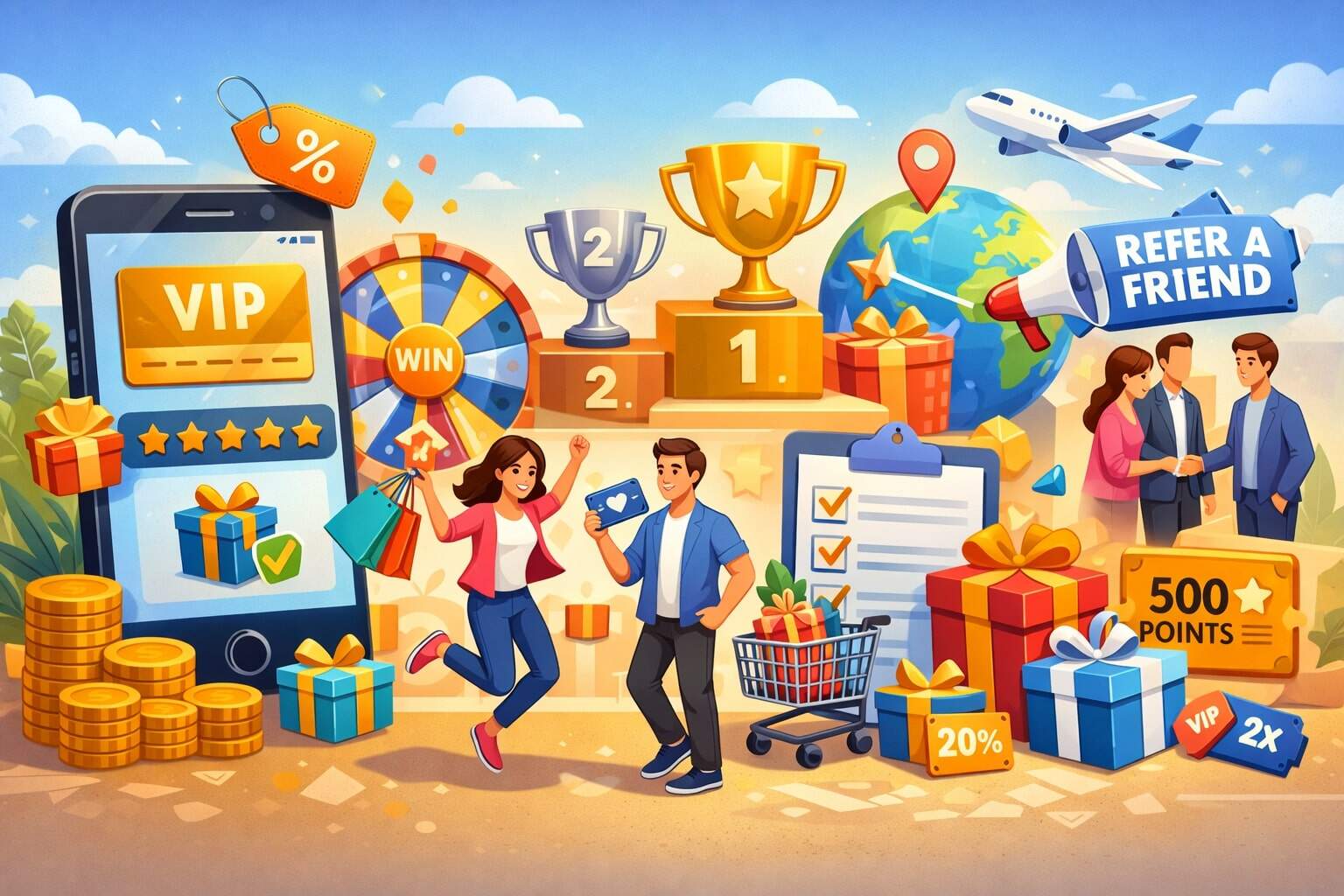
Loyalty Program Ideas That Actually Work
Most loyalty programs fail for one boring reason: they’re designed like a coupon machine, not like a relationship. Customers don’t wake up hoping to “collect points.”
They wake up wanting less hassle, better value, faster service, and a brand that feels worth sticking with. The loyalty program is simply the system you build to deliver that value consistently—while still protecting margins and staying simple enough that people actually use it.
In this guide, you’ll get loyalty program ideas that actually work across retail, ecommerce, services, food, wellness, and subscription-style businesses. You’ll also learn how to design the mechanics (earning, redeeming, tiers, missions), how to avoid the most common loyalty traps, and how to measure real incremental lift (not vanity metrics).
Every section focuses on loyalty program ideas that improve retention, increase purchase frequency, raise average order value, and generate referrals—without turning your brand into a permanent discount dispenser.
You’ll see how modern loyalty programs are shifting from purely transactional to experience + personalization + trust, while still keeping the basics (points, perks, tiers) easy to understand.
Surveys and industry research also show a growing reality: customers belong to many programs, and attention is the scarce resource—so your loyalty program ideas must be sharper, more relevant, and more human than ever.
Start With a Value Exchange Customers Actually Want

Before you choose points, tiers, or perks, define the value exchange—what the customer gets that feels genuinely worth it, and what you get in return (repeat purchases, higher share of wallet, richer first-party data, referrals, lower churn). The strongest loyalty program ideas start here because “rewards” alone rarely create loyalty; consistent value does.
A practical way to think about this is: What do customers routinely struggle with in your category? Shipping costs, waiting time, uncertainty, customer support, sizing, complicated reorders, out-of-stocks, product discovery, or the feeling that they’re not getting a fair deal.
Your loyalty program ideas should reduce friction first, then add delight second. If your program only offers discounts, your “best customers” learn to wait for deals, and your margins silently bleed.
Good loyalty program ideas also respect the customer’s mental load. People won’t do backflips to earn 25 points. They will, however, opt into a program that saves them money or time predictably—and makes them feel recognized.
That’s why the best programs offer a clear “why join” moment in the first 30 seconds: welcome perk, instant benefit, or a fast path to the first reward.
Finally, your value exchange must be trust-based. Customers will share preferences and purchase intent if they understand why and see immediate benefits. That “permission-based” model is increasingly important as brands lean into first-party and zero-party data for personalization.
Build rewards around “painkillers,” not “vitamins”
A “vitamin” reward is nice-to-have (a small coupon). A “painkiller” reward solves a real problem (free shipping, priority support, easy returns, early access, guaranteed inventory holds, faster service).
Loyalty program ideas become more profitable when you replace broad discounts with painkiller perks that customers value highly but cost you less than a straight price cut.
Start by listing your top three customer frictions. Then map each friction to a perk:
- Waiting → priority fulfillment, express pickup lane, appointment slots
- Uncertainty → extended returns, fit guarantee, try-before-you-buy credit
- Complex reorders → one-tap reorder, “subscribe & save” without lock-in
- Out-of-stocks → back-in-stock priority, reserve a unit, waitlist perks
- Support pain → VIP chat, faster resolutions, dedicated rep for high tiers
These loyalty program ideas create stickiness because the customer doesn’t want to lose them. You’ll often find you can reduce discounting once the program becomes genuinely useful.
Also design one signature perk that’s uniquely yours. When every competitor offers points, your differentiator might be “members get 2-hour service windows,” “members get free inspections,” or “members get access to limited drops.” Signature perks become the story people tell, which is what real loyalty looks like.
Use zero-party data without being creepy
Modern loyalty program ideas often rely on personalization: “recommended for you,” tailored rewards, and relevant reminders. But there’s a line between helpful and intrusive. Research warns that poorly executed personalization can backfire and create negative experiences or regret, which can reduce repeat purchasing.
The safest approach is zero-party data: information the customer chooses to share (preferences, sizes, goals, favorite categories). Make it feel like a fair trade:
- Ask one question at a time, right after delivering a benefit
- Explain “why we ask” in plain language
- Give an immediate payoff: bonus points, perk unlock, better recommendations
- Let customers edit preferences anytime (control builds trust)
A strong pattern: build a “Preference Center” inside the loyalty experience—then create loyalty program ideas that directly reference those preferences. Example: “Pick your birthday reward,” “Choose your monthly perk,” or “Select your top 3 categories to earn faster.” This keeps personalization opt-in, transparent, and consistently useful.
Points Programs That Don’t Feel Like a Math Class
Points still work—when they’re designed to be simple, fast, and satisfying. Many points programs fail because customers can’t quickly answer three questions: How do I earn? How long until I get something? How do I redeem myself? If those answers require effort, adoption and engagement drop.
The best loyalty program ideas use points as a progress engine, not a spreadsheet. Customers should feel momentum. That means (1) faster time-to-first-reward, (2) easy redemption with low friction, and (3) rewards that match what customers actually want—not just what’s cheapest for the business.
Also, points programs should not become “discount-only.” If points always equal dollars off, you’re basically training price sensitivity.
Instead, mix redemption options: product upgrades, services, access, bundles, shipping perks, exclusive items, or partner offers. This variety is where loyalty program ideas turn into a real retention machine rather than a coupon treadmill.
One more crucial point: points are a liability on your books (unredeemed rewards). So you need thoughtful controls: expiry rules that are fair, redemption thresholds that are motivating, and reward options that encourage profitable behavior. The goal is a points program that feels generous and stays financially healthy.
Earn-and-burn design: faster first reward
A high-performing points program is built around “earn and burn”—customers earn quickly and redeem often. If the first meaningful reward is too far away, you’ll see sign-ups without engagement. A practical target: customers should be able to hit a real reward within the first 1–3 purchases (depending on your price point).
High-impact loyalty program ideas for faster momentum:
- Welcome boost: points for joining + first purchase multiplier
- Starter reward: a small but valuable perk at a low threshold
- Progress bar: show “You’re 72% to your next reward” everywhere
- Instant redemption: allow partial redemptions or “apply at checkout”
Also think beyond points: give “members-only pricing” on a small set of evergreen items. This makes the program feel valuable every time they shop, not only when they redeem.
Finally, keep the math clean. If customers need a calculator, you lose. Use round numbers, clear thresholds, and transparent values. Loyalty program ideas that feel effortless always win in saturated markets.
Dynamic earning: category multipliers and behavior bonuses
Once your basics are simple, dynamic earning becomes a powerful lever. This is where loyalty program ideas can drive specific behaviors: higher frequency, cross-category purchasing, subscriptions, reviews, and referrals.
Examples that work when done carefully:
- Category multipliers: “2x points on essentials, 3x on new arrivals”
- Behavior bonuses: points for trying a new category or reactivating after inactivity
- Margin-aware rewards: higher multipliers on higher-margin items
- Time-bound boosts: weekend multipliers, seasonal missions, or launch weeks
The rule: don’t make earning so complex that customers feel manipulated. Use dynamic learning sparingly, explain it clearly, and always show the benefit upfront. When customers feel the system is fair, these loyalty program ideas can increase basket size and purchase frequency without defaulting to blanket discounting.
Tiered Loyalty That Creates Status

Tiered programs work because they tap into identity and progress. Customers don’t only want savings; they want recognition, convenience, and a feeling of “I’m valued here.” Tiered loyalty program ideas can deliver that—if tiers are attainable, benefits are meaningful, and the experience doesn’t feel exclusionary or confusing.
A common mistake is creating too many tiers or making the jump between tiers unrealistic. If customers don’t believe they can reach the next tier, they stop caring. Your tiers should reflect real customer segments: casual, regular, VIP. Keep it simple.
Another key is status benefits vs. transactional rewards. VIPs often care less about $5 off and more about priority access, service, speed, and exclusivity. That’s where tiered loyalty program ideas become margin-friendly: the perceived value is high, while the cost can be controlled.
Tiered loyalty also helps with personalization and retention strategy. You can design different communications, perks, and missions per tier. That makes the experience feel curated instead of generic.
Tier names, benefits, and speed
Tiers are storytelling. The names, thresholds, and benefits should match your brand voice and customer motivations. Don’t call it “Silver/Gold/Platinum” unless you truly have no better narrative. Use names that reflect belonging and progression.
Strong loyalty program ideas for tier structure:
- 3 tiers max for most businesses
- Clear thresholds: spend, visits, or points—avoid mixing too many criteria
- Time window: rolling 12 months is common; keep the rules transparent
- Accelerators: make it easier to climb through missions or multipliers
Benefits that typically motivate tier pursuit:
- Faster earning rate (simple and visible)
- Early access to drops or appointments
- Priority service and returns
- Free shipping or expedited handling
- Exclusive bundles or “VIP-only” redemptions
You also need a thoughtful downgrade policy. Customers hate surprises. If someone is about to lose status, warn them early and offer a safe opportunity (“complete one mission to keep your tier”). These loyalty program ideas reduce churn and protect goodwill.
Surprise-and-delight perks that scale
Surprise-and-delight is powerful, but only if it’s systematic. Random gifts can become expensive and inconsistent. Instead, build rule-based surprise perks:
- “After your 5th purchase, unlock a mystery perk”
- “VIPs get a quarterly ‘choose your perk’ drop”
- “Members get a surprise upgrade on slow days”
- “Birthday month: pick one of three rewards”
The secret is to align surprises with high-lifetime-value signals: repeat purchases, referrals, high-margin categories, or long tenure. That way, surprise-and-delight loyalty program ideas feel generous while staying profitable.
Also, make the surprise visible. If a customer receives faster support or a free upgrade, tell them it’s because they’re a member. Recognition turns operational benefits into emotional loyalty.
Paid Loyalty Memberships and Subscriptions
Paid loyalty is not new, but it’s getting smarter. Customers will pay for membership when the value is immediate, predictable, and clearly exceeds the fee. Research highlights how loyalty can be integrated with pricing and value delivery, which is especially relevant for paid models that combine perks, pricing advantages, and member-only benefits.
Paid membership loyalty program ideas work best when your customers buy frequently, value convenience, or care about access. But you must be careful: a paid program changes expectations. Members become less tolerant of friction because they’re paying for a better experience.
Think of paid loyalty as “a bundle of unfair advantages.” Not gimmicks. Real advantages. If you can’t articulate the advantages in one sentence, the program will struggle.
Also note the market reality: customers are enrolled in many loyalty programs, and engagement is competitive—paid loyalty must earn attention through strong benefits and excellent execution.
When paid loyalty works
Paid loyalty tends to perform when you have:
- Frequent purchase cycles (weekly/monthly)
- High shipping sensitivity or convenience needs
- Strong brand affinity and repeat behavior
- A compelling perk bundle (shipping + access + pricing + support)
Examples of paid loyalty program ideas that often work:
- Free shipping + member-only pricing on a curated set
- Priority booking + service upgrades + faster turnaround
- Monthly member credit (feels like “it pays for itself”)
- Early access + limited drops + exclusive inventory
Be conservative with promises. If you can’t reliably deliver faster shipping or priority service, don’t sell it. Paid loyalty lives or dies on operational consistency.
Bundling, partner benefits, and churn controls
To strengthen perceived value without blowing up costs, use smart bundling:
- A monthly credit that can only be used on profitable items
- Partner perks (local experiences, complementary services)
- Members-only bundles that increase AOV
- “Giftable” perks (members can share a perk once per quarter)
Churn control matters, too. The best loyalty program ideas for retention inside paid programs include:
- Annual plans with meaningful savings
- “Pause membership” options instead of cancel
- Clear usage reminders (“you saved $X this month”)
- Win-back offers tied to benefits, not deep discounts
Industry commentary on loyalty trends continues to emphasize value, experience, and smarter program design as the category evolves.
Gamification That Drives Repeat Behavior
Gamification works when it’s not childish. Done right, it’s simply behavior design: clear goals, progress, feedback, and rewards that feel satisfying. The best gamified loyalty program ideas don’t distract from shopping—they make engagement feel fun and purposeful.
Gamification is especially useful for increasing frequency, expanding product discovery, and building habits. Instead of “buy more,” customers experience “complete a mission,” “keep a streak,” or “unlock a perk.” That small psychological shift can create big retention gains.
However, gamification must stay aligned with brand tone. A premium brand can still use missions, but the language might be “collections,” “journeys,” or “member challenges” rather than “levels” and “badges.” The mechanism matters more than the theme.
Many 2025-focused loyalty trend discussions highlight gamification and experience-based rewards as high-impact directions for programs over the next few years.
Missions, streaks, and challenges
Here are gamified loyalty program ideas that reliably drive results:
- Missions: “Buy from 2 categories this month to earn a bonus”
- Streaks: “Visit 3 weeks in a row to unlock a perk”
- Milestones: “After 10 purchases, get a VIP reward”
- Learning challenges: “Watch a demo, earn points, unlock an upgrade”
Missions should be short, visible, and achievable. If a mission takes three months, it stops feeling like a game and starts feeling like homework.
Also, reward the behavior you truly want. If you reward only purchases, you create discount dependency. Mix in non-purchase actions that improve retention: profile completion, product reviews, referrals, app installs, preference selection, and service bookings.
Community, referrals, and UGC loops
Some of the strongest loyalty program ideas are built around community and advocacy:
- Referral ladders: better rewards when you refer multiple friends
- Ambassador missions: earn perks for posting content (with clear rules)
- Member spotlights: recognition is often more motivating than points
- Group challenges: “members unlock a surprise when we hit a goal”
Be careful with UGC incentives: require authenticity, avoid spammy mechanics, and keep compliance in mind. The goal is to create a loop where customers want to share because it reinforces identity and belonging.
Experiential, Local, and Values-Based Rewards
Discounts are easy to copy. Experiences are harder—and often more memorable. That’s why experiential loyalty program ideas can outperform purely transactional offers. Experiences create stories, and stories create emotional loyalty.
Experiential rewards don’t have to be expensive. Access is often enough: early shopping windows, member-only events, limited-edition drops, workshops, consultations, or behind-the-scenes content. You can also build “local” partnerships (cafes, studios, venues, services) that increase value without heavy discounting.
Values-based rewards also matter more now, but only when they’re credible. Donation-based redemptions and sustainability perks can work, but customers can detect performative gestures. The best loyalty program ideas in this category are specific, transparent, and tied to real impact.
Experiences and access over discounts
Key experiential loyalty program ideas:
- Early access to launches and limited inventory
- Member-only workshops or live demos
- VIP service lanes or concierge help
- Invitations to community events
- “Access upgrades” (priority booking, exclusive slots)
Trend commentary about loyalty in 2025 commonly points to experiences and engagement-driven rewards as a major direction, alongside smarter personalization.
To make experiences scalable, segment them by tier. Your top tier might get event invitations, while entry tiers get digital experiences (tutorials, guided sessions, early previews). That keeps costs controlled while still delivering delight.
Sustainability & donation rewards without greenwashing
Values-based loyalty program ideas can include:
- Redeem points to support verified causes
- “Round up at checkout” + member matching
- Rewards for eco-friendly choices (refills, reuse, repair)
- Trade-in credits that encourage circular behavior
The rule: show receipts. Customers want clarity: What happens when I redeem? What impact did it create? Keep it transparent and avoid vague claims.
Also, keep values and rewards optional. Not every customer wants that, and forcing it can feel preachy. Offer it as a redemption path alongside practical perks and experiential benefits.
Omnichannel Loyalty That Connects Every Touchpoint
Customers don’t think in channels. They think in outcomes: “I bought it, I need help, I want it fast, I want to return it easily.” Omnichannel loyalty program ideas make membership benefits consistent whether the customer shops online, in-store, through service appointments, or through support.
This is where many programs break: the online store has one view of the customer, the in-store system has another, and support has none. When that happens, loyalty benefits become inconsistent and trust erodes. Your goal is a single loyalty identity that works everywhere.
Operationally, omnichannel loyalty means: easy identification, easy earning, easy redemption, consistent rules. It also means your team understands the program well enough to explain it in one sentence.
Industry research continues to emphasize that customers expect more from loyalty programs as the space becomes crowded—making consistency and ease-of-use critical.
Mobile wallet, QR, and receipt scanning
Practical omnichannel loyalty program ideas:
- QR code sign-up and member ID
- Digital membership card in mobile wallet
- Receipt scanning for points (especially for offline purchases)
- One-tap redemption at checkout
- “Earn for appointments” in service businesses
Make join-and-identify frictionless. If someone has to download an app just to get started, you’ll lose sign-ups. Offer multiple entry points: SMS, email, wallet card, or lightweight web-based profile.
Customer service and returns as loyalty moments
Support is where loyalty is tested. Great loyalty program ideas make customer care feel like a benefit, especially for top tiers:
- VIP chat for members
- Faster resolution SLAs for higher tiers
- Member-friendly returns (within guardrails)
- “Make it right” credits for service failures
Bond’s loyalty research highlights the importance of customer care and experience in loyalty outcomes, reinforcing why service is not separate from loyalty—it is loyalty.
Measuring What Matters So Loyalty Pays for Itself
If you can’t measure incremental value, loyalty becomes a cost center. The most important shift is moving from “how many members joined?” to “did the program change behavior profitably?” Effective loyalty program ideas are built on testable hypotheses and clear metrics.
Start by defining your “north star”: retention rate, purchase frequency, margin-adjusted revenue, or churn reduction. Then track supporting metrics: repeat rate by cohort, time between purchases, redemption rate, and tier migration.
A common trap is celebrating high redemption without checking margin impact. Redemption can be good (engagement), but it can also be expensive (over-incentivizing). Your job is to tune the system so the program creates incremental lift while keeping reward costs under control.
Also measure attention and engagement: app opens, mission participation, referral rate, review rate. Those behaviors often predict future revenue.
Metrics: incremental lift, CLV, breakage, and liability
Core metrics for loyalty program ideas that scale:
- Incremental lift: compare member vs. non-member behavior (with controls)
- Customer lifetime value (CLV): margin-adjusted, not revenue-only
- Purchase frequency: did time between orders shrink?
- AOV and basket mix: did customers buy higher-margin items?
- Redemption rate: healthy engagement without runaway costs
- Breakage: unredeemed rewards (don’t over-rely on it)
- Points liability: forecast and manage outstanding points
McKinsey has discussed integrating loyalty and pricing strategy to unlock more holistic value—measurement is what makes that integration possible.
Testing roadmap and attribution
Testing is how you refine loyalty program ideas without gambling.
Run experiments like:
- Two welcome offers (points vs. free shipping)
- Different first reward thresholds
- Different tier thresholds and benefits
- Missions vs. static multipliers
- Paid vs. free tier entry (or hybrid)
Use clean cohort comparisons. Track results over weeks and months, not days. Loyalty is a long game, and short windows can mislead you.
Compliance, Privacy, and Trust
Trust is no longer optional. Loyalty programs are data engines, and customers know it. The best loyalty program ideas build loyalty because they respect privacy, not despite it.
That means consent-based communication, transparent data use, and clear controls. It also means avoiding creepy personalization. Gartner has warned that personalization can create negative reactions when it crosses boundaries or feels invasive.
You should also consider fraud and abuse. Points are currency. If your program gets exploited, honest members get worse experiences. So you need sensible safeguards that don’t punish legitimate customers.
Consent, data minimization, and transparency
Practical trust-building loyalty program ideas:
- Clear opt-ins for email/SMS and easy opt-outs
- A preference center that users can edit
- Collect only what you need (minimize risk)
- Explain benefits: “share your size to get better rewards”
- Publish simple rules for points, expiry, and eligibility
Deloitte’s loyalty-focused research has emphasized personalization and loyalty trends—strong personalization requires strong trust foundations to work long-term.
Fraud prevention and security without friction
Fraud controls that protect the program:
- Rate limits on referrals and bonus stacking
- Identity checks for high-value redemptions
- Abuse monitoring for suspicious patterns
- Manual review queues for edge cases
- Clear member terms to reduce disputes
The goal is to protect value while keeping the program easy for real customers.
Future Predictions: Where Loyalty Is Headed
The next wave of loyalty program ideas will be shaped by three forces: (1) AI-powered personalization, (2) experience-driven value, and (3) trust + data responsibility. Many loyalty trend reports and industry commentary point to gamification, experiences, and smarter personalization as “must-watch” directions through the next few years.
At the same time, brands must be careful: personalization can help, but it can also create backlash if it feels intrusive or manipulative. The winners will be the programs that use AI to be more helpful—without crossing the line.
AI agents, real-time personalization, and guardrails
Expect loyalty program ideas to increasingly include:
- Predictive offers (based on likely needs, not just past purchases)
- Real-time, context-aware perks (timing and relevance improve conversion)
- Automated segmentation and mission assignment
- “Next best action” journeys that feel like a concierge experience
Marketing commentary in late 2025 continues to focus on AI-driven personalization as a major driver of growth—loyalty is one of the clearest places it can be applied responsibly because members have opted into an ongoing relationship.
The guardrails will matter more: explain why someone got an offer, allow preference controls, and keep personalization human.
Coalition loyalty, interoperable rewards, and engagement ecosystems
Another future direction: partner ecosystems. Instead of one brand trying to do everything, loyalty program ideas will increasingly connect to partners—local experiences, complementary brands, service providers—so customers get broader value without you funding it all yourself.
Also expect more flexibility in redemption: more immediate value, more “apply at checkout,” and more cross-channel benefits. Programs that feel like an integrated membership experience (not just points) will be harder to replace and easier to love.
FAQs
Q.1: What are the best loyalty program ideas for small businesses?
Answer: The best loyalty program ideas for small businesses are the ones you can execute consistently and explain simply. Start with a friction-reducing benefit: a punch-style reward, store credit after a clear number of visits, or member-only perks like priority booking.
Small businesses often win by using loyalty program ideas that feel personal—remembering preferences, offering early access, and giving members a sense of belonging.
Keep the mechanics minimal: one way to earn, two or three ways to redeem. Make the first reward fast. Then add a second layer only after you see engagement—like a tier for your most frequent customers or monthly missions.
If you want personalization, use opt-in preference questions (“Choose your favorite category”) rather than guessing. That aligns with the broader shift toward permission-based personalization in loyalty trends.
Finally, measure one outcome: did repeat purchases increase? If yes, your loyalty program ideas are working. If not, change one lever at a time (first reward threshold, welcome perk, or redemption options).
Q.2: Do points-based loyalty program ideas still work?
Answer: Yes—points-based loyalty program ideas still work when they are simple, fast, and tied to real value. The failure mode is slow rewards and confusing math. Customers should understand earning and redemption instantly, and they should reach the first reward quickly.
To avoid discount addiction, don’t make every redemption “$ off.” Mix in perks like free shipping, upgrades, access rewards, or services. Also keep points visible with progress bars and reminders. When customers feel momentum, they stay engaged.
The modern improvement is adding targeted bonuses and missions carefully. Just don’t overcomplicate it. Customers have many programs competing for attention, so simplicity is a competitive advantage.
Q.3: How do I prevent my loyalty program ideas from turning into nonstop discounts?
Answer: Design your loyalty program ideas around value, not just price cuts. Swap broad discounts for high-perceived-value perks: priority support, early access, free shipping thresholds, member-only bundles, or experiential rewards. These often cost less than constant discounting while feeling more meaningful.
Also, separate “promotions” from “loyalty.” Promotions are temporary. Loyalty should feel evergreen and identity-based: membership, recognition, progress, and consistency. Use points as a progress tool, not only a discount tool. Make some redemptions non-monetary (access, upgrades, VIP service). That reduces price sensitivity.
Finally, measure margin-adjusted lift. If the program increases revenue but destroys margin, it’s not actually working. Build smarter earning and redemption rules over time using tests.
Q.4: What loyalty program ideas work best for ecommerce?
Answer: For ecommerce, the loyalty program ideas that work best usually combine: (1) fast first reward, (2) shipping and convenience benefits, (3) personalized redemption options, and (4) referral loops.
High-performing mechanics include: points + “apply at checkout,” member-only shipping perks, tiered benefits like early access, and missions that encourage repeat purchases and reviews. Omnichannel-style features like wallet cards or frictionless ID also help, even in digital-first brands, because they reduce steps and increase repeat behavior.
Personalization can be powerful in ecommerce, but it must be controlled and opt-in. Research warns that personalization can backfire if it feels invasive, so use preference centers and transparent value exchanges.
Conclusion
The loyalty program ideas that actually work are not magic tricks. They’re systems that consistently reward the behaviors you want—while making customers feel recognized, supported, and confident that staying with you is the smart choice.
Start with the value exchange: what pain do you remove, what benefits do you deliver, and why should someone care today (not someday). Then pick mechanics that match your business model: simple points with fast redemption, tiers that create status, missions that build habits, or paid membership bundles that deliver predictable value.
Keep the experience frictionless across every touchpoint, and treat customer service as a loyalty benefit—not a separate department.
As loyalty programs keep getting more crowded, the future belongs to brands that combine experience-driven rewards with responsible personalization, backed by trust and transparency.
If you focus on clarity, fairness, and usefulness, your loyalty program ideas won’t just increase retention—they’ll become part of why customers choose you even when competitors offer a cheaper price.